(800) 682-9444
Call Now


Looking to buy a mobility scooter but not quite sure what details to look for or where to begin? Let's face it, there are a lot of mobility scooters on the market today and a comprehensive mobility scooter buying guide is what you need for guidance. Well, we have got you covered in this article.
Mobility scooters are good for someone who doesn't have any limitations in their motor skills and can use both hands without any issue. As you read on, we will go over the different types of units and best brands in the mobility scooter industry.
Finding the perfect mobility scooter to meet your needs shouldn't be overwhelming. At Electric Wheelchairs USA, we understand just how important it is for you to choose a reliable and comfortable scooter as your primary mode of transportation.
That's why we are proud to offer one of the widest selection of mobility scooters on the market today — all designed with comfort, quality, and practicality in mind!
From larger durable vehicles for outdoor use to ultra-lightweight models ideal for indoors, our comprehensive collection has something that is sure to fit any lifestyle or budget.
And if you have any questions, our team of mobility experts are waiting for your phone call!
Let's get into it...
There are a lot of reasons why you would want to use a mobility scooter. It basically comes down to a personal decision or a decision made by the family. If you are having difficulty driving then a mobility scooter might be ideal, as it can replace a vehicle.
If you’re not able to operate a motor vehicle, it might become a road safety issue. If that is the case it will be better to have a mobility scooter. It is easy to use and you can drive at low speeds, which is less of a hazard in comparison to a car.
You can also use a mobility scooter in conjunction with other modes of transport. Many types can be stored in the trunk of a car to be transported and used somewhere else like in a shopping mall.
Are you recovering from an injury or surgery? Then a mobility scooter might be ideal as it will provide temporary assistance, allowing you to maintain your independence.
There are so many different types of mobility scooters available today that it is easy to find one that is suitable for you. Before you run off and start selecting one for you, you first have to ask yourself this question.
What do you need it for?
Do you only need a small scooter that you use to get around inside your home or inside the shopping mall? Or would you rather want something to ride on to get to the the shopping mall or get to your friend’s home?
Or maybe you need something more robust that you can use more like a car for trips to locations that are further away?
Don’t forget to take into consideration where you live. What type of terrain is around the area where you live? While you can navigate flat pathways with a smaller scooter, you would need something with more power for an area with uneven ground.
Something else to look at is your physical build. A smaller scooter has a smaller seat and a smaller foot area. Should you have a bigger body frame you obviously need something larger to make you feel more comfortable.
Before comparing brands or specs, you need to know which category of scooter fits your life. These are the seven main types — each designed for a different use case.
1. Travel / Folding Scooters: The most popular category for active buyers who need to transport their scooter regularly. Travel scooters fold or disassemble into a compact form for car trunks, airline gate-checking, and cruise ship cabins. Battery ranges typically span 8–18 miles on the standard models; the Enhance Mobility Triaxe Sport pushes this to 35 miles. Most use lithium-ion batteries compliant with FAA regulations for air travel. Best for: frequent travelers, active seniors, users who make regular car trips with the scooter. → Browse Folding Travel Scooters
2. Full-Size / Standard Scooters: The category that covers everyday community use — shopping, errands, visiting friends, navigating parks and neighborhoods. Full-size scooters prioritize comfort (captain's seats, adjustable armrests, footrests) and range (15–30 miles typical) over portability. They don't disassemble for car trunks; they're designed to be stored at home and used from there. Available in 3-wheel and 4-wheel configurations. Best for: daily community users who don't need to transport the scooter regularly. → Browse Full-Size Mobility Scooters
3. Heavy-Duty / Bariatric Scooters: Engineered for users above the standard 250–330 lb capacity range. Heavy-duty scooters use reinforced frames, more powerful motors (500–1,400W), wider seats (20"–24"+), and larger tires designed to maintain performance under sustained high-weight operation. Capacity ranges from 400–600 lbs. Always apply the 30-lb buffer rule: choose a scooter rated at least 30 lbs above your body weight. Best for: users over 300 lbs who need a scooter that maintains full performance at their weight. → Browse Bariatric Mobility Scooters
4. Outdoor / All-Terrain Scooters: Built for serious outdoor use beyond smooth sidewalks. Key specs: ground clearance of 4–6.5 inches (vs. 2–3 on standard models), pneumatic tires of 12–16 inch diameter, full independent suspension, and motors of 600–1,400W. Designed to handle grass, gravel, moderate slopes, and outdoor terrain that would challenge a standard scooter. Best for: rural users, golfers, nature trail riders, users with larger properties. → Browse Outdoor All-Terrain Scooters
5. Recreational / High-Performance Scooters: The "sports cars" of the mobility world. Recreational scooters reach 9–18 mph (vs. 4–5 mph for standard), deliver 20–55 miles of range (vs. 8–18 miles), and feature advanced technology (Bluetooth, NFC ignition, LCD dashboards, backup cameras). The Merits Silverado Extreme (55 miles, 9.6 mph), Green Transporter Q Runner (18 mph, enclosed cabin), and Bespoke Legacy (15 mph, customizable) represent this tier. Best for: active community users who cover significant distances daily. → Browse Recreational Scooters
6. 2-Person / Dual-Seat Scooters: Purpose-built for two riders in a side-by-side configuration. These scooters feature combined weight capacities of 500–550 lbs, powerful motors (1,100–1,400W), full suspension, and wide seating systems. They're outdoor vehicles — not designed for standard residential doorways. Best for: couples, caregiver + user riding together, golf partners. → Browse 2-Person Scooters
7. 3-Wheel vs. 4-Wheel: Applicable to most categories above. 3-wheel scooters have tighter turning radii (ideal for indoor navigation, restaurants, stores) but less lateral stability than 4-wheel models. 4-wheel scooters provide more stability on outdoor terrain and slopes. If you primarily use indoors: consider 3-wheel. If you primarily use outdoors on varied terrain: choose 4-wheel. → Browse 3-Wheel Scooters | Browse 4-Wheel Scooters
The post notes that mobility scooters are for users without motor skill limitations who can use both hands — which is the most important differentiator from power wheelchairs. Here's the full comparison.
Mobility Scooter: best when
You can use both hands with reasonable dexterity (tiller steering requires bilateral hand function)
You want to cover longer distances comfortably — scooters excel at community mobility over significant distances
You primarily need mobility assistance outside the home (shopping, errands, community events)
Cost is a consideration — scooters are generally less expensive than equivalent power wheelchairs
You want a device that looks less "medical" — modern scooters have sleek, consumer product aesthetics
Power Wheelchair: best when
You have limited hand function in one or both hands (joystick requires only one hand with minimal strength)
You primarily need mobility assistance inside the home — power chairs are smaller and more maneuverable in tight indoor spaces
You have specific positioning needs (tilt, recline, elevating seat) that scooters don't accommodate
A physician has documented medical necessity that specifically requires a power chair rather than a scooter
You need a device that accommodates head, chin, or breath-controlled input (for users with very limited limb function)
Key practical differences
|
For a deeper comparison, see our Electric Wheelchair vs. Mobility Scooter guide or call 800-682-9444 — our team helps buyers navigate this decision every day.
Finding the right mobility scooter doesn't have to be overwhelming. Work through these 7 steps in order and you'll narrow the field from hundreds of options to 2–3 that fit your specific situation.
Step 1: Determine your primary use case: Where will you use this scooter most? Circle the environment that best describes you:
Primarily indoor (home, stores, restaurants) → prioritize tight turning radius, compact frame, quiet motor
Primarily outdoor (neighborhood, parks, errands) → prioritize ground clearance, suspension, battery range
Both indoor and outdoor equally → prioritize versatility; turning radius and range both matter
Travel-focused (airline, car trips, cruise) → prioritize weight, folded dimensions, airline compliance
Step 2: Determine your weight capacity: Weigh yourself. Add 20–30 lbs for typical accessories and clothing. Add 30 lbs for the safety buffer. The result is your minimum weight capacity requirement.
Example: 290 lbs body weight + 25 lbs accessories + 30 lb buffer = 345 lbs minimum capacity needed → choose a 350–400 lb rated scooter.
Never purchase a scooter rated at or below your body weight. Operating at maximum capacity strains the motor, reduces battery range, and shortens component lifespan.
Step 3: Calculate your daily mileage: Think about your typical outing. How far do you travel from home to destination, and how far do you travel at the destination? Add it all up and multiply by 1.3 to get your minimum range requirement (accounting for real-world range being 15–25% below manufacturer ratings).
Example: 3 miles to store + 1 mile at store + 3 miles back = 7 miles × 1.3 = 9.1 miles minimum range → choose a scooter rated for at least 10 miles.
Step 4: Choose 3-wheel or 4-wheel: Simple rule: if your primary environment has tight turning requirements (narrow store aisles, home corridors, restaurant tables), lean toward 3-wheel. If your primary environment is outdoor and stability matters more than turning precision, choose 4-wheel. If you're genuinely split, choose 4-wheel — the stability advantage is more universal.
Step 5: Determine your portability requirements: Answer these questions:
Will you transport the scooter in a car regularly? → You need a folding or disassembly model; determine what weight you can lift
Will you fly with the scooter? → Must have an airline-approved battery under 300Wh
Will it stay in one place (home/community)? → Portability is not a priority; focus on performance and comfort
Step 6: Set your budget: Mobility scooters range from approximately $600 (entry-level travel) to $8,000+ (recreational/enclosed models). Realistic budget tiers:
$600–$1,500: Basic travel and indoor scooters
$1,500–$3,000: Standard full-size and mid-range travel
$3,000–$5,000: Heavy-duty, high-performance, or bariatric
$5,000+: Recreational, enclosed, or maximum technology
Financing through Klarna, Shop Pay (Affirm), and PayTomorrow is available on all models.
Step 7: Evaluate warranty and service: The best scooter in the world is frustrating if it fails and the warranty requires you to ship it away for 4–6 weeks. Look for in-home service warranties (Golden Technologies: 1 year; Shoprider Excursion: 1 year; Pride Mobility selected models: 1 year). This means a technician comes to you rather than you shipping the scooter — a significant quality-of-life difference.
Every spec on a mobility scooter product page means something specific for real-world performance. Here's what to look for and what to ignore.
Weight Capacity: The maximum load the scooter is designed to support. This is a structural rating — the point at which the frame, motor, and components are certified safe. Operating consistently near maximum capacity accelerates motor wear, reduces battery range, and can void the warranty. Rule: always choose a scooter rated at least 30 lbs above your body weight. Add accessory weight (oxygen tanks, bags, winter clothing) before applying the buffer.
Battery Range: The stated miles per charge under ideal conditions: flat surface, lighter rider, moderate speed. Real-world range is typically 15–25% less depending on terrain, your weight, and speed. Rule: choose a rated range at least 30% above your typical daily distance. A scooter rated for 18 miles that you plan to ride 12 miles per day has adequate real-world margin.
Top Speed: Standard mobility scooters travel at 4–6 mph (fast walking to jogging pace). Recreational and outdoor scooters reach 8–18 mph. Speed affects more than just how fast you get there — higher speeds require better braking systems, and should be matched to your environment. 4–5 mph is appropriate for crowded pedestrian environments; 8–15 mph for open outdoor paths.
Turning Radius: Measured in inches, this is the diameter of the smallest circle the scooter can complete without reversing. Smaller = more maneuverable. As a reference guide:
Under 40": Exceptional indoor maneuverability (HandyScoot at 26" is the tightest available)
40–56": Good for most indoor and outdoor navigation
57–80": Outdoor use; requires 10+ feet of open space to turn
80"+: Large outdoor models; plan route turns carefully
Ground Clearance: The distance from the scooter's lowest chassis point to the ground. Standard scooters: 2–3 inches. For grass and gravel, you need 4"+ clearance. Heavy-duty outdoor models: 5–6.5 inches. If you regularly cross thresholds, garden paths, or uneven surfaces, clearance directly determines whether you navigate or get stuck.
Motor Wattage: More wattage = more torque for hill climbing and heavy use. Standard scooters: 250–500W. Outdoor/recreational: 600–1,400W. The Afiscooter S's 1,400W motor climbs 11.3-degree grades at 500 lbs; a 300W motor handles gentle residential grades only. Match motor wattage to your terrain demands.
Battery Type:
Sealed Lead Acid (SLA): Standard on most full-size scooters; 12–18 month lifespan; heavier; lower cost; generally airline-compliant as non-spillable
Lithium-Ion: Standard on travel/folding scooters; 3–5 year lifespan; lighter; airline-compliant (under 300Wh); faster charging; higher upfront cost
A mobility scooter is like a vehicle — and using it safely requires understanding its capabilities and limitations. Here's the practical safety guide every buyer should read before their first ride.
Always stay within weight capacity: Never exceed the rated weight capacity. Operating at or above capacity puts abnormal stress on the motor (generating excess heat), reduces battery range, and — most importantly — creates a genuine structural safety risk. Apply the 30-lb buffer rule: choose a scooter rated at least 30 lbs above your weight so you're never operating at the limit.
Use the speed dial appropriately: Every mobility scooter has adjustable speed settings. Start at the lowest setting when first learning the scooter — in your driveway or a quiet parking lot, not a crowded store. Build up to higher speeds as you develop confidence with the steering, braking, and turning radius of your specific model. In crowded spaces, keep speed at its lowest setting regardless of your experience level.
Understand braking distances: At 5 mph, a scooter stops within a few feet. At 9–12 mph, stopping distance multiplies significantly. Higher-speed outdoor models (recreational scooters) require more advanced braking — give yourself twice the stopping distance you think you need, especially on downhill sections. Always brake before a turn, not during it.
Match the scooter to the terrain: Never ride a scooter on terrain that exceeds its design parameters. Practical rules: don't use a 2–3" ground clearance scooter on significant grass or gravel; don't attempt slopes that exceed your scooter's published incline rating; don't attempt off-road terrain with a standard travel scooter. Using a scooter on terrain it's not designed for is a tip-over and motor failure risk.
Anti-tip wheels: understand and use them: Anti-tip wheels prevent backward tipping when climbing grades. Some models include front and rear anti-tips; others only rear. They must be properly adjusted and not disabled. On any incline, approach straight-on — never turn on a slope.
Visibility: use your lights: The post's existing safety note says "if your mobility scooter has lights, use them" — this is exactly right, and worth emphasizing. Use LED headlights, taillights, and turn signals (if equipped) any time visibility is reduced: at dusk, dawn, in rain, in shadow, or near traffic. Being visible to pedestrians, cyclists, and drivers is not optional.
Know where you can legally ride: In most US jurisdictions, mobility scooters are classified as mobility devices under the ADA — not motor vehicles. This means: no registration, no license, no license plate required in most states. Sidewalks are generally accessible. Roads: rules vary by state. At speeds above 8–10 mph, check your local municipal codes about bike lanes and road use. The rule of thumb: pedestrian areas and bike paths are appropriate; active vehicle traffic lanes are not, unless specifically permitted.
The answer to this question is an important one that will help you narrow down your choices and find the right type of mobility scooter for you. After that it's just a matter of what features that are to your liking, so you can find the right one for you. Below, we will go through each kind and break down some of the main benefits and features of each below.

If you are simply looking for something that is made for transporting, practical, and affordable, a transportable travel mobility scooter is a great option. These are the most affordable kind of mobility scooter. Many people who are first starting out their search for a scooter, just want something to help them get their mobility back, is easy to operate, and won't break the bank.
What makes these great is that you can break these down into more manageable pieces, without the use of tools so you can store or transport your scooter. Often times the heaviest piece is around 30-40 lbs, so it is much easier to lift. It is also simple to travel with, you simply take it apart, place the pieces in the trunk of your car, and when you get to your destination, reassemble them and go about your way.


Another great option for someone who is active is a foldable mobility scooter. This type of scooter is also made for someone who wants to take their scooter with them. They are compact also, however, they simply fold into one piece as opposed to breaking them down into pieces. This is more convenient and takes seconds to fold the scooter into a compact piece for storing or putting in your car. Majority of these are airline approved as well.
Foldable scooters can also range in weight from as low as 34 lbs up to 60 lbs and just about all of these require no assembly, so its just a matter of charging your unit and they are ready to go!
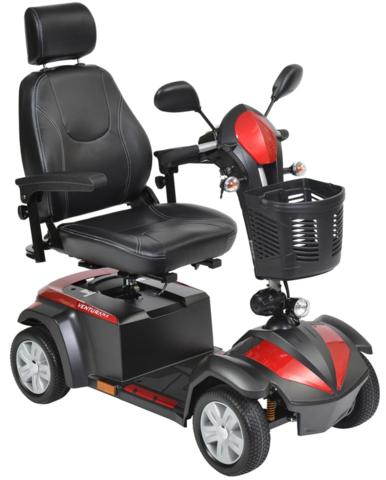
If you are looking for something a little more heavy duty, full-size mobility scooters are great choice. Many of these are similar to transportable mobility scooters in that they break down into pieces for transport. However, they pieces do weigh more, but it helps with taking up less space and makes it easier to transport.
These scooters offer a higher weight capacity, typically a longer battery range, and a faster top speed. Often times, they have more bells and whistles, making them more appealing as well, but at a higher price tag.

Perhaps you are looking for the heaviest duty power scooters on the market. Well, these units certainly fit the bill. Bariatric mobility scooters are heavy duty and some of the offer the highest weight capacity available today; as high as 600 lbs of weight.
Some of these are even classified as recreational scooters because they can reach speeds of up to 15 mph and offer longer than average battery ranges of up to 40 miles per charge. They are just like mini cars, except they are electric scooters.

Some people just simply don't want to ride alone. Dual seating mobility scooters are somewhat newer to the market, but are very popular. These units are also considered "bariatric" or "heavy duty" simply because they need to support the weight of humans. Many of them offer longer battery ranges and fast top speeds as well making them appealing to many of our customers. Some even offer a suspension, so you have the smoothest ride possible on various terrains.
It is best to first try out your scooter on a flat surface and in an area that is free of traffic or structures in order to get a feel for the controls. Switch it on and practice using the controls such as stopping, turning and going up and down the inclines.
Make sure that you are able to operate all of the controls. Also make sure you can adjust your seat and can get on and off without needing assistance.
Now that you have that out of the way, find a suitable place to store it when not in use. If it is a small scooter, you might be able to keep it indoors, but if it is bigger, then a garage or carport might be more convenient. Wherever you choose to park make sure it is in the vicinity of a power outlet, so that you can recharge without any issue.
In order to keep your mobility scooter functioning to at an optimum level, you may want to make sure it is serviced every year. Or at least contact the manufacturer’s tech support on tips to maintain its longevity. That is what they are there for!
Always make sure the battery is fully charged before you go out. To do that, follow these instructions:
Before you go on a trip, you must first check and see if your battery is fully charged. Also check to see if everything is secured. As in the case of a normal vehicle, you must never use your mobility device when you are tired, feeling sick, or impaired.
You want to be visible to other cars and pedestrians when you are outside. If your mobility scooter has lights, use them. To add towards additional visibility, you want to add an orange safety flag to your unit.
When riding, make sure you don’t overload your scooter with bags and accessories. Anything you carry should not obstruct your view or your ability to use your controls.
Before you travel, make sure you plan out your route and make sure you know exactly where you are going. Try to steer clear of busy roads and pavements that are too narrow. Also cross the roads at places where there are marked pedestrian crossings or traffic lights.
Currently, Electric Wheelchairs USA carriers 26 different brands that offer mobility scooters. However, there are a few that stand out as our best selling brands that we do the most business with. They all offer some of the best warranties in the industry. We will go over each of them below.

Pride is widely considered the flagship brand in the mobility industry. They design power wheelchairs, lift chairs, and of course, mobility scooters. The company was started in 1986 and have a history of designing and manufacturing some of the best products with cutting edge technology and many patented features that you will not find with other brands.
Many of their scooters come with multiple accessory options to suit your specific needs or desires. This is another company that has a great warranty and also includes one year of in-home service for the first as well. Pride's best selling mobility scooters are the Victory LX Sport, Victory 10 4 Wheel, and the Go-Go Elite Traveller 4 Wheel.


Golden is an American manufacturer of power wheelchairs, lift chairs, and mobility scooters. Their corporate headquarters is located in Old Forge, PA and they are also a company with longevity being in business for over 30 years. This company's products set the pace in the mobility industry for comfort, performance, and convenience.
It all starts with using cutting edge craftmanship, designs, and superior materials. Plus, they have never lost sight of what the customer's needs are. This is another brand that offers one year of in-home service for the first which helps with the end user's peace of mind. Their top-selling mobility scooters are the GB148D.

Once you have narrowed down your selection based on your height and weight, you can narrow down the selection even more by choosing on preference of stability over maneuverability or maneuverability over stability to find the right and most appealing three wheel or four wheel model. Three Wheel Scooters tend to turn a lot easier around narrow and tighter spaces making them much better on maneuverability. With Four Wheel Scooters there is more stability and less of a chance of tipping. Overall a four wheel model normally provides a little more support.
Once you narrow down to models that you feel are the best mobility scooters, check for available options and accessories. There are plenty of mobility scooters that will have upgrades on seat sizes in case you need something a little wider to sit in. Battery options will allow a longer lasting life and put more power and mileage on the performance side of things. You will see there are many different batteries whether lead acid, deep cycle, or lithium that are available on numerous models. A word of caution to users who decide to purchase lithium batteries.
If you plan to travel on a plane with your mobility scooter you must check to make sure whatever flight you decide to go on allows lithium batteries brought aboard. There are some airlines that will not allow lithium batteries on their aircrafts. Some mobility scooters come with other options such as buckles and buckle sizes, canopies, and even styles of seats with different adjustments.
On the Accessory side of things, you have plenty of options available for a majority of mobility scooters. Things such as cup holders, side arm bags, oxygen tank holders, cane or crutch holders are mostly universal, attaching to most all handicap mobility scooters. Some accessories will come with certain mobility scooters.
When you find a mobility scooter that you like, check the page for accessories and options and you should be able to find out what is available or compatible for that particular model. If you don't see an option you are looking for, Contact Us. We can often times add on some customization depending on the brand or model.
A mobility scooter is a battery-powered personal vehicle operated via a tiller (handlebar-style steering column) that allows people with mobility limitations to move independently. Unlike power wheelchairs (which use joystick control), mobility scooters require the user to operate tiller steering with both hands. They're designed for community and outdoor use — shopping, errands, parks, and neighborhood travel — and come in configurations ranging from lightweight 27-lb folding travel models to 500-lb-capacity outdoor recreational scooters.
A mobility scooter is the right choice when: you have full or near-full use of both hands for tiller steering; you primarily need mobility assistance in community settings (outdoors, stores, neighborhoods) rather than in the home; and longer-distance travel is a priority. A power wheelchair is the right choice when: you have limited hand or arm function (joystick requires only minimal one-hand control); you primarily need mobility assistance indoors in tight spaces; or you have clinical positioning needs (tilt, recline, seat elevation) that scooters don't offer.
Yes — Medicare Part B covers mobility scooters (classified as "power-operated vehicles") when prescribed by a physician and deemed medically necessary for use in the home. Coverage requires a face-to-face physician examination, documentation of the patient's inability to perform mobility-related daily activities without the device, a Certificate of Medical Necessity, and purchase from an authorized Medicare supplier. Medicare typically covers 80% of the approved amount after the Part B deductible.
Mobility scooters range from approximately $600 to $8,000+ depending on type, capacity, and features. Budget tiers: travel/folding models $600–$2,500; standard full-size $1,000–$3,500; heavy-duty/bariatric $2,500–$6,000; recreational/high-performance $3,000–$8,000+. Medicare coverage can reduce out-of-pocket cost substantially for qualifying buyers. Financing through Klarna, Shop Pay (Affirm), and PayTomorrow is available for all models. Use code SCOOTER5 for a 5% discount.
Range varies significantly by model. Standard travel scooters typically deliver 8–18 miles per charge. Full-size everyday models deliver 15–30 miles. The range leaders in the heavy-duty and recreational categories push to 55 miles (Merits Silverado Extreme). Manufacturer range ratings are tested under optimal conditions; real-world range is typically 15–25% less depending on rider weight, terrain, and speed. As a planning rule: choose a model whose rated range exceeds your typical daily distance by at least 30%.
The best mobility scooter for a senior depends on their primary use environment and physical requirements. For active community use on pavement: a standard full-size 4-wheel model with a comfortable captain's seat, LED lighting, and 15–20 mile range. For travel: a folding model under 50 lbs with airline-approved batteries. For heavier seniors: a heavy-duty model rated 30+ lbs above their weight. For seniors with back pain: prioritize full suspension and orthopedic seating. For all seniors: always choose in-home service warranty over ship-back warranty — it eliminates the transportation burden when service is needed.
Standard mobility scooters travel at 4–6 mph — roughly equivalent to a brisk walk to a jogging pace. This is appropriate for sidewalks, stores, and neighborhood streets. Recreational and outdoor high-performance scooters reach 8–18 mph. The Green Transporter Q Runner (18 mph) and Bespoke Legacy (15 mph) represent the fastest models available. At speeds above 8–10 mph, riders should use designated paths or bike lanes rather than crowded pedestrian areas.
No — you can purchase a mobility scooter without a prescription. However, to have Medicare cover the cost, a physician must issue a Certificate of Medical Necessity. For out-of-pocket purchases, prescriptions are not required. Some state Medicaid programs and VA benefits may require physician documentation. If you're paying privately and don't need insurance coverage, you can purchase directly through Electric Wheelchairs USA at 800-682-9444 without any prescription.
Yes — under the Air Carrier Access Act, airlines are required to transport mobility devices at no charge. The key requirement is battery compliance: lithium-ion batteries must be under 300Wh (calculated as Voltage × Amp-hours = Wh). Sealed lead acid (SLA) non-spillable batteries travel installed in the scooter in cargo. The scooter is gate-checked at the jetway and returned at your destination jetway. Notify your airline's accessibility desk 48–72 hours in advance. For the full airline process, see our airline-approved mobility scooter buying guide.
A 3-wheel scooter has one front wheel centered under the tiller, providing a tighter turning radius ideal for indoor navigation in stores, restaurants, and homes. A 4-wheel scooter has two front wheels providing a wider, more stable base — better for outdoor terrain, slopes, and users who value stability over tight turning. The practical decision: 3-wheel for primarily indoor/tight-space use; 4-wheel for primarily outdoor/uneven terrain use. If you do both regularly and can't choose, 4-wheel typically serves both environments better, though with wider turning arcs.
Per charge: 8–55 miles depending on the model (see individual product specs). Over time: Sealed lead acid (SLA) batteries last 12–18 months with proper care. Lithium-ion batteries last 3–5 years. The most important battery maintenance habit: charge after every use rather than waiting for full depletion. Never store a scooter with a depleted battery. Avoid extreme temperature storage (below freezing or above 100°F). Replace batteries when your range drops 30–40% from what it was when new.
For outdoor use, prioritize ground clearance (4"+ minimum; 5–6.5" for serious outdoor terrain), suspension (full front and rear), and tire type (pneumatic over solid). Top choices include: the Afiscooter S4 (5" clearance, 1,400W motor, 38-mile range, Red Dot Design Award), Pride Baja Wrangler 2 (5.5" ground clearance, 11.4 mph, adjustable shocks), and Merits Silverado Extreme (55-mile range, 5.1" clearance, safety turning sensor). For the full outdoor comparison, see our Top 9 Best Outdoor Mobility Scooters guide.
When considering a mobility scooter, price and how you’ll pay for it are key parts of the decision. Costs can vary widely based on the type, size, features, and intended use of the scooter.
Mobility scooters come in a range of price points depending on category and features:
Budget & Travel Models: Often start around $600–$1,000 — ideal for indoor use or short outings.
Mid-Range Scooters: Many reliable lightweight and standard models fall between $1,000–$3,000.
Full-Size & Heavy-Duty Scooters: Larger outdoor or bariatric units — with longer battery life, higher weight capacity, and more features — can cost $3,000+.
Prices are influenced by things like battery range, weight capacity, suspension, accessories, and whether the unit is designed for indoor, outdoor, or long-distance use.
For many buyers, insurance or government programs can help make mobility scooters more affordable:
Medicare (U.S.)
If you’re eligible, Original Medicare Part B may pay a portion of the cost of a mobility scooter classified as durable medical equipment (DME), but only if it’s medically necessary and prescribed by your doctor.
Here’s how Medicare coverage generally works:
You must have a doctor’s prescription and meet Medicare’s criteria for mobility limitations.
After meeting the annual Part B deductible, Medicare typically covers 80% of the approved cost. The remaining 20% coinsurance is your responsibility.
Note that Medicare’s “approved amount” may be lower than the scooter’s retail price — meaning you could pay any difference out-of-pocket.
Medicaid & State Programs
Medicaid benefits vary by state and individual eligibility, and may cover all or part of a scooter with adequate documentation. Local agencies on aging and disability services may also offer support or funding guidance.
Many retailers — including Electric Wheelchairs USA — offer financing plans to help spread the cost of a mobility scooter over time.
Electric Wheelchairs USA Financing
At Electric Wheelchairs USA, you don’t have to pay the full price upfront — you can choose from several flexible financing providers during checkout:
Klarna: Choose a manageable installment plan that fits your budget.
Shop Pay (in partnership with Affirm): Allows you to split the purchase into monthly payments, often with transparent terms at checkout.
PayTomorrow: A newer option with a simple application, clear pricing and automatic monthly payments; applying does not affect your credit score.
Laybuy: Interest-free installments paid weekly — a way to get your scooter now and pay over time.
How It Works
Add your selected product(s) to your cart at checkout.
Proceed to the checkout page and enter shipping details.
Select one of the financing options (Klarna, Shop Pay/Affirm, PayTomorrow, Laybuy).
Complete the application on the financing provider’s page and await approval.
Note: Terms, interest rates, and eligibility requirements vary by provider and your creditworthiness.
If retail financing isn’t right for you, there are additional ways to help manage scooter costs:
Personal Loans: A common option that can offer flexibility and fixed repayment terms.
Credit Cards: Useful for spreading costs, especially if you can take advantage of low or promotional APR periods — but watch for high interest after introductory periods.
Non-Profit Assistance: Some organizations provide grants or low-interest loans to help people afford mobility equipment.
Now that you have some knowledge to use and look for when shopping, make sure you’re shopping with a reliable source online. Make sure your source deals directly with the manufacturer. This way you know you will get a warranty and if for any reason you need any type of technical support your source can either speak with the manufacturer on your behalf or you can speak to them directly for assistance.

Now that you have read our mobility scooter buying guide, do you feel like you’re ready to shop? Hopefully, this guide helps you in finding the right choice! If you have any further questions that come to mind contact us and we will provide any other information to help you shop online for the best mobility scooter to suit your needs.
Many of our customers are active an are on the go. If you fall into that category, take a look at our top folding mobility scooters. These are all easy to fold up, lightweight, and are the most popular that we sell. If you are looking for more of a heavy duty unit that can be used outdoors, take a look at our top outdoor all terrain mobility scooters. These are not as easy to travel with, but some people just want to get out and explore and don't want to be stopped.
Our helpful and knowledgeable agents are available Monday-Saturday from 8AM-6PM at 800-682-9444. Call us to find the right mobility scooter for your situation!
This buying guide covers the landscape — but the right scooter for you is the one that matches your weight, environment, range needs, and budget specifically. Our free printed catalog covers every mobility scooter we carry across all categories, with full specs, seat dimensions, warranty details, and current pricing — in one comprehensive reference you can review at home or bring to a physician appointment.
Request Your Free Catalog Here →
No purchase required. No obligation.
Our mobility experts are available every day from 8AM to 8PM EST at 800-682-9444. We'll walk you through the decision framework, verify Medicare eligibility, and match you to the right model for your specific situation.
Explore by category:
Folding Travel Scooters — Lightweight, portable, airline-approved
Full-Size Scooters — Everyday community use
Heavy-Duty / Bariatric — 400–600 lb capacity
3-Wheel Scooters — Tight indoor turning
4-Wheel Scooters — Outdoor stability
Deep-dive guides by topic:
Best Airline Approved Mobility Scooters — Complete air travel guide
Top Folding Mobility Scooters — All folding models reviewed
Top 9 Best Outdoor Mobility Scooters — Terrain-focused guide
The 7 Best Heavy Duty Mobility Scooters — Bariatric/heavy-duty roundup


I guess you may like my address to send my new scooter guides
Denis Smith 50 George Street,Morrinsville 3300 New Zealand.
Many thanks Regards Denis
Want to test drive a Pride cruder in saint louis
Leave a comment