(800) 682-9444
Call Now


Let's get right to it. If there's one number that makes all the difference in accessibility, it's 32 inches of clear width for a doorway. That single measurement can be the difference between a frustrating daily struggle and true independence, ensuring a wheelchair can glide through without scraped knuckles or getting jammed in the frame. This guide will break down everything you need to know to get it right.
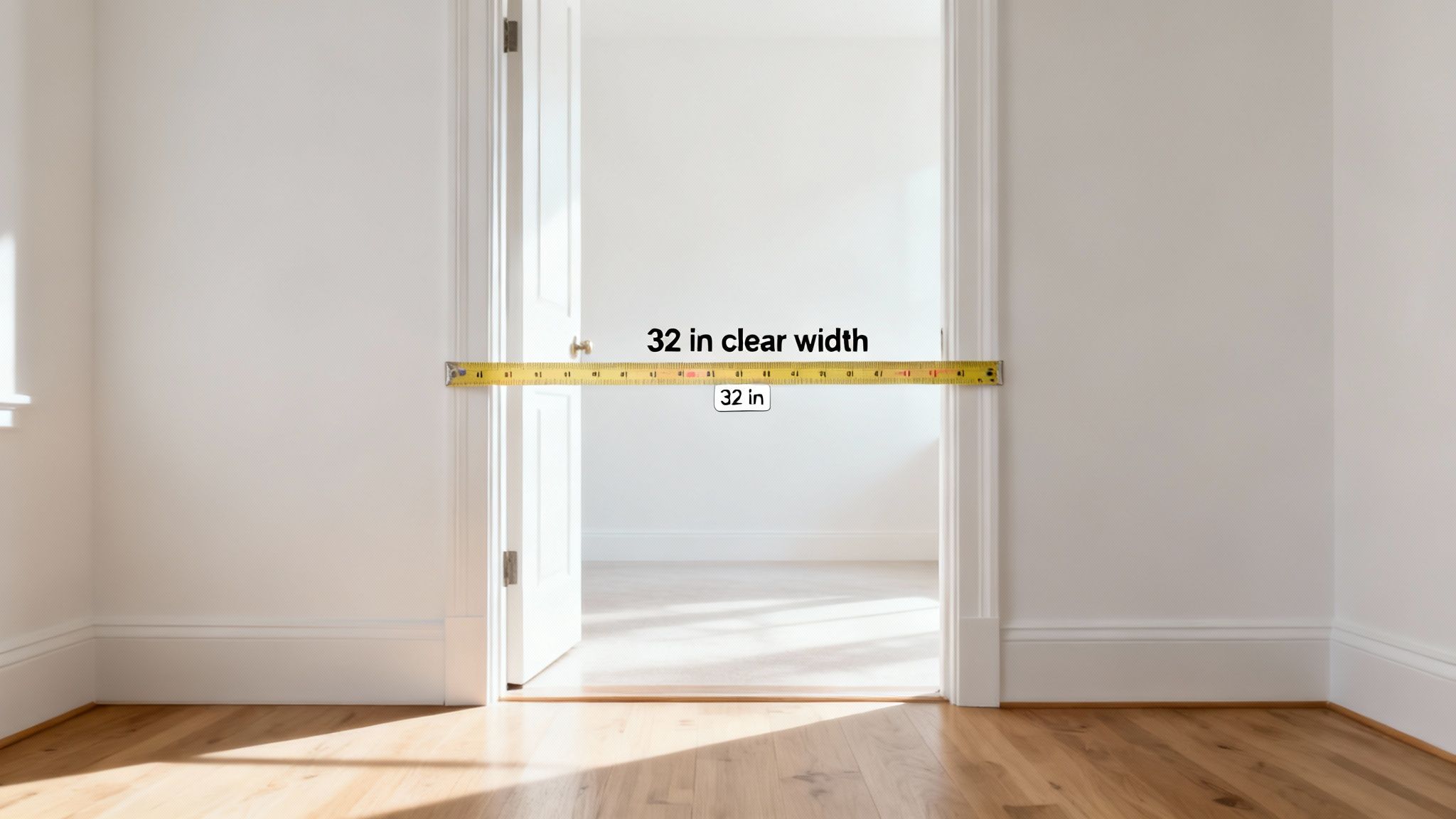
Think about it like this: imagine a brand-new highway, but one of the lanes is just a few inches too narrow. The entire system grinds to a halt right at that spot. An inaccessible doorway creates the exact same bottleneck inside a home, chipping away at a person's freedom and turning simple movement into a constant puzzle.
This isn't just about making things easier; it’s about dignity and basic safety. Before the Americans with Disabilities Act (ADA) came along in 1990, it wasn't uncommon for homes to have doorways as narrow as 23 to 27 inches. For most people using a mobility device, that’s a complete non-starter.
The ADA completely changed the game by setting a minimum clear doorway width of 32 inches (815 mm) for public spaces when the door is open at a 90-degree angle. This became the standard that ensures a single wheelchair user can pass through an opening without a fight.
This landmark legislation, detailed in the original 1991 ADA Accessibility Guidelines, set a new benchmark that has thankfully become the gold standard for residential homes, too. That 32-inch rule wasn't just pulled out of thin air; it came from extensive research into the size of mobility aids and the real-world space people need to pass through comfortably.
While the ADA enforces this rule for public buildings, bringing that same mindset into your home is just plain smart. It’s a core principle of "universal design"—the idea of creating spaces that work for everyone, no matter their age, size, or ability.
A wider doorway is a perfect example because its benefits extend far beyond wheelchair users:
By focusing on the right doorway width for wheelchair access, you aren't just solving one specific problem. You're creating a home that’s more functional, more welcoming, and ready for whatever life throws your way.
Getting an accurate measurement of a doorway seems simple enough, but when it comes to wheelchair access, the devil is truly in the details. One of the biggest mistakes people make is measuring the door itself or the full width of the frame from outside edge to outside edge. This gives you a number that looks great on paper but doesn't reflect the actual, usable space.
The measurement you really need is called the clear width. Think of it as the narrowest bottleneck a wheelchair has to squeeze through. Getting this one number right can save you a world of frustration and costly guesswork down the road.
To nail this measurement, you just need a tape measure and a clear idea of what to look for. Here’s how you do it step-by-step:
Open the Door Fully: Swing the door open until it’s at a 90-degree angle to the wall. This is the position it will be in when someone is actually passing through, so it's the most realistic scenario.
Measure from Door Face to Doorstop: Place one end of your tape measure right on the face of the open door. Stretch it across the opening until it hits the doorstop on the other side of the frame—that little strip of wood the door rests against when it’s closed.
That distance is your true clear width. It’s the absolute minimum space available for a wheelchair to navigate. This is a critical first step before buying any mobility device, and understanding how it relates to different models is key. You can learn more about this in our detailed guide on the standard wheelchair width.
Remember, the thickness of the door and the protruding doorstop both eat into the total frame width. A 32-inch door slab in a standard frame will not provide 32 inches of clear passage.
This simple, precise method ensures you know exactly what you’re working with. A doorway that looks plenty wide at a glance can easily lose an inch or two to the door and its hardware, making it just a bit too tight.
So, why get this granular? Because the difference between a 31-inch opening and a 32-inch one can be the difference between freedom and feeling trapped.
An inaccurate measurement, even if it's off by just half an inch, could lead you to buy a wheelchair that simply doesn't fit through your home's doorways. That could mean facing expensive home modifications that were completely avoidable. Taking a few moments to measure correctly provides peace of mind and empowers you to make the right choices for a truly accessible home.
That 32-inch clear width standard you see everywhere isn't just some random number pulled out of thin air. It’s a carefully calculated dimension that serves as the foundation of accessible design, straight from the Americans with Disabilities Act (ADA).
Think of it as the perfect balance point—wide enough for the vast majority of wheelchairs to glide through without a hitch, yet still practical for everyday construction.
It’s like a key fitting a lock. If the key is off by just a hair, the door stays shut. A doorway that’s even slightly too narrow becomes an instant, frustrating barrier that chips away at independence.
But true accessibility is never about a single measurement. That 32-inch opening is part of a much bigger puzzle. It has to work in harmony with other critical factors, like the clear floor space needed to approach the door and the room you need to turn once you're on the other side.
The ADA gives us the legal requirements for public spaces, but there’s a broader, more human-centered philosophy called Universal Design. This approach is all about creating spaces that are just plain usable by everyone, no matter their age, size, or ability, without needing special tweaks or after-the-fact adaptations.
A wide doorway is a perfect example. It helps a wheelchair user, a parent pushing a stroller, and someone hauling in new furniture. It just works better for everybody.
This forward-thinking mindset ensures spaces aren't just compliant, but genuinely welcoming. For a deeper dive into how these principles are applied in demanding environments, looking into resources on designing accessible hospitals can be incredibly insightful, since these buildings must put universal access at their core.
Accessibility standards aren't set in stone. They have to change with the times, adapting to new technology and a smarter understanding of what people really need. The primary standard, ICC A117.1, has been evolving since 1961 to keep up with modern mobility devices.
These updates have made a huge difference, boosting accommodation from just 50-60% of devices to over 75% by the 2017 edition.
Early on, the standards were based on a much smaller manual wheelchair. Today, they have to account for larger, bulkier power chairs. Still, the rules wisely avoid mandating massive doorways that would make retrofitting older buildings a nightmare, striking a critical balance between progress and practicality.
The Takeaway: A truly accessible doorway isn’t just about the width. It’s a gateway that considers the entire user experience—the approach, the turn, and the ease of getting through.
The infographic below shows the simple, three-step process for getting an accurate measurement of your doorway’s clear width.
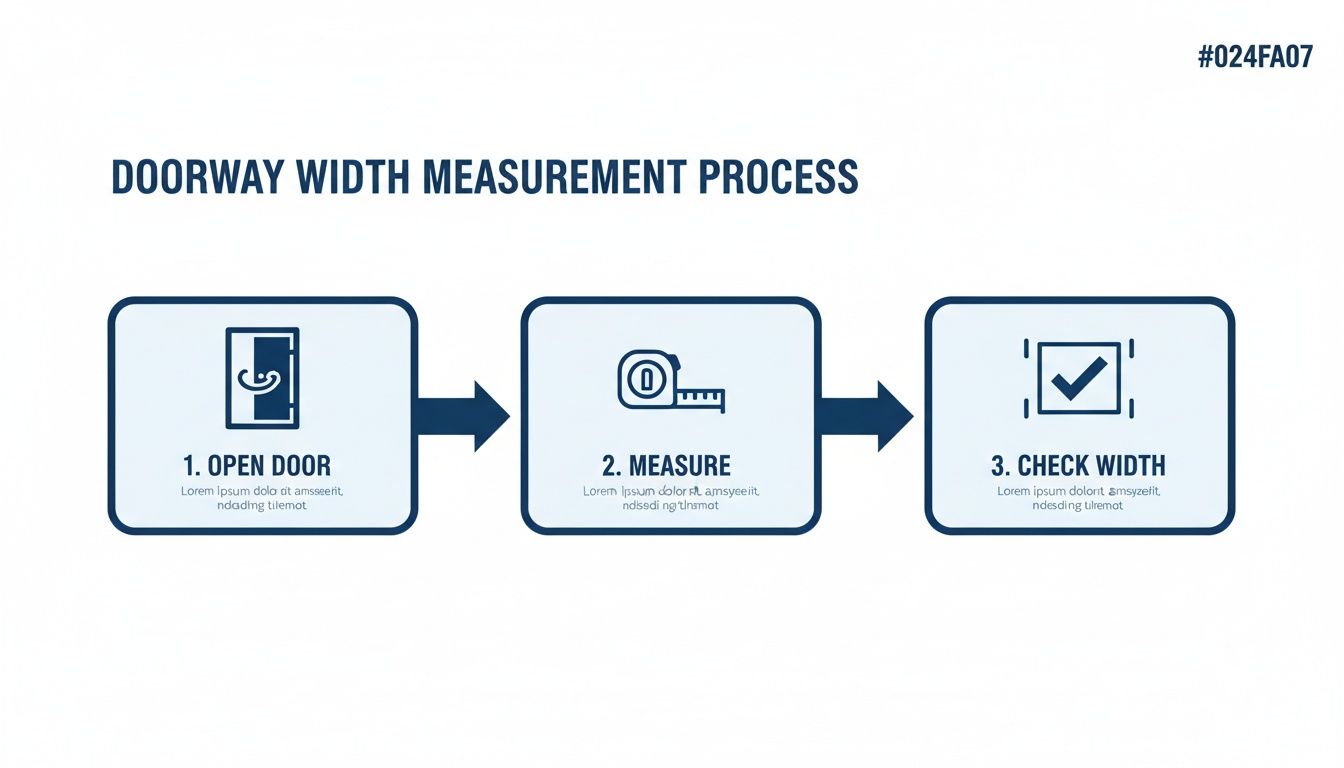
This process makes it clear why the usable space is always less than the physical size of the door itself. That’s why following these steps is so important for getting it right.
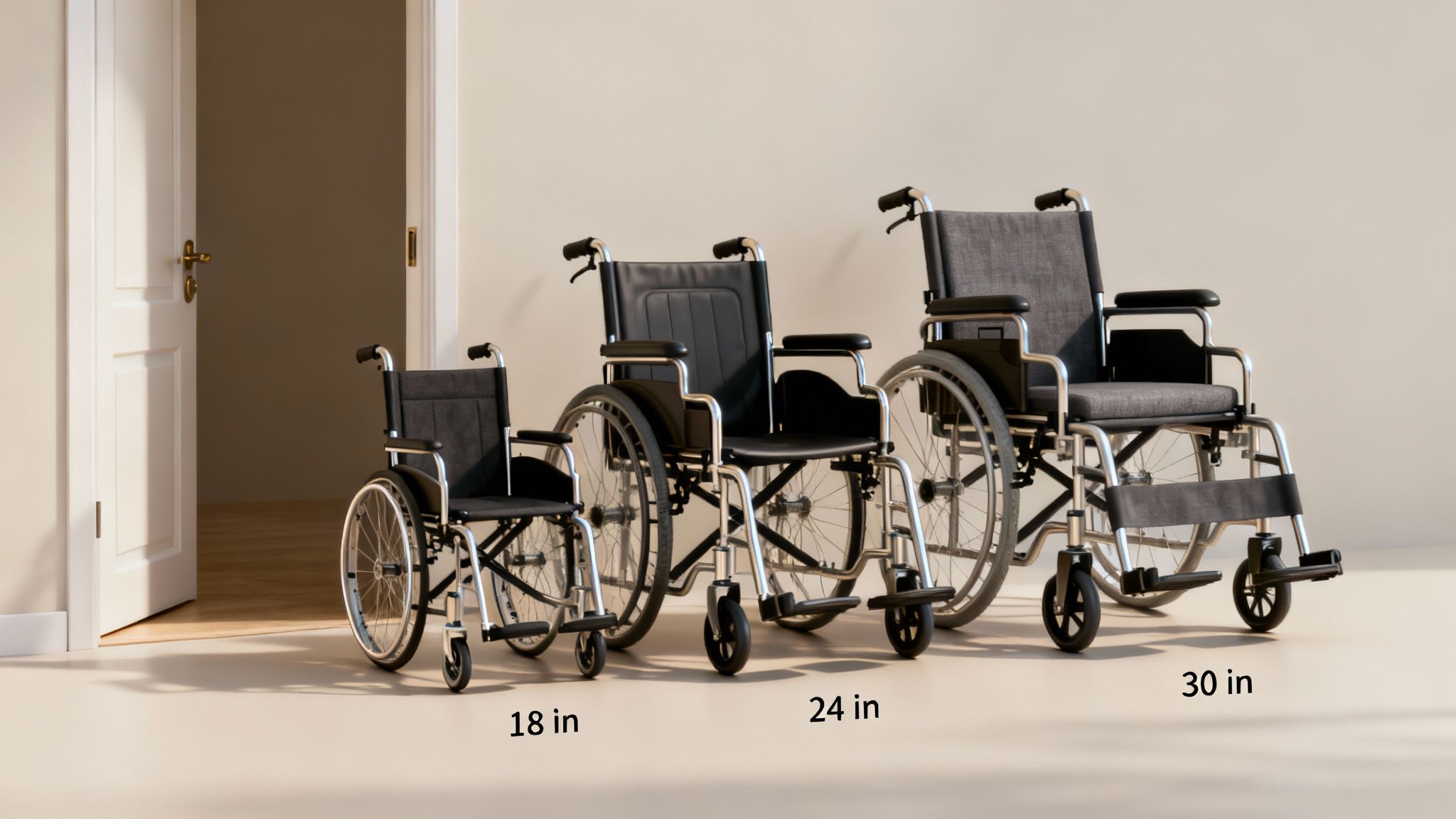
It’s easy to think of a wheelchair as a simple, one-size-fits-all product, but that’s like assuming one pair of shoes will fit everyone. Just like our homes, mobility devices come in an incredible variety of shapes and sizes. The key to true freedom of movement is finding the perfect match between the two.
A wheelchair’s dimensions are everything when it comes to navigating a home. A standard manual chair might clock in at around 25 inches wide, while a heavy-duty bariatric model can easily push past 36 inches. That’s a massive difference, especially when you realize your bathroom door might only offer 32 inches of clear space.
This is exactly why that tape measure is your best friend. A chair that feels perfectly comfortable out in the open can quickly become a major source of frustration if it can’t get through the most important rooms in your home. It’s absolutely critical to know your home’s limitations before you even start shopping.
To get a better sense of how different wheelchairs measure up, it helps to see the numbers side-by-side. The type of chair you need will have the biggest impact on its overall width.
| Mobility Device Type | Average Width Range (Inches) | Ideal For |
|---|---|---|
| Transport Wheelchairs | 22" – 24" | Narrow, portable chairs designed to be pushed by a caregiver. |
| Standard Manual Wheelchairs | 24" – 30" | The most common type, balancing everyday function and comfort. |
| Electric Wheelchairs | 25" – 32" | Varies widely to house motors, batteries, and advanced seating. |
| Bariatric Wheelchairs | 28" – 40" | Wider frames built for higher weight capacities and stability. |
Looking at these figures, you can see why that 32-inch clear doorway width for wheelchair access is such a common benchmark. With so many popular chairs falling into the mid-to-high 20s, anything less than 32 inches just doesn't leave enough wiggle room.
Beyond just fitting through the door, you have to be able to move. A wheelchair's drive type and turning radius play a huge role in how it handles tight corners and cluttered spaces. A mid-wheel drive power chair, for example, can practically spin in place, making it a fantastic choice for smaller apartments. On the other hand, a front- or rear-wheel drive model needs a bit more room to swing around.
A wheelchair's "turning radius" is the smallest circle it can make. A smaller turning radius means better agility in tight hallways and around furniture.
To find that perfect match, you need to measure both the user and the environment. For a deeper dive, check out our guide on the key measurements to determine the best wheelchair fit. Thinking ahead, understanding the role of a design studio in personalizing your home can also spark some great ideas for creating a space that’s truly accessible. When you consider all these factors, you ensure the wheelchair you choose actually enhances independence, rather than limiting it.
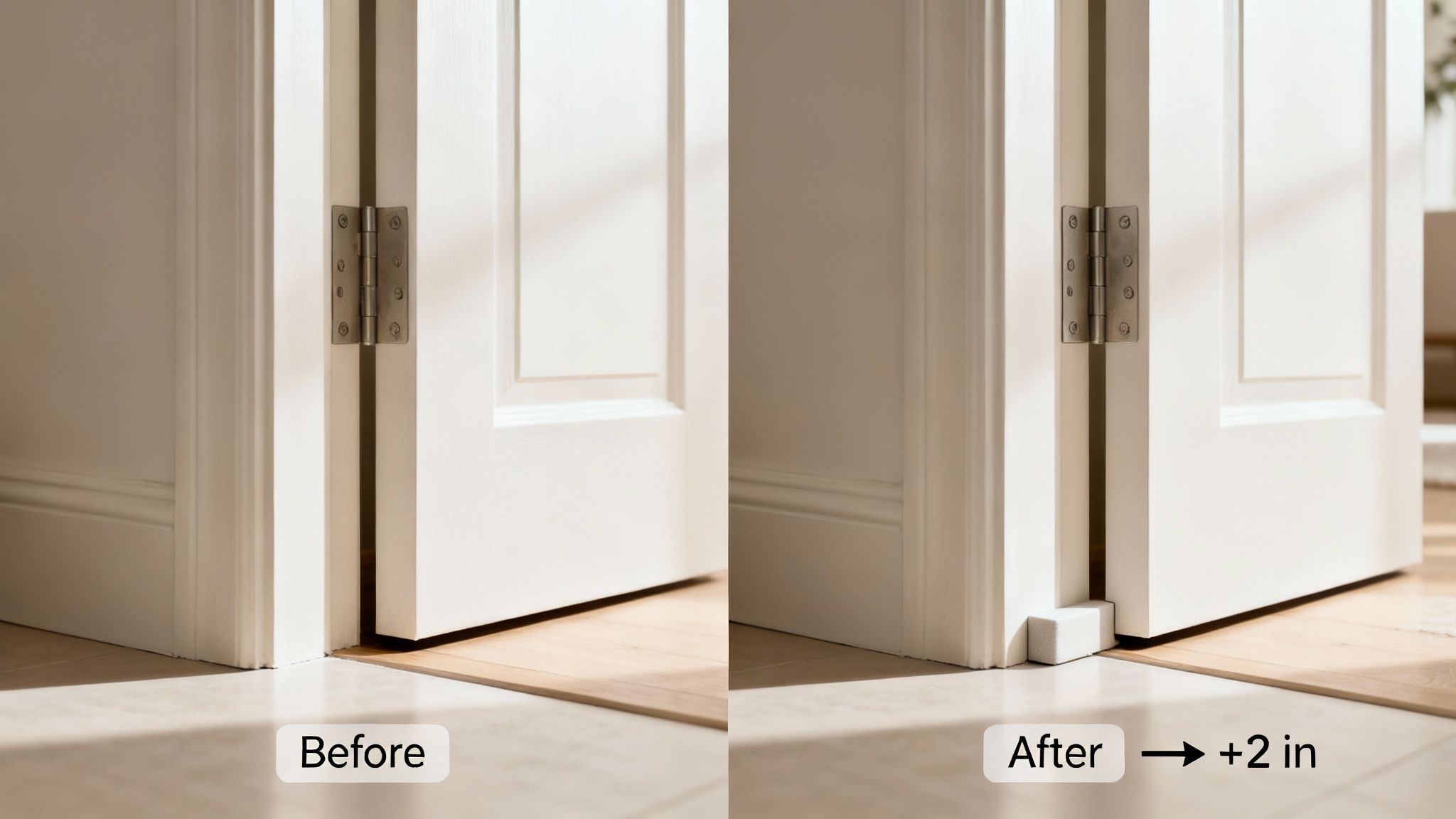
Realizing your doorways are just an inch or two shy of being comfortable can feel like hitting a brick wall—literally. It's a frustrating moment, for sure, but it doesn't have to be a permanent roadblock. There are plenty of practical ways to reclaim that crucial space, ranging from simple afternoon fixes to more involved renovations that can totally transform your home's accessibility. You've got options when it comes to improving the doorway width for wheelchair access.
Before you start knocking down walls, though, it’s worth seeing if the right mobility device could solve the problem for you. Our guide on the best narrow wheelchairs for tight doorways is a great place to start. A slimmer chair might be all you need. If you still need to modify the doorway, always start with the simplest fixes first.
Sometimes, you just need a couple of extra inches to make life easier. These simple, low-cost tricks can often be done in a single afternoon and make an immediate difference. Think of them as the low-hanging fruit before you consider a bigger project.
If those easy fixes don't quite cut it, it might be time to think bigger. Widening a door frame is a real construction project. It means cutting into the wall, reframing the opening, and then patching up the drywall and paint. This is almost always a job for a qualified contractor.
A professional can figure out if a wall is load-bearing and make sure your home's structural integrity isn't compromised. While it costs more, widening a doorway is a permanent fix that guarantees you'll have all the space you need.
And while you're at it, think about other upgrades that make life easier. Swapping out those classic round doorknobs for lever-style handles can make a world of difference for someone with limited hand strength. It's also a great time to replace a high, bumpy threshold with a low-profile, beveled one to create a smooth, trip-free transition from room to room.
A wide doorway is the first big win, but true, everyday accessibility is about the entire journey from point A to point B, not just getting through the door. Think of it like a beautiful, wide-open gate with a tangled, narrow path leading up to it. The gate itself doesn't do you much good if you can't get to it in the first place. The same idea applies at home—the space around the door is every bit as important as the opening itself.
That surrounding area has a name: maneuvering clearance. It’s the open floor space on both sides of a door that you need to comfortably approach, open, and pass through it without a struggle. If that space is too tight, you might find yourself doing an awkward three-point turn just to get lined up, which is draining and just plain frustrating.
The amount of room you need actually changes depending on which way you're headed through the door. A push-side approach, where you’re moving toward the side the door swings away from, is usually the easier of the two. You can just roll up and push the door open.
The pull-side approach is where things get tricky. You have to pull the door toward you, which means you need enough space to back up and get out of the way of the swinging door. That little dance requires a lot more clear floor space to do safely without bumping into walls or furniture.
Key Takeaway: An accessible path is a complete system. A 32-inch clear doorway, 36-inch hallways, and plenty of maneuvering clearance all have to work together to create a smooth, independent experience.
Picture trying to get from your living room into a small bathroom. The living room side (the push side) might feel easy, but once you're inside, you need enough room to turn and close the door behind you. For homes with multiple entry points, you might also want to think about adding a ramp. Our guide on selecting wheelchair ramps for home use can help you figure out the best fit for your exterior doors.
At the end of the day, a truly accessible home thinks about the entire path of travel. It’s about making sure every step of the journey—from the hallway, through the doorway, and into the room beyond—is clear and easy to navigate. That’s what creates an environment that supports real independence.
Thinking through accessibility can bring up a lot of practical questions. It's one thing to know the standards, but it's another to figure out how they apply to your home. Here are some of the most common things people ask when trying to make doorways easier to navigate.
Officially, the ADA’s 32-inch clear width rule is a legal requirement for public spaces like stores, offices, and government buildings. It’s not federally enforced for most private homes.
That said, it has absolutely become the gold-standard "best practice" for home accessibility for a reason. Aiming for this width ensures that almost any wheelchair or mobility scooter can get through without a struggle. It's all about promoting safety and independence for anyone living in or visiting the home. Plus, many local building codes are now adopting similar standards for new construction.
The most budget-friendly trick in the book is swapping out your standard door hinges for a set of offset hinges. You might also see them called swing-clear or expandable hinges.
These clever hinges are designed to swing the door completely out of the frame, instead of leaving part of it sitting in the opening. Just by making this one simple change, you can gain up to 2 inches of extra clear width. It’s often just enough to turn a frustratingly tight doorway into an accessible one without calling a contractor.
This simple hardware swap is a go-to first step for many homeowners. It’s amazing how often that little bit of extra space makes a huge difference in daily life, all without needing to tear into a wall.
Both sliding doors (like barn doors) and pocket doors are fantastic options for accessibility. Their biggest advantage is that they don't swing into a room, which frees up a ton of floor space that's critical for turning and maneuvering a wheelchair.
A pocket door is the ultimate space-saver, disappearing right into the wall and leaving the widest possible opening. A barn door slides along the outside of the wall. The right choice really comes down to your home's layout and what your walls will allow. Either way, the goal is to make sure the hardware is easy to use and the final opening hits that 32-inch sweet spot.
At Electric Wheelchairs USA, we believe that the right mobility equipment is the key to unlocking independence. From narrow models designed for tight spaces to all-terrain power chairs, we have a solution to match your home and lifestyle. Explore our curated selection and find your perfect fit today at https://www.electricwheelchairsusa.com.


Leave a comment