(800) 682-9444
Call Now


Let’s get right to it: In the United States, you do not need a driver's license to operate an electric wheelchair. It’s a question we hear all the time, and the answer is refreshingly simple. Federal and state laws see these chairs for what they are: medical devices that restore personal mobility, not motor vehicles.
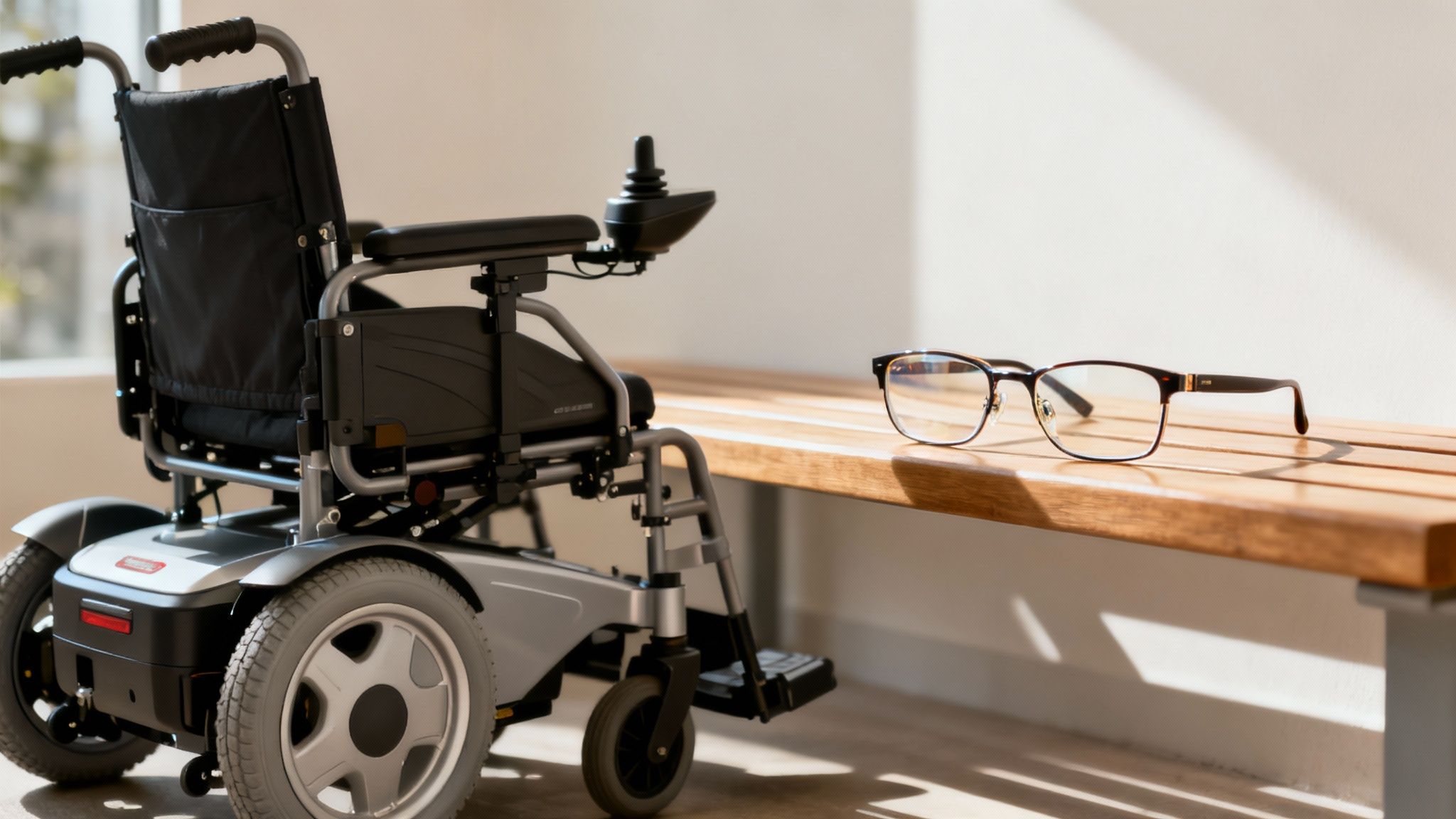
Here’s a helpful way to think about it: an electric wheelchair is a lot like a pair of prescription glasses. One helps with sight, the other with mobility. Just as you don’t need a special permit to wear glasses, you don’t need a license to use a device that helps you get around. It's a tool for independence, plain and simple.
This distinction is the key to understanding the rules. Because electric wheelchairs are classified as medical equipment, they fall under a completely different set of regulations than cars, trucks, or motorcycles. This means no driver's license, no special permits, and no vehicle registration in almost every corner of the country, from Florida to California.
Now, while a license isn't on the table, it's still smart to know the local rules of the road—or rather, the sidewalk. We often get questions about whether electric wheelchairs are allowed on public roads, and that’s where understanding your city or county ordinances really comes into play.
To give you a crystal-clear picture of how different the requirements are, we put together a quick comparison.
This table breaks down the core legal differences between using an electric wheelchair and driving a car. It really highlights why one requires extensive legal documentation while the other focuses on accessibility.
| Requirement | Electric Wheelchair | Standard Car |
|---|---|---|
| Legal Classification | Medical/Assistive Device | Motor Vehicle |
| Driver's License | Not Required | Required |
| Vehicle Registration | Not Required | Required |
| Mandatory Insurance | Not Required | Required |
| Primary Use Area | Sidewalks, Pedestrian Areas | Public Roads |
As you can see, the legal framework treats these two things worlds apart. An electric wheelchair is a personal mobility aid, giving you the freedom to navigate your world without the red tape associated with driving a car.

Here’s the main reason you don't need a driver's license for an electric wheelchair: in the eyes of the law, it's not a vehicle at all. It’s legally classified as a medical device—an extension of the person using it.
This isn’t just some technicality; it's the entire legal bedrock that allows for license-free operation. Federal laws, especially the Americans with Disabilities Act (ADA), are what establish and fiercely protect this status. The whole point of the ADA is to tear down barriers, not put up new ones, ensuring people with disabilities can get around in public without jumping through unnecessary hoops.
The law sees your electric wheelchair much like it sees a walker or crutches—it's a tool for personal mobility. It’s designed to give you freedom, not bog you down with the rules and regulations meant for cars.
Because of this classification, the complicated world of vehicle codes—think licensing, registration, and mandatory insurance—simply doesn't apply.
The way an electric wheelchair is built reinforces its role as a medical aid. These devices are intentionally designed with specific limitations that clearly separate them from motor vehicles like cars or motorcycles.
This intentional design is what solidifies their legal standing. Under federal guidelines, public places are required to let people with disabilities use powered mobility aids anywhere pedestrians can go. You can learn more about how the NHTSA approaches adapted mobility on their website.
It's also important to know what kind of device you're using. For a deeper dive, check out our guide on the distinctions between a power chair and a power wheelchair. By getting the classification right, the law ensures your right to get around is always protected.
Here’s the deal: federal law makes it clear you don’t need a driver's license for an electric wheelchair. But what you really need to know are the rules for your own neighborhood, and that’s where things get local.
Think of it this way: the federal government sets the big, foundational rules of the road. Your state and city, however, are the ones who put up the specific street signs in your community. They’re adding the details that keep everyone safe day-to-day.
For example, a busy downtown area might have posted speed limits on crowded sidewalks to protect pedestrians. Another town might have specific ordinances telling you whether it’s okay to use a bike lane for a short stretch if construction blocks the sidewalk. These local rules don’t overrule federal law; they just add a layer of practical guidance for getting around safely.
Most laws that protect your right to use an electric wheelchair fall under big civil rights umbrellas like the Americans with Disabilities Act (ADA). The ADA ensures you have access to public spaces and transportation, but it’s the states and cities that fill in the smaller details.
You’ll likely find differences in areas like:
It can be interesting to see how other countries handle this. In the United Kingdom, for instance, mobility scooters are divided into classes. Their "Class 3" devices, which can hit speeds up to 8 mph, actually have to be registered for road use. It just goes to show how different the approaches can be.
The goal isn't to become a legal expert overnight. It’s about knowing where to look for the rules that affect you directly. That knowledge is what gives you the confidence to travel freely and safely.
A great starting point is your city or county’s official website—try looking in the transportation or public works section. Local disability advocacy groups are another fantastic resource; they know the practical, on-the-ground rules better than anyone. Staying informed is the best way to make sure nothing gets in the way of your freedom and mobility.
When we talk about mobility aids, it’s easy to get tangled up in the terminology. Not all of these devices are created equal, and knowing the difference between an electric wheelchair, a mobility scooter, and an adapted vehicle is a big deal.
Why? Because the category your device falls into directly determines what rules—if any—you need to follow.
Most of the time, the conversation is about either an electric wheelchair or a mobility scooter. An electric wheelchair is what you probably picture first: joystick control, incredible maneuverability indoors, and designed for all-day living support.
A mobility scooter, on the other hand, usually has a tiller for steering (think bicycle handlebars) and is often built with longer-distance outdoor trips in mind. Even with those differences, they share one crucial thing in common: they are almost always classified as medical devices, not motor vehicles.
If you want to really dig into the nitty-gritty of how they stack up, we've got a complete electric wheelchair vs. mobility scooter comparison guide that breaks it all down.
This is where things get completely different. Adapted vehicles are in a league of their own. We're talking about cars, vans, or trucks that have been professionally modified with special equipment like hand controls, wheelchair lifts, or power lock-down systems.
Since these are fully functional, street-legal automobiles designed for public roads, the answer is simple: you absolutely need a valid driver's license to operate one. Getting behind the wheel of an adapted vehicle isn't something you just do; it often requires a thorough evaluation by a Certified Driver Rehabilitation Specialist and specific training to ensure you can handle it safely.
The real takeaway is this: An electric wheelchair or scooter helps you navigate pedestrian spaces like sidewalks and stores. An adapted vehicle allows you to drive on public roads right alongside other cars. One is a medical aid; the other is a licensed motor vehicle.
To help you visualize where these devices stand in the eyes of the law, here’s a quick feature comparison.
This table breaks down the core features and legal classifications for each type of mobility aid, helping to clarify their intended use and requirements.
| Feature | Electric Wheelchair | Mobility Scooter | Adapted Vehicle |
|---|---|---|---|
| Primary Control | Joystick | Tiller/Handlebars | Steering Wheel, Hand Controls |
| Typical Environment | Indoors & Outdoors (Pedestrian Areas) | Primarily Outdoors (Pedestrian Areas) | Public Roads, Highways |
| Legal Classification | Medical Device / Personal Mobility Device | Medical Device / Personal Mobility Device | Licensed Motor Vehicle |
| Driver's License | Not Required | Not Required | Required |
| Registration/Insurance | Rarely | Rarely | Required |
This comparison makes it clear that while wheelchairs and scooters are designed to enhance personal mobility in pedestrian environments, adapted vehicles are fully integrated into the world of licensed, registered, and insured transportation.
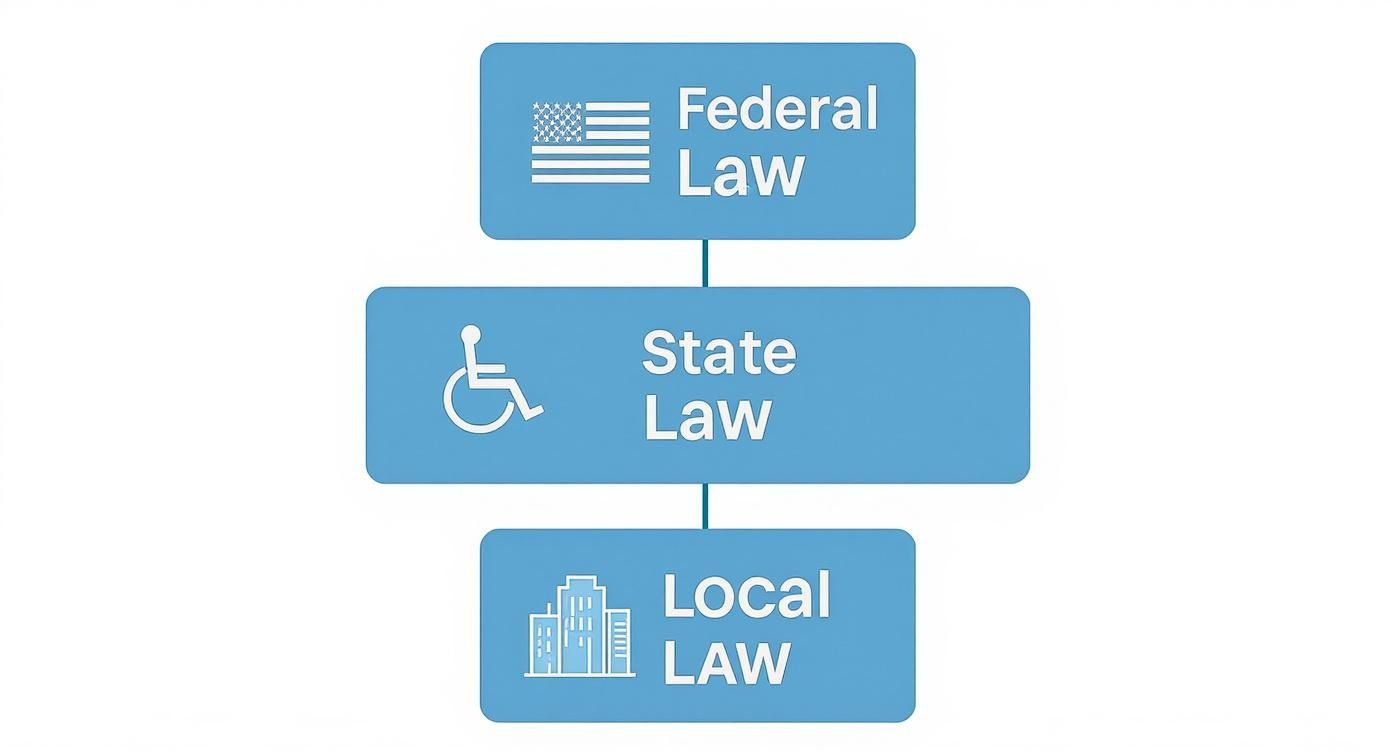
This chart helps explain how the rules are structured. While the federal government provides broad protections (like the ADA), the specific, day-to-day rules you'll encounter are often set at the state or even city level.

While the law is crystal clear that you don’t need a driver's license to use an electric wheelchair, there’s another requirement that’s far more important: mastering the device itself. Confidence and skill are your true licenses to freedom. Just like a new driver needs practice behind the wheel, so does a new power chair user.
The electric wheelchair market is growing fast, but research shows that over 40% of new users struggle with the basic driving skills they need for daily life. This lack of hands-on practice can unfortunately lead to accidents, which is why getting the hang of your chair is so critical. You can explore more about this growing industry on GrandViewResearch.com.
Instead of a legal test, think of this as a personal one. Your real goal is to become so comfortable with your chair that its movements feel like a natural extension of your own body.
Gaining this confidence doesn't have to be a huge challenge. It’s all about taking small, practical steps to build muscle memory and spatial awareness before you start navigating crowded sidewalks or grocery store aisles. True independence really begins with feeling secure and in control of your machine.
Here are a few proven ways to get started on the right foot:
Of course, safe operation goes hand-in-hand with good upkeep. For tips on keeping your chair in top shape, check out our guide on 7 maintenance tips for your electric wheelchair. Viewing safe operation as a skill to be proud of, rather than a chore, is the key to unlocking the true freedom your wheelchair offers.
Even with the basics down, you probably have a few more specific questions about what it’s really like to use a power chair day-to-day. We get it. Let’s clear up the most common questions we hear so you can get out there and ride with total confidence.
This is easily the number one question people ask, and the answer is refreshingly simple: nope!
In the United States, you do not need to register your electric wheelchair with the DMV or carry liability insurance like you would for a car. Under the Americans with Disabilities Act (ADA), these are considered medical devices, not vehicles, so all those pesky vehicle rules don't apply.
That said, your wheelchair is a valuable piece of equipment. For your own peace of mind, it’s a smart move to add it as a scheduled item on your homeowner's or renter's insurance policy. This can be a lifesaver if it's ever stolen or damaged.
Another big one: Is it legal to operate my power chair on the street?
Generally, you should stick to the sidewalk. Electric wheelchairs are designed for pedestrian areas, not for mixing it up with cars and trucks. Zipping along in traffic is incredibly dangerous and almost always against local rules.
Now, there are some exceptions. If a sidewalk is blocked or simply doesn't exist, some local laws might permit you to use a bike lane or the shoulder of a very quiet, low-speed road. But this is a last resort, and you must check your local city or town ordinances first before even considering it.
Your safety is everything. Always, always use the sidewalk when one is available. The rules are there to keep you—and everyone else—out of harm’s way.
Finally, people often wonder what documents they need on hand. Do I need to carry any specific paperwork when I’m out and about?
Legally, you don't have to carry any special documents like a license or registration. However, some people feel more comfortable carrying a doctor's note that simply confirms their need for a mobility device. It's rarely necessary, but it could smooth things over in the unlikely event you run into an uninformed staff member who questions your access.
Beyond that, just carrying a standard personal ID is always a good idea, no matter where you're going.
Ready to find the perfect mobility solution that gives you freedom without all the red tape? The experts at Electric Wheelchairs USA are here to help you pick a device that fits your life perfectly. Explore our collection of electric wheelchairs and mobility scooters today!


Leave a comment