(800) 682-9444
Call Now


So, you're dreaming of a scenic river cruise but need your mobility scooter to get around. The big question is, can you bring it along? The short answer is yes, but it's a qualified yes, loaded with some pretty significant challenges. Frankly, on many river cruises, especially those navigating Europe's historic waterways, it's extremely challenging and often outright prohibited.
The reality is that most river cruise ships just weren't built to handle them. Success hinges almost entirely on the specific cruise line you choose and the physical layout of their ships.
When you picture yourself gliding past medieval castles and charming vineyards, the last thing on your mind is the logistical puzzle of a mobility scooter. But unlike massive ocean liners, river cruise vessels are built long and slender. They have to be, in order to navigate narrow locks and slide under centuries-old bridges. This design necessity is precisely what creates a headache for scooter users.
This isn't just a minor inconvenience; it presents some immediate and often insurmountable challenges.
The first hurdle is the ship's interior. You're almost guaranteed to find narrow corridors where maneuvering a scooter feels like a game of Tetris you just can't win. It’s tight.
Beyond that, many ships—particularly the older, more character-filled ones—don't have elevators that go to every deck. This could confine you to just one level of the vessel for your entire trip. Even if you get to your cabin, the doorways are often too narrow, and there's rarely enough room inside to park, let alone charge, a scooter.
The core issue boils down to space and safety. River ships lack the wide-open decks of their ocean-going cousins. Plus, strict fire safety rules usually forbid leaving scooters or any other obstructions in the hallways, leaving you with nowhere to put it.
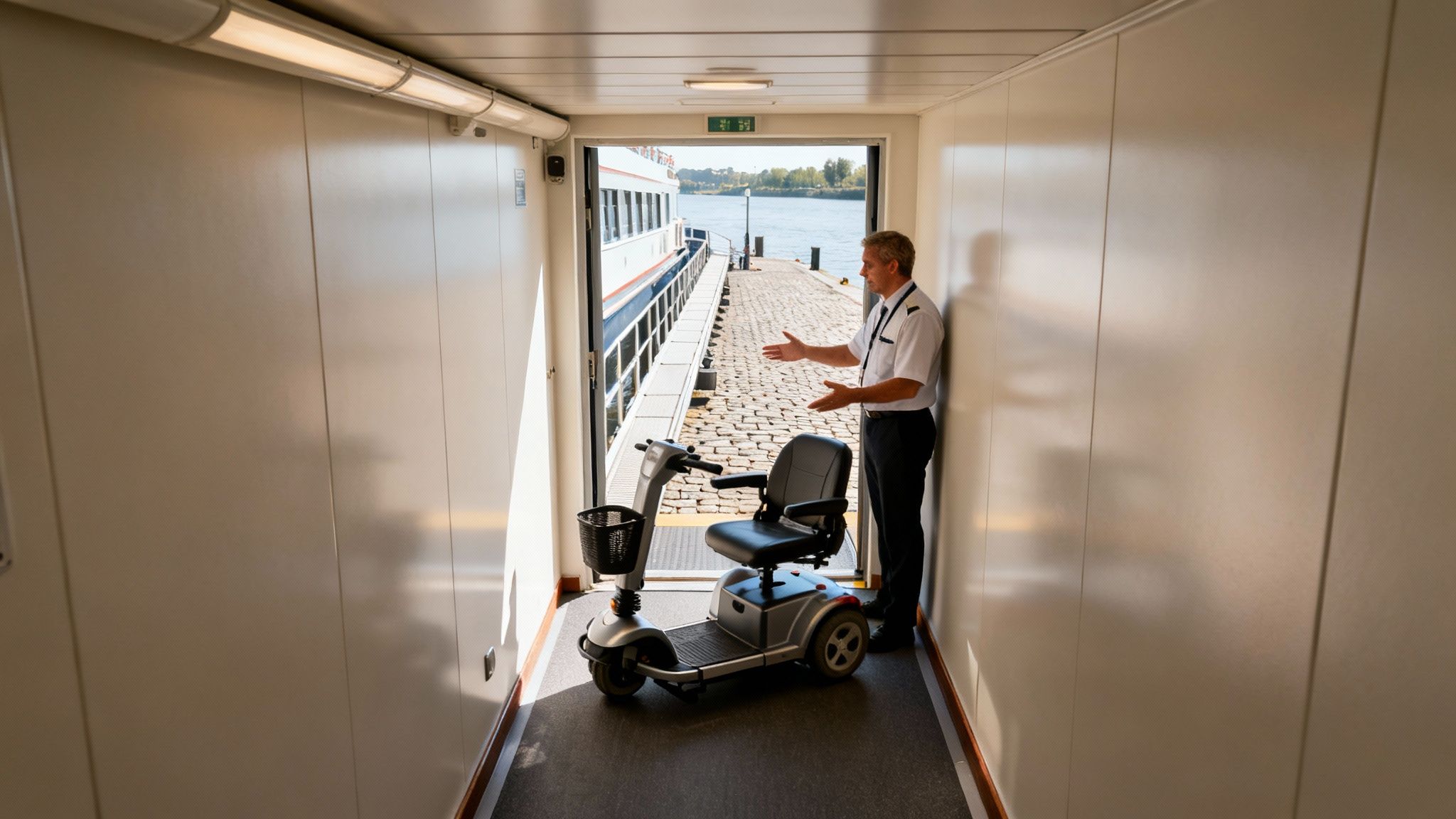
The accessibility problems don't stop at the water's edge. Getting on and off the ship often means dealing with steep, narrow gangways that shift with the river's water level. Once you're on shore, the historic European towns you came to see present a whole new set of obstacles.
Here’s what you’re likely to face at the ports:
The numbers back this up. Based on industry experience, less than 5% of river cruise ships on major European routes are truly equipped to handle mobility scooters, and most of the big-name lines explicitly say "no." It’s a tough reality to face when planning your dream trip. Exploring options for general river cruises early in your research can help you get a sense of which routes and ships might even be a possibility.
To put it all in perspective, here's a quick rundown of the major hurdles you'll face.
| Challenge Area | Typical River Cruise Limitation |
|---|---|
| Ship Interior | Narrow corridors, tight corners, and lack of turning space. |
| Deck Access | Elevators are often small or may not service all decks. |
| Cabins | Doorways are too narrow; insufficient space for storage or charging. |
| Gangways | Often steep, narrow, and unstable for a scooter. |
| Port Towns | Cobblestones, curbs, and lack of ramps make exploration difficult. |
| Excursions | Tour buses are rarely equipped with scooter lifts or storage. |
Navigating these limitations requires a ton of advance planning and direct communication with the cruise line. It's not impossible, but you need to go in with your eyes wide open.
Before you even dream about that perfect itinerary or think about putting down a deposit, your first job is to become a detective. You need to dig into the cruise line’s specific rules for mobility devices. A lot of river cruise websites have a beautiful "Accessibility" page full of vague promises, but the real details are almost always buried somewhere else.
Start by scouring their website for terms like "mobility scooter," "wheelchair policy," and "special needs." You're looking for the nitty-gritty: hard limits on scooter dimensions, weight, and especially battery types. Some lines, like Viking River Cruises, are refreshingly direct and state clearly that they don't allow motorized scooters at all because their ships simply don’t have the space.
After you’ve done some initial recon online, it's time to get on the phone. Don't let them off the hook with a simple "yes" or "no" when you ask if you can bring your scooter. You need concrete answers.
Frame your questions to get specific, useful information:
Getting this specific usually forces the reservation agent to check with their accessibility department, getting you past the standard script. And remember, the goal is to get it all in writing. A verbal "yes" over the phone is worthless if you run into problems at the pier; you need that email printed and in your travel documents.
Unfortunately, strict rules aren't anything new. The reality is that river cruises have been notoriously difficult for scooter users for a long time, and progress has been incredibly slow. Back in 2013, a major report found that just 2 out of 100 European river ships had any real accessibility for powered mobility devices. By 2026, that number had only inched up to 5 out of 100. A 2026 survey was even more blunt, revealing that 95% of operators simply didn't allow scooters. You can read more about these findings on river cruise accessibility.
Getting approval almost always boils down to one make-or-break factor: your scooter has to be small and light enough to be kept entirely inside your cabin. Leaving it in a hallway is a universal fire code violation, and there's no wiggle room on that.
This history is important because it helps set your expectations. While you might get lucky with a niche operator or one of the newer, more modern ships, the default answer from most lines will likely be "no." Be prepared to call several companies before finding one that might be able to work with you, and always have the detailed specs of your scooter ready to go.
So, you've found a cruise line that seems willing to work with you. Great! Now comes the part where you prove your specific scooter is a perfect fit for their ship. This isn't the time for guesswork; you need to be exact.
First things first, get out the measuring tape. Cabin doorways on river cruise ships are notoriously narrow, and storage space is tight. A single inch can make the difference between approval and denial.
You need to know these three numbers like the back of your hand:
If you find yourself shopping for a new scooter with travel in mind, you’ll want something built for these tight spaces. A good best folding mobility scooter buying guide can walk you through some of the most compact and travel-friendly options out there.
Beyond size, the single biggest hurdle is the battery. Maritime safety rules are incredibly strict, and they are especially cautious about lithium-ion (Li-ion) batteries because of fire risks. You absolutely have to know the specs of your battery.
Most cruise lines and airlines base their rules on the Watt-hour (Wh) rating. You should be able to find this number printed right on the battery or in the owner's manual. If you only see Volts (V) and Amp-hours (Ah), you can figure it out yourself with a simple calculation: Volts (V) x Amp-hours (Ah) = Watt-hours (Wh).
Have this number ready. You might even need to provide a Material Safety Data Sheet (MSDS) from the manufacturer, so it’s worth tracking that down ahead of time.
A battery that doesn't meet their safety standards is an automatic no-go. Cruise lines won't bend the rules on safety, so having this information sorted out is non-negotiable if you're wondering if you can take a mobility scooter on a river cruise.
Finally, think about how easy it is to handle your scooter. What’s the total weight? Does it fold up or break down into smaller, lighter pieces? Make sure you highlight this in your communications with the cruise line.
Don't just describe it—show them. Take a few clear photos or even a quick video of the scooter folded down. If it comes apart, show the separate pieces. This visual proof helps the accessibility coordinator see it's not some huge, clunky machine, but a manageable piece of equipment designed for travel.
Showing that it can be easily lifted and stored in your cabin without blocking anything is a huge step toward getting that "yes" you're looking for.
This flowchart breaks down the basic approval process.
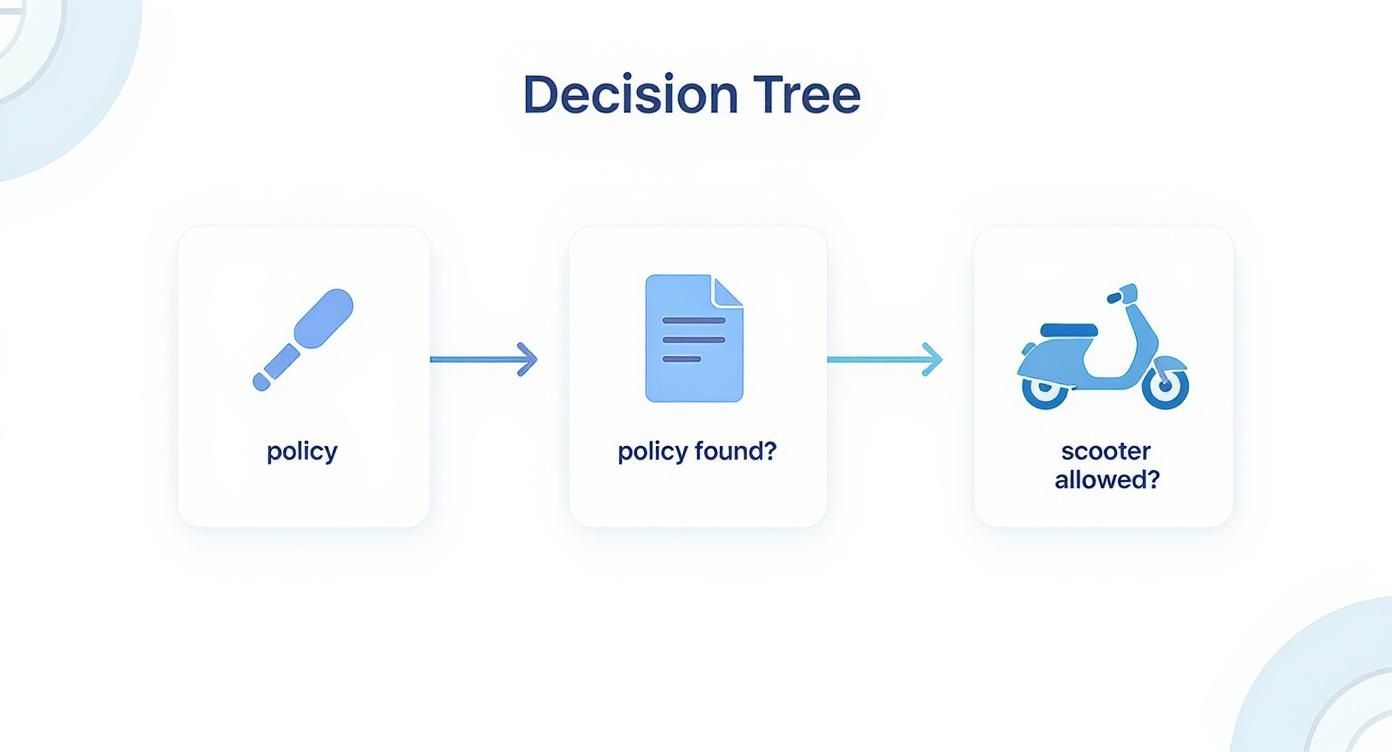
As you can see, everything starts with finding a clear, affirmative policy. Once you have that, you can move forward with the rest of your preparations.
Okay, so you've made the call and have a verbal "maybe" from the cruise line. That’s a great first step, but now the real work begins. A casual phone conversation won’t cut it when you arrive at the pier; you need a solid, undeniable paper trail to guarantee a smooth boarding process.
Think of it this way: you’re building a case for getting your scooter approved. Clear, professional, and organized documentation is your best friend here. Just showing up on embarkation day and hoping for the best is a recipe for disaster. Cruise lines run on strict safety and liability rules, and without the right paperwork, they can—and will—refuse your scooter, putting your entire vacation at risk before it even starts.
Your mission is to make it incredibly easy for the accessibility department to give you the green light. That means handing them everything they need, all neatly packaged up. Two pieces of paper are absolutely vital: a letter of medical necessity from your doctor and a detailed specification sheet for your scooter.
The letter from your doctor doesn't need to be a novel. It should be short, sweet, and to the point. It needs to state clearly that a mobility scooter is medically required for your travel, not just a nice-to-have for convenience. Have it briefly explain your mobility limitation without getting into overly personal health details.
Crucial Tip: A powerful letter avoids vague language. Instead of saying "patient needs a scooter," it's far more effective to state, "Due to a chronic mobility impairment, [Patient Name] requires the use of a personal mobility scooter to safely ambulate distances greater than 50 feet."
This is basically your scooter’s resume. It’s a simple, one-page document that gives the cruise line all the technical details they need at a glance. It stops the endless back-and-forth emails and shows them you’ve done your homework.
Here’s what to include on your spec sheet:
To help you get everything in order, here’s a quick checklist of the documents you’ll want to prepare and have on hand.
This table summarizes the essential paperwork you'll need to gather before contacting the cruise line's accessibility department. Having this ready will make the approval process much smoother.
| Document | Key Information to Include | Who to Send It To |
|---|---|---|
| Doctor's Letter | Statement of medical necessity, your name, brief mobility limitation details. | Cruise Line's Accessibility/Special Needs Department |
| Scooter Spec Sheet | Photo, make/model, dimensions (L/W/H), total weight, battery type, and Wh rating. | Cruise Line's Accessibility/Special Needs Department |
| Cruise Line Approval | The final written confirmation email or letter from the cruise line. | Keep multiple copies with your travel documents. |
Getting this paperwork sorted out ahead of time is the key to a stress-free experience.
A lot of the requirements for cruising are surprisingly similar to flying. If you want more tips on preparing your scooter for travel, you can find some great advice in these 10 handy tips when flying with a mobility scooter, as the core principles of clear documentation are the same.
Once you have that final, written approval email or letter from the cruise line, print out a few copies. Keep one with your passport, one in your carry-on, and maybe even give one to your travel companion. This written confirmation is your golden ticket for a hassle-free embarkation day.
So you got the green light from the cruise line! That's fantastic news. Getting that written approval is a big step, but now you’re probably wondering what it's actually like to have a scooter onboard a river cruise ship for a week or more. It's a bit different than you might expect, and setting the right expectations now will make your trip that much smoother.
First things first: storage. This is probably the most critical detail to wrap your head around. Unlike those massive ocean liners, river cruise ships simply don't have dedicated parking spots for mobility devices. Plus, strict maritime fire safety rules mean you absolutely cannot leave your scooter in a hallway or public area. They can block emergency exits, so this rule is set in stone.
This means your scooter has to live inside your stateroom whenever it's not in use. This single requirement is the main reason cruise lines are so particular about allowing only compact, foldable models. Before you even pack your bags, spend some time practicing folding and unfolding your scooter until it feels like second nature. You'll be glad you did.
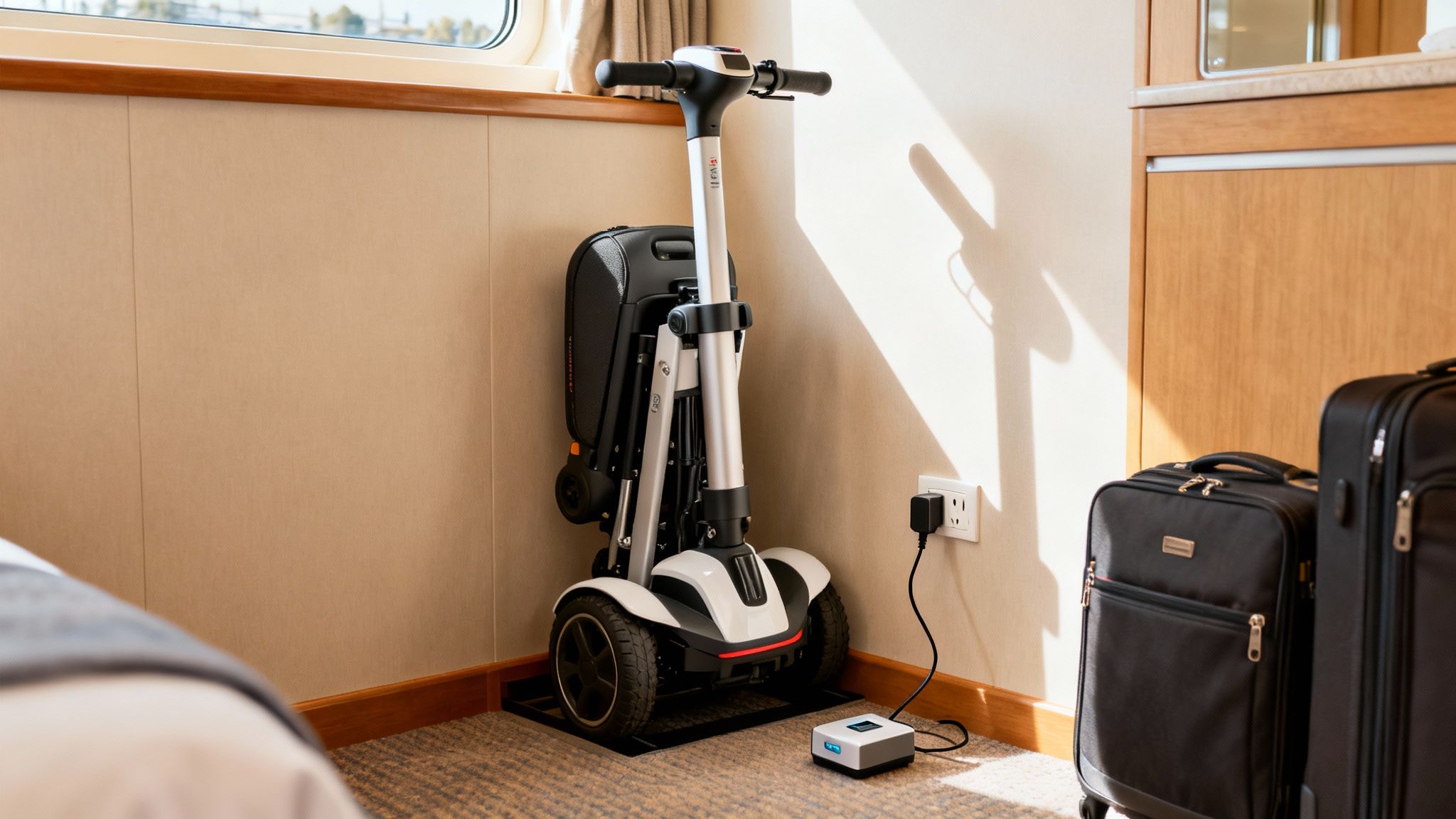
Once you've got your scooter tucked away in your cabin, the next puzzle is charging it. Outlets can be few and far between, and often in the most awkward places. I always suggest packing a multi-outlet extension cord (just double-check with the cruise line that they're allowed) to make your life easier.
Then there's the voltage to consider. Most European river cruises run on 220V power, but if you're from the US, your scooter likely uses 110V. Many modern chargers are dual-voltage, but you must check the label on your charger to be sure. If it's not, you'll need a step-down voltage converter to avoid frying your equipment. A simple plug adapter won't cut it!
Here's the reality of using a scooter on a river ship: it’s not like using it at home. The corridors are narrow, the turns are tight, and you’ll find raised thresholds leading into lounges and restaurants. You almost certainly won't be riding your scooter from place to place around the ship's public areas.
Think of your scooter as your key to unlocking the shore excursions, not your transport from the cabin to the dining room. It’s for exploring the charming port towns you’ll be visiting.
Most experienced travelers keep their scooter folded in their room and use the ship’s handrails or a cane for getting around onboard. You'll bring it out when it's time to disembark for the day's tour, then fold it back up and store it as soon as you get back. This approach respects the limited space and keeps everyone safe and happy.
Finding that balance is key to a great trip and can even influence which ship you choose. You can learn more about what different cruise lines offer in our complete guide to the best cruises for limited mobility seniors.
Let's be realistic—sometimes, even with the best intentions, bringing your own scooter on a river cruise just isn't in the cards. When you run into a cruise line with a strict no-scooter policy, it's not time to give up on the trip. It's time to pivot to a smart backup plan.
Fortunately, you have some excellent options. The most practical alternative is often renting a mobility scooter or wheelchair locally in your destination ports. This move neatly sidesteps all the cruise line's rules, storage headaches, and battery regulations, letting you enjoy your vacation without the logistical stress.
Most major European cities have companies that specialize in renting mobility equipment to tourists. It's their bread and butter. A quick online search for "mobility scooter rental in Vienna" will likely give you several reputable suppliers to choose from. This strategy gives you freedom and mobility on land, right where you need it most.
To make sure everything goes off without a hitch, here's what I recommend:
The real beauty of renting is the flexibility. You can have a scooter waiting for you in Vienna for a day of exploring, and then not have to think about it for the next two days while you're sailing.
Even if you have a scooter, shore excursions require their own layer of planning. Historic European towns are beautiful, but they weren't built with accessibility in mind. Cobblestones, steep hills, and buildings without ramps are often the norm.
Before you book any tour, have a frank conversation with the ship's shore excursion desk. Be crystal clear about your mobility needs. Ask direct questions: How much walking is involved? What kind of surfaces will we be on? Does the tour bus have storage space for a scooter or a lift? For instance, some cruise lines are very proactive with this information; you can find details on options for a Viking river cruises scooter rental and similar accessible arrangements with a little research.
Many cruise lines now offer "gentle walker" or "slow-paced" tour groups. These are often your best bet. The guides know the most accessible routes and build in more time at each stop. And remember, don't feel pressured to join an excursion if it sounds too strenuous. Sometimes, the best adventure is the one you create yourself, exploring the port town at your own comfortable pace.
Even after doing all the research, you might still have a few nagging questions about taking your scooter on a river cruise. That’s perfectly normal! Getting these details ironed out beforehand is the key to a stress-free trip. Let’s tackle some of the most common questions we hear.
Yes, by a long shot. River cruises that stick to U.S. waterways, like those sailing the Mississippi or Columbia Rivers, operate under the Americans with Disabilities Act (ADA). This is a game-changer for accessibility.
Because of the ADA, these vessels are typically built with mobility in mind from the ground up. You'll generally find:
For anyone relying on a mobility scooter, these design elements make American river cruises a much more practical and comfortable choice.
Please don't do this. Showing up with a scooter that the cruise line hasn't approved is a high-stakes gamble you are almost guaranteed to lose. It's not just about rules; it’s about strict safety regulations, liability, and the simple reality of limited space.
The cruise line will almost certainly refuse to let your scooter on board. You'd be stuck scrambling to find a secure place to store it at the port at the last minute, which is no way to start a vacation. In a worst-case scenario, they could deny you boarding altogether—without a refund.
Always, always get explicit, written approval from the cruise line before you even think about packing.
This is a fantastic question, and the answer is usually "it's complicated." Most standard travel insurance plans have specific exclusions for medical equipment, and yes, that often includes mobility scooters. You absolutely have to dig into the policy's fine print before you buy.
Protecting your trip investment is just as important as sorting out the scooter logistics. If you're wondering how to best safeguard your cruise, it’s worth looking into a comprehensive cruise travel insurance policy that covers the unique situations that can pop up on a river journey.


Leave a comment