(800) 682-9444
Call Now


Mobility is a crucial aspect of daily life, particularly for the elderly and those with disabilities. For these individuals and their caregivers, a wheelchair lift for a handicap van can be a game-changer, providing ease of travel and fostering independence. In this blog post, we will explore the different types of wheelchair lifts available, their benefits, and how to select the right one for your needs. Whether you’re a caregiver, disabled, or simply mobility-challenged, understanding these options can make a world of difference.
Best Wheelchair Lift for Van for Sale
The AL301XL is a powerful and versatile lift for large power wheelchairs and mobility scooters. With self-tensioning retractors, manual crank backup, and optional swing-away feature, it offers convenience and safety. Made in the USA with high-quality materials, it is a reliable choice for those needing a dependable lift.


| Lifting Capacity: | 350 lbs |
| Recommended For: | Travel Scooters, Full Sized Scooters, Full-Size Power Wheelchairs |
| Installed Product Weight: | 100 lbs |
| Hitch Height: | 5" to 19" |
| Warranty: | 3 Year Limited Warranty |
Exclusive Offer!
Get 20% Off + Free Cup Holder
The AL301XL is a fully powered lift that operates effortlessly with the flip of a switch, making it a versatile solution for most large power wheelchairs and mobility scooters.
Thanks to its robust construction and spacious aluminum deck, this Harmar power lift can efficiently accommodate a wheelbase of up to 48 inches, making it ideal for larger mobility aids.
The stable lifting platform ensures reliability and confidence, especially in tight parking situations where side-entry accessibility is crucial.
One of the standout features of the AL301XL is its self-tensioning retractors. These secure your power chair or scooter without the need for any drilling or modifications, offering a hassle-free experience.
Additionally, the lift comes equipped with a manual crank backup, a license plate mount, and an optional swing-away feature, ensuring both safety and convenience.
Engineered with high-quality materials and made in the USA, the AL301XL also includes a Class III hitch adapter, with upgrade options available.
The combination of ease of use, reliable performance, and robust design makes the AL301XL an excellent choice for anyone needing a dependable lift for larger mobility devices.
Pros
Cons
Wheelchair Lift for Van for Sale
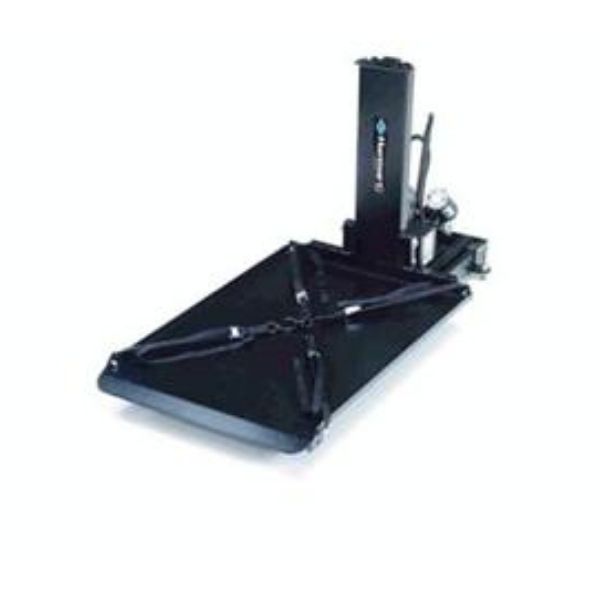
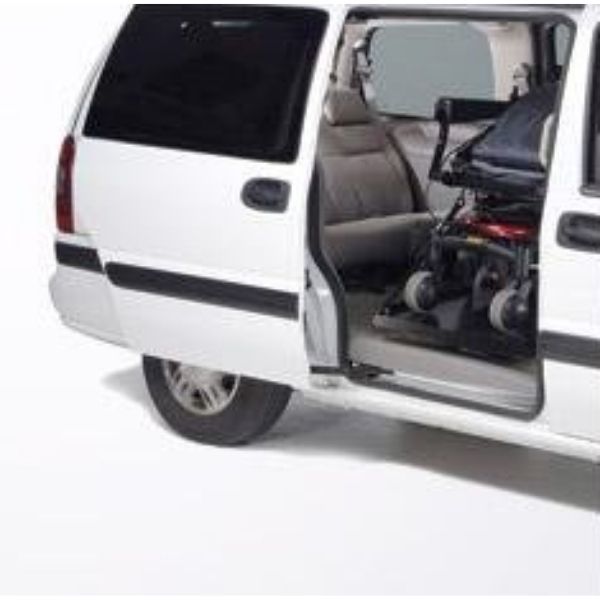
The AL690 Side-Door Hybrid Platform Lift is a convenient, fully automatic solution for loading small mobility scooters or power wheelchairs through the side door of your minivan or SUV. Easy to use and compatible with most vehicles.

| Lifting Capacity: | 275 lbs |
| Recommended For: | Travel Scooters, Full-Size Power Wheelchairs |
| Installed Product Weight: | 199 lbs. |
| Headroom Required: | 32" |
| Warranty: | 3 Year Limited Warranty |
Exclusive Offer!
Get 20% Off + Free Cup Holder
The AL690 Side-Door Hybrid Platform Lift offers a convenient alternative to rear-loading lifts. This Harmar platform lift easily mounts to the second row of seating, allowing you to load your small mobility scooter or power wheelchair through the side door of your minivan or full-size van.
It positions your mobility aid closer to the passenger door, making transfers much easier. Fully automatic and operated with a remote control, the AL690 simplifies the process of loading your mobility scooter or power wheelchair into your vehicle.
There's no need for modifications or special mounting devices. Just drive your mobility aid onto the platform, secure it, and the lift handles the rest. It's truly that simple. Durable, convenient, and powerful, the AL690 is an excellent solution for your transportation needs.
Aside from its ease of use, the AL690 also preserves space by sparing the third-row seat in most applications and requires no drilling in most vehicles, connecting seamlessly to existing hardware. It’s compatible with most minivans and SUVs, making it a versatile choice for many.
Pros
Cons
Wheelchair Lift for Van for Sale
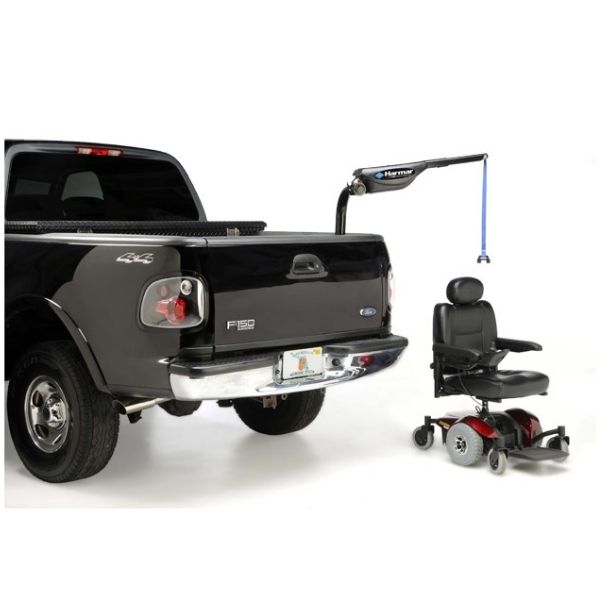
The AL425 Axis II boom lift by Harmar is a versatile and easy-to-use mobility aid with a 400 lb weight capacity. Its adjustable base and boom can be mounted on either side of the vehicle, making it a popular choice for rear-loading applications. With full powered functionality and a weatherproof remote control, this lift offers great value and ease of use. Note that installation may be challenging for those who are not mechanically inclined, and an adaptor kit may be needed for vehicles with Stow and Go seating.

| Lifting Capacity: | 400 lbs |
| Recommended For: | Travel Scooters, Full Sized Scooters, Full-Size Power Wheelchairs |
| Installed Product Weight: | 90 lbs. |
| Adjustable Boom Height: | 30" to 41" |
| Warranty: | 3 Year Limited Warranty |
Exclusive Offer!
Get 20% Off + Free Cup Holder
The AL425 Axis II boom lift can lift up to 400 lbs and offers full powered functionality. It requires only 30 inches of headroom to operate, and its adjustable base and boom can be mounted on either side of the vehicle.
The offset post design ensures safe unloading of your mobility aid beside the vehicle. Known for its ease of use and installation, this Harmar boom lift stands out in the industry.
When ordering, keep in mind that if you’re not handy or mechanically inclined, installing a unit that bolts to the floor or is wired to your vehicle’s battery can be challenging. Additionally, if your van or SUV has Stow and Go seating, you may need an adaptor kit.
Note that this lift is not compatible with vehicles that have power hatches.
The AL425 Axis II is fully powered for lifting and rotating, making loading simple. It’s our most popular model, fitting most rear-loading applications and requiring minimal headroom.
This lift features an extremely adjustable base and boom, can be mounted on either side of the vehicle, and comes with a weatherproof remote control. Additionally, it offers an economical package, providing significant value without sacrificing performance.
Pros
Cons
Wheelchair Lift for Van for Sale
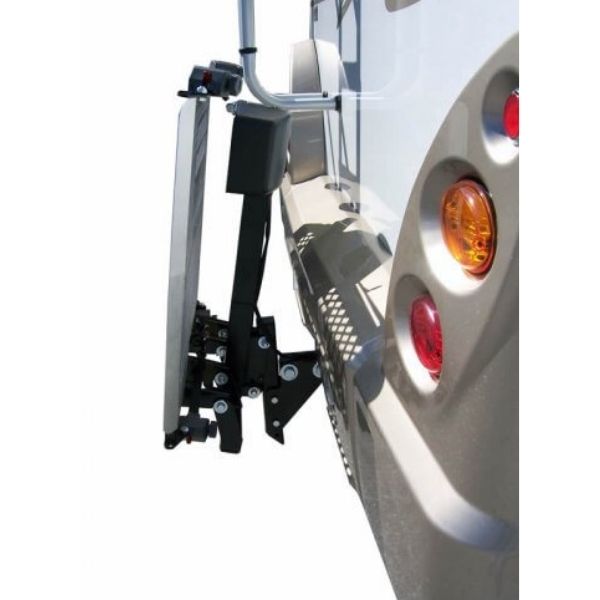
The Harmar AL300RV Lift from Electric Wheelchairs USA is the perfect solution for transporting your mobility aid behind your RV. With key features like a drop hitch adapter and manual crank backup, this American-made, heavy-duty lift ensures you can take everything you need on your adventures. Built to handle nearly all power chairs and scooters, the AL300RV is easy to install and comes pre-assembled. With its strong and stable features, the BraunAbility line of wheelchair lifts is another reliable option for challenging parking situations. Transport your mobility aid with confidence on your next trip with the Harmar AL300RV Lift.


| Lifting Capacity: | 350 lbs |
| Recommended For: | Travel Scooters, Full Sized Scooters, Full-Size Power Wheelchairs |
| Installed Product Weight: | 105 lbs. |
| Hitch Height: | 5" to 26" |
| Warranty: | 3 Year Limited Warranty |
Exclusive Offer!
Get 20% Off + Free Cup Holder
Looking for a lift designed specifically for your RV? Electric Wheelchairs USA has the perfect solution with the Harmar AL300RV Lift. This American-made, heavy-duty lift allows you to transport your mobility aid effortlessly behind your RV, ensuring you take everything you need on your adventures.
Key features include a drop hitch adapter, a manual crank backup for emergencies, and a license plate mount. The AL300RV is built to handle nearly all power chairs and scooters, with a universal hitch adapter fitting most RVs.
In case of power failure, the manual crank allows easy access to your mobility aid. The lift comes pre-assembled and is ready for installation, with the Battery Pack available for professional setup. The BraunAbility line is another reliable and durable series of wheelchair lifts, known for its strong and stable features, particularly suitable for challenging parking situations.
With its four automatic self-tensioning retractors and one-switch operation, securing and operating your lift is a breeze. Start your next trip with confidence, knowing your mobility aid is safely transported with the Harmar AL300RV Lift.
Pros
Cons
Four lifts with meaningfully different applications. Here's every key spec side by side so you can match the right product to your vehicle and device before reading individual reviews.
|
At a glance:
Highest lifting capacity: AL425 Axis II at 400 lbs — the only model that exceeds 350 lbs
Lowest lifting capacity: AL690 at 275 lbs — appropriate for travel scooters and lighter power chairs only
Only side-door option: AL690 — unique in allowing side-loading through the minivan's sliding door
Best for RVs and motorhomes: AL300RV — designed specifically for this with 5"–26" hitch height range
Lightest installed: AL425 Axis II at 90 lbs — easiest to mount
Emergency backup crank: AL301XL and AL300RV — for power failure situations
Most headroom-efficient: AL425 at just 30" headroom needed
This is the most practical question buyers have before purchasing — and the post's existing "How to Select" section doesn't answer it. Here's the vehicle-by-vehicle guidance.
Minivans (Honda Odyssey, Toyota Sienna, Chrysler Pacifica, Dodge Grand Caravan)
The AL690 side-door lift is specifically designed for minivans — it mounts to the existing second-row seat hardware without drilling and loads the mobility device through the sliding side door. This is the most convenient option for minivan owners because it positions the scooter or chair closest to the driver/passenger area.
The AL301XL and AL425 rear hitch models also work with most minivans when equipped with a Class III hitch (2" receiver). Many minivans ship with factory hitches that may be Class II — confirm your hitch class before ordering.
For Chrysler Pacifica and Dodge Grand Caravan with Stow 'n Go seating: the AL690 uses the seat hardware directly, making it a natural fit; the AL425 Axis II requires an adaptor kit for Stow 'n Go configurations.
Full-Size Vans (Ford Transit, Ram ProMaster, Mercedes Sprinter)
The AL301XL and AL425 are the primary choices for full-size vans. Their rear-hitch platforms accommodate the larger openings and square door configurations of these vehicles. The AL690's side-door approach is less common for full-size cargo vans.
SUVs (Ford Explorer, Chevrolet Suburban, GMC Yukon, Toyota 4Runner)
The AL690 works with most mid-size and full-size SUVs — the second-row seat hardware approach is broadly compatible. Confirm headroom clearance (32" needed) for the specific SUV.
The AL301XL and AL425 work with any SUV equipped with a Class III hitch. Verify your SUV's factory hitch class — many SUVs come with Class III as standard, but smaller models may have Class II.
Power hatches: The AL425 is not compatible with vehicles with power hatches. If your SUV or van has an automatic power liftgate, choose the AL301XL or AL690 instead.
RVs, Motorhomes, and Large Trucks
The AL300RV is purpose-built for this use case. Its 5"–26" hitch height range (compared to the AL301XL's 5"–19") accommodates the taller hitch positions on Class A, B, and C motorhomes and large truck chassis. The AL300RV is described as built for cross-country durability — appropriate for RV users who travel extensively.
Class II vs. Class III hitch — the most important vehicle check
Before ordering any hitch-mounted lift (AL301XL, AL425, AL300RV), verify your vehicle's hitch class:
Class I: 1.25" receiver — not compatible with any of these lifts
Class II: 1.875" or 1.25" receiver — not compatible; an aftermarket hitch upgrade required
Class III: 2" receiver — compatible; the standard requirement for all three hitch models
If your vehicle doesn't have a Class III hitch, a compatible aftermarket hitch can be installed by U-Haul, a tow hitch specialty shop, or an auto dealer. Cost is typically $150–$500 depending on the vehicle.
Hitch requirements are one of the most practically important — and most frequently misunderstood — considerations for van lift buyers. The post's individual product sections mention Class III hitches, but don't explain what that means or how to verify your vehicle's hitch.
Hitch classes explained
|
How to check your vehicle's hitch class
Look at the existing hitch receiver opening — measure the square opening
Check your vehicle owner's manual under "towing" specifications
Look for a label on the hitch itself — most factory hitches list the class
Call your dealer with your VIN to confirm factory hitch class
Factory vs. aftermarket hitches: Many vans and SUVs come with factory-installed trailer hitches, but a significant number of minivans ship with Class II receivers rather than Class III. If your vehicle has a Class II hitch and you want to use the AL301XL, AL425, or AL300RV, you'll need an aftermarket Class III hitch installed first.
Aftermarket hitch installation: U-Haul hitch installation centers, trailer hitch specialty shops, and automotive dealers can all install aftermarket Class III hitches. Cost ranges from approximately $150–$500 depending on the vehicle make and model. Many installations take 1–2 hours.
Hitch height compatibility: The hitch height on your vehicle affects which lift will fit:
AL301XL: Accommodates hitch heights of 5"–19" from the ground to the center of the receiver. This covers most standard vans, SUVs, and passenger vehicles.
AL300RV: Accommodates hitch heights of 5"–26" — the wider range specifically designed for the taller hitch positions on large motorhomes and Class A RVs.
AL425: Uses an adjustable boom with a height range of 30"–41" — this adjustable boom design accommodates vehicle height variation differently than a fixed hitch platform.
Drop hitches and adapters: If your vehicle's hitch receiver is higher than the optimal range for your lift, a drop hitch (a receiver extension that lowers the mounting point) can bring the height into range. These are typically inexpensive ($30–$100) and don't require professional installation.
Tongue weight considerations: When the lift is loaded, the weight of the mobility device is transferred to the vehicle's hitch as tongue weight. The AL301XL at 100 lbs installed + up to 350 lbs device + rider weight approaches 500 lbs of total hitch load. Check your vehicle's tongue weight limit (in the owner's manual) and confirm the loaded weight doesn't exceed it. Most vehicles with Class III hitches have 500–800+ lb tongue weight limits — sufficient for these lifts at typical loads.
The existing "Installation and Maintenance" section says "always seek professional installation" without explaining what that process involves. Here's the complete picture.
What professional installation involves: A professional Harmar-authorized installer will:
Verify your vehicle's hitch class and confirm compatibility
Mount the lift platform or boom to the hitch receiver (or, for the AL690, to the second-row seat mounting hardware)
Run wiring from the lift to the vehicle's battery — typically through the trunk, along the door sill, to a fused connection at the battery
Test all lift functions (raise, lower, rotate on AL425; extend/retract on AL301XL)
Confirm all safety interlocks are functioning
Demonstrate operation and provide the owner's manual
Typical professional installation time: 2–4 hours. The AL690's side-door mount is generally faster; the AL425's boom and wiring setup is more involved.
Where to find a qualified installer
Harmar's authorized dealer network: Electric Wheelchairs USA can connect you with authorized Harmar installers — call 800-682-9444
NMEDA-certified mobility equipment dealers: The National Mobility Equipment Dealers Association certifies installers who specialize in vehicle accessibility modifications. Search at nmeda.com
Mobility vehicle conversion shops: Located throughout the US, these specialize in vehicle accessibility modifications
Auto dealers: Some dealers offer hitch and accessory installation through their service departments
DIY feasibility — an honest assessment: The AL301XL and AL300RV are described as "self-installable" for mechanically inclined buyers because their primary installation steps are mechanical (bolting to the hitch receiver). However, the electrical connection — running the control wire from the lift to the vehicle's battery — requires basic automotive electrical knowledge. Incorrect wiring can damage the vehicle's electrical system or void the lift's warranty.
The AL425 similarly bolts to the hitch, but its adjustable boom base requires precise alignment. The floor-mounted bolt pattern (on some installation configurations) requires locating structural floor points.
The AL690 is the most consistently owner-friendly: in terms of the mechanical connection — it attaches to the existing second-row seat hardware without drilling. However, the electrical wiring still connects to the vehicle battery.
The Stow 'n Go complication (AL425): Chrysler Pacifica and Dodge Grand Caravan models with Stow 'n Go seating have fold-into-floor rear seats that create obstacles for standard floor mounting. The AL425 Axis II requires an adaptor kit for these vehicles — confirm with your installer before scheduling.
What voids the warranty: Harmar's 3-year limited warranty on all four models covers defects in materials and workmanship. The warranty does not cover damage from: improper installation, modifications not authorized by Harmar, overloading beyond rated capacity, or damage from failure to follow the owner's manual. DIY electrical wiring errors that damage the lift may not be covered — one reason professional installation is recommended.
A wheelchair lift failure can cause serious injury. Understanding safe operation prevents accidents before they happen.
Weight capacity: the most critical safety spec: Never load a lift at or near its maximum rated capacity. Apply a 50 lb safety buffer — choose a lift rated at least 50 lbs above the combined weight of the device and rider (if the rider is in the device during lifting).
Total load calculation example: 200 lb user + 250 lb power chair = 450 lb total load. The AL425 at 400 lb capacity is undersized for this combination; the AL301XL or AL300RV at 350 lbs is also insufficient. This combination requires a higher-capacity lift — call 800-682-9444 to discuss bariatric lift options.
Pre-use safety checklist: Before each use, briefly inspect:
The platform surface for debris that could cause the device to roll unexpectedly
The retractors (AL301XL and AL300RV) for proper tension — they should be snug against the device's tires
The remote control battery level — a low battery can cause intermittent operation
The hitch connection — confirm the lift is fully seated and pinned in the receiver
Vehicle position — ensure the vehicle is on level ground before operating the lift
Securing the mobility device: the most commonly skipped step: The AL301XL and AL300RV include four self-tensioning Q'Straint retractors. These are not optional — they must engage the device's tires before lifting. Failure to properly engage retractors can result in the device shifting or falling off the platform at highway speeds. Always confirm all four retractors are in contact with the tires and have appropriate tension before driving.
Emergency manual crank procedures: The AL301XL and AL300RV both include a manual crank backup for power failure situations. Keep the crank tool accessible (not buried in the trunk), and know where the manual crank connection point is on your specific unit before an emergency situation arises. Test the manual crank periodically in a safe location so you're familiar with it.
Operating in tight parking situations: The AL301XL includes a side-entry platform specifically for loading in tight parking situations — you don't need to be behind the vehicle to load. For the AL425 Axis II, the boom swings to the side of the vehicle during loading — be aware of the swing path and ensure no pedestrians or other vehicles are in the rotation zone.
Weather considerations:
Rain: The AL690's weatherproof remote and the AL425's weather-resistant construction handle light rain; avoid operating any lift in heavy rain when possible
Ice and snow: Ice accumulation on the platform surface eliminates the anti-slip properties — clear ice before loading any device
Temperature: Cold temperatures reduce battery performance — in very cold climates, store the vehicle in a heated garage when possible and allow the lift to warm before first morning operation
Wheelchair lifts come in various forms, each designed to meet specific needs and preferences. The three primary types are platform lifts, under vehicle lifts, and folding lifts.
Platform Lifts
Platform lifts are one of the most common types used in vans. They consist of a flat platform that raises and lowers the wheelchair, allowing easy access into and out of the vehicle. These lifts are ideal for individuals who need a stable and secure way to enter and exit their vans. Additionally, platform lifts often feature dual hydraulic lift arms, providing dependable operation and a time-tested design.
Under Vehicle Lifts (UVLs)
Under vehicle lifts are mounted beneath the van, making them an excellent choice for those who prefer a more discreet option. UVLs are hidden when not in use, preserving the vehicle’s aesthetics and interior space. They are particularly suitable for individuals who frequently use their vans for other purposes. This type of lift ensures maximum interior space, optimizing the vehicle's interior for passengers and cargo.
Folding Lifts
Folding lifts are designed to fold up and out of the way when not in use. This type of lift is perfect for those who need to maximize interior space within their van. Folding lifts are convenient and versatile, catering to various mobility needs and vehicle types.
When selecting a wheelchair lift for your van, consider essential features such as weight capacity, ease of use, and safety mechanisms. Look for lifts that offer smooth operation, remote controls, and emergency backup systems. Additionally, prioritize safety features such as interlocking mechanisms that prevent operation in unsafe situations and alarms that alert users to potential dangers. Thoughtful features like side-entry platforms designed for tight parking situations can also enhance usability. These features ensure that the lift meets your specific requirements and provides a safe and reliable experience.
One of the most significant benefits of wheelchair lifts is the enhanced mobility they provide. With a wheelchair lift, individuals can access their vehicles independently, reducing reliance on others. This increased autonomy fosters a sense of freedom and empowerment, allowing users to participate more actively in daily activities and social engagements. Additionally, the time-tested durability of these lifts ensures long-term reliability and confidence in their performance.
Wheelchair lifts also offer convenience for caregivers and family members. The ease of transferring a wheelchair into and out of a van reduces physical strain and the risk of injury. This convenience allows caregivers to focus on providing quality care and support, improving the overall well-being of both the caregiver and the individual in need.
The ability to travel and engage in social activities contributes significantly to an individual's social and psychological well-being. Access to a wheelchair lift allows users to maintain relationships, attend social events, and participate in community activities. This engagement combats feelings of isolation and promotes mental health, enhancing the overall quality of life.
Before choosing a wheelchair lift, assess your specific mobility needs. Consider factors such as the frequency of use, the type of wheelchair, and the user's physical capabilities. Understanding these needs will help you select a lift that offers the best support and functionality.
Not all wheelchair lifts are compatible with every vehicle. Ensure that the vehicle lift you choose is suitable for your van’s make and model. Consult with a professional to verify compatibility and receive recommendations tailored to your vehicle.
Budget is an important consideration when selecting a wheelchair lift. Prices can vary widely based on the type and features of the lift. Explore funding options such as insurance coverage, grants, and assistance programs that may help offset the cost. Investing in a high-quality lift is crucial for safety and long-term use, so consider all available financial resources.
Proper installation of a wheelchair lift is critical for ensuring safety and functionality. Always seek professional installation services to guarantee that the lift is securely and correctly fitted to your van. Consulting a local BraunAbility dealer can provide expert guidance on vehicle modifications and help you choose the most suitable vehicle and wheelchair lift options based on your individual mobility needs and vehicle compatibility. Professional installers can also provide valuable insights into the operation and maintenance of the lift.
Regular maintenance is essential for the longevity and safety of your wheelchair lift. Perform routine checks to ensure that all components are functioning correctly. Lubricate moving parts as recommended by the manufacturer and address any signs of wear or damage promptly. Regular maintenance not only enhances the lift's performance but also ensures the safety of its users.
Occasionally, wheelchair lifts may encounter operational issues. Familiarize yourself with common problems and their solutions, such as battery replacements, sensor calibrations, and software updates. Having a basic understanding of troubleshooting can help you address minor issues promptly, reducing downtime and inconvenience.
The best lift depends on your van type and how you want to load. For minivans loading through the side door: the Harmar AL690 (side-door hybrid platform, 275 lbs, connects to existing seat hardware). For rear-loading with a full-size power chair or scooter: the Harmar AL301XL (350 lbs, platform lift, self-tensioning retractors, manual backup crank). For the highest weight capacity: the Harmar AL425 Axis II (400 lbs, boom lift, lightest installed weight at 90 lbs). For RVs: the Harmar AL300RV (350 lbs, 5"–26" hitch height range for tall RV hitches).
Harmar van lifts on this page range from approximately $1,500 to $4,000 for the lift itself, depending on the model. The AL425 Axis II is typically the most economical; the AL690 and AL301XL are in the mid-range; fully featured configurations with swing-away options or extended decks add cost. Professional installation adds $200–$600 depending on your location and installer. If an aftermarket Class III hitch is needed, add approximately $150–$500 for that installation. Call 800-682-9444 for current pricing on specific models.
Medicare does not directly cover vehicle lifts or vehicle modifications. Medicare Part B covers durable medical equipment (DME) for use in the home — vehicle lifts are classified as vehicle modifications rather than DME. However, some state Medicaid programs, Veterans Affairs (VA) benefits (specifically the VA Automobile Adaptive Equipment grant), and nonprofit programs may provide assistance.
The AL301XL, AL425 Axis II, and AL300RV all require a Class III hitch — a 2-inch square receiver. This is the most common heavy-duty hitch class and is standard on most full-size vans, SUVs, and trucks. Many minivans and some smaller SUVs come with Class II hitches (1.875" receiver) — if your vehicle has a Class II hitch, you'll need an aftermarket Class III hitch installed before ordering. The AL690 does not use a hitch — it mounts to the second-row seat hardware.
Technically yes for mechanically inclined buyers — the Harmar lifts bolt to the hitch receiver or seat hardware using standard tools. However, the electrical wiring connection (from the lift to the vehicle battery) requires automotive electrical knowledge, and incorrect wiring can damage the vehicle or void the lift's warranty. The AL690 is the most owner-friendly for the mechanical connection; the AL425 requires more precise alignment. Professional installation (typically 2–4 hours) is recommended and ensures the warranty remains valid.
A platform lift (AL301XL, AL300RV) is a flat deck that lowers to the ground — the mobility device rolls or is pushed onto the deck, then the deck rises into the vehicle's rear or beside it. A boom lift (AL425 Axis II) uses an arm that lifts the device by attaching to it or placing it in a cradle, then swings or raises it into position. Platform lifts are generally better for self-loading (rolling the device on); boom lifts can be more compact and have higher capacity. The AL690 is a side-door platform lift that swings the device up and into the van's interior.
Two options on this page specifically work with most minivans. The AL690 is the primary minivan choice — it mounts to the existing second-row seat hardware without drilling and loads through the sliding side door. The AL301XL and AL425 rear-hitch models also work with minivans equipped with a Class III hitch. For Chrysler Pacifica and Dodge Grand Caravan with Stow 'n Go seating: the AL690 uses the seat hardware directly; the AL425 requires an adaptor kit.
The four lifts on this page have capacities of 275 lbs (AL690), 350 lbs (AL301XL and AL300RV), and 400 lbs (AL425 Axis II). The capacity covers the total weight of the mobility device — not the user plus the device (the user should exit the mobility device before it's loaded on most of these lifts). Apply a 50-lb safety buffer: if your device weighs 300 lbs, choose the 350-lb or 400-lb rated lift.
Not when properly installed. The hitch-mounted models (AL301XL, AL425, AL300RV) connect to the vehicle's hitch receiver, which is a structural mounting point designed for towing loads — the lift is well within those structural tolerances. The AL690 connects to the second-row seat hardware without drilling in most applications. Improper installation — particularly incorrect electrical wiring — can damage the vehicle's electrical system. Professional installation eliminates this risk.
For most SUVs, the AL690 (side-door, if the SUV is a minivan-style with a sliding rear door) or AL301XL (rear hitch, 350 lbs) are the primary choices. For SUVs with power hatches: avoid the AL425 (explicitly not compatible with power hatches) — use the AL301XL. Verify your SUV's hitch class before ordering any rear-hitch model. For bariatric scooters or heavier power chairs, the AL425 at 400 lbs capacity is the strongest rear option.
Monthly maintenance routine: (1) Inspect all bolts and connections for tightness; (2) lubricate the platform hinges and boom pivot points with manufacturer-recommended lubricant; (3) check retractor tension and spring function (AL301XL and AL300RV); (4) inspect wiring connections at the battery for corrosion — clean terminals with a battery terminal cleaner if corrosion appears; (5) test the manual crank backup if equipped; (6) clean the platform anti-slip surface of debris. Annually: have a certified mobility equipment technician inspect the lift, particularly the electrical system and structural connections.
A van lift is a powered device that raises and lowers a mobility device — the user doesn't have to push the device up a slope. A van ramp is a sloped surface that the user or caregiver pushes the device up manually (or with the device's own motor). Ramps are typically less expensive and have no power source to maintain, but require physical effort or motor power to navigate and may not be appropriate for very heavy devices or users with limited caregiver strength. Browse our car ramps collection for ramp alternatives, or call 800-682-9444 to discuss which is right for your situation.
Wheelchair lifts for vans play a vital role in enhancing mobility and independence for the elderly, disabled, and their caregivers. By understanding the different types of lifts, their benefits, and how to select the right one, you can make an informed decision that meets your specific needs. Regular maintenance and professional installation further ensure the safety and functionality of your lift.
Converting a standard van into a wheelchair accessible vehicle with features like a power tri-folding platform and safety mechanisms can significantly improve the comfort and accessibility for passengers.
If you are considering a wheelchair lift for your van, seek professional advice to explore the best options available. Share your experiences and insights with others to help build a supportive community of mobility-focused individuals. Together, we can enhance the quality of life for those who rely on wheelchair lifts for their daily activities.
For more information, please check out our other guides “The Best Lift Systems For Heavy Duty Mobility Scooters” and “How To Choose The Right Scooter Lift For Cars”.
For more insights and personalized advice, feel free to reach out to our experts or consult with your healthcare provider. Our team of Mobility Experts is ready to assist you.
Got questions about a specific chair or unsure which option suits your unique needs?
Give us a call at 800-682-9444 or email us directly at info@electricwheelchairsusa.com. Your journey to improved mobility starts here!
Need help finding the perfect wheelchair? Our mobility experts are here to assist! Contact us at 800-682-9444 for personalized guidance.
We offer a range of financing options tailored to fit your financial situation, ensuring you get the choice you deserve:
Klarna Financing: Partnering with a leading European banking entity, we offer installment plans suited to your budget.
Shop Pay: In collaboration with Affirm, this option provides a straightforward payment schedule.
PayTomorrow: Enjoy a hassle-free application process, clear pricing, and auto-pay features, all while maintaining your credit standing.
Call us now at 800-682-9444 to get a brand new mobility scooter without breaking the bank!
Choosing a wheelchair lift involves matching your specific vehicle, mobility device weight, and loading preference — details that are much easier to get right with expert guidance. Our free printed catalog covers the full Harmar lift lineup along with our complete accessibility and mobility equipment selection, with specs, compatibility notes, and current pricing.
Request Your Free Catalog Here →
No purchase required. No obligation.
Our mobility experts are available every day from 8AM to 8PM EST at 800-682-9444. We can confirm compatibility with your specific vehicle make and model, verify your hitch class, help calculate whether your device weight is within a lift's capacity, and connect you with a certified Harmar installer in your area.
Related guides:
The Best Lift Systems for Heavy Duty Mobility Scooters — For buyers with large or bariatric scooters
How to Choose the Right Scooter Lift for Cars — General scooter lift selection guide
Browse All Wheelchair Ramps → — If a ramp is a more practical option for your situation


Leave a comment