(800) 682-9444
Call Now


If you're looking into renting a mobility scooter, the first question on your mind is probably, "What's this going to cost me?" It's a fair question, and the answer isn't a single number. Think of it like renting a car—the final price tag depends on how long you need it and what kind of ride you're looking for.
On average, you can expect to pay somewhere between $35 to $85 per day, with most places landing around the $55 mark. But the real savings kick in when you book for a week or a month.

When you only need a scooter for a little while, understanding the costs upfront is key. The price isn't set in stone; it really hinges on how long you'll be using the scooter. The pricing is almost always tiered, meaning you get a better deal for longer commitments.
A one-day rental is perfect for a big event like a family trip to the zoo or a music festival. If you're heading out on vacation for a week, a weekly rental makes a lot more sense and saves you a good chunk of change. And for anyone recovering from surgery or needing longer-term support, a monthly rental almost always offers the best value.
Let's break it down. Just like booking a hotel, the per-day cost drops significantly the longer you rent. A single day might feel a bit pricey, but stretch that to a week or a month, and the daily rate becomes much more budget-friendly. This structure is designed to help those who need the scooter the most for an extended period.
Rental prices can fluctuate based on your location, the specific scooter model you choose, and, of course, the rental duration. Here in the U.S., a typical daily rental is about $55 plus tax, though you’ll see that $35 to $85 range pretty consistently.
Weekly packages are where you start to see the savings, usually falling between $300 and $400. For those longer-term needs, monthly rentals can range from $800 to $1,200, which brings the daily cost way down. If you're curious about the business side of these numbers, you can find some great mobility industry insights from joyride.city.
To give you a clearer picture, let's put those numbers into a simple table. This should give you a solid baseline for figuring out your budget.
This table summarizes the average costs for renting a mobility scooter for different durations, providing a quick financial overview.
| Rental Period | Average Daily Rate | Average Weekly Rate | Average Monthly Rate |
|---|---|---|---|
| Daily | $35 - $85 | N/A | N/A |
| Weekly | ~$43 - $57 | $300 - $400 | N/A |
| Monthly | ~$27 - $40 | N/A | $800 - $1,200 |
As you can see, the numbers speak for themselves. The longer you rent, the more you save on that daily rate.
Key Takeaway: The longer you rent, the less you pay per day. A monthly rental can cut the daily cost by more than half compared to a single-day rental, making it a smart choice for extended use.
These figures are a great starting point, but they're not the whole story. In the next section, we’ll dive into other factors that can tweak your final cost, like the scooter's features, delivery fees, and insurance options.
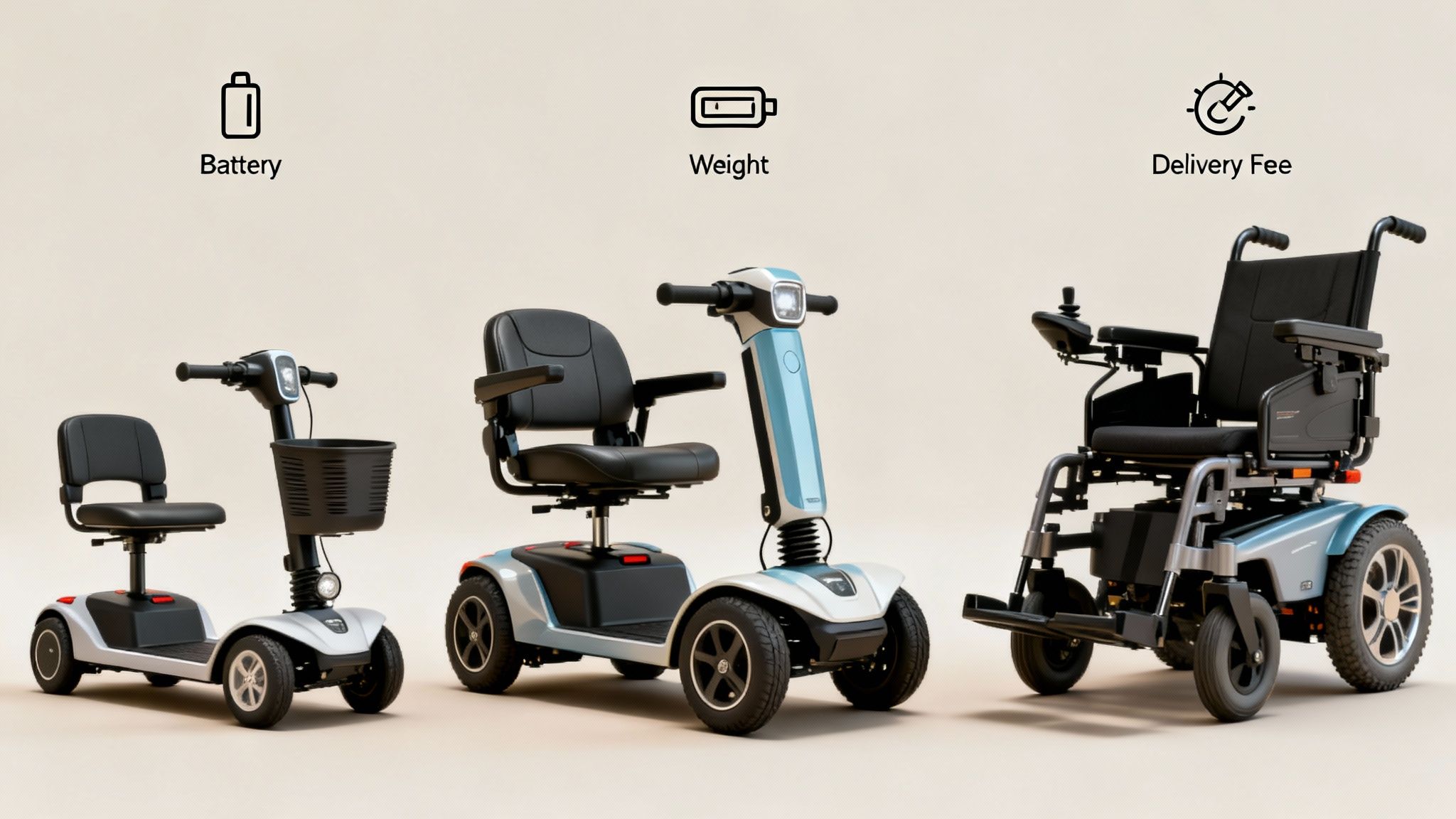
You've seen the average rates, but you're probably wondering why there's such a wide gap—from $35 to $85 per day. What gives?
Think of it like renting a car. The basic compact you grab for a quick city trip won't cost the same as a rugged SUV you need for a mountain adventure. The same logic applies to mobility scooters. The price isn't just a random number; it's a direct reflection of the scooter's features, capabilities, and the services bundled with it.
Understanding what goes into the price tag helps you pick a scooter that perfectly fits your plans without overspending. It's all about matching the machine to your mission.
The single biggest factor that sways the price is the type of scooter you rent. Companies offer a whole range of models designed for different situations, from lightweight travel options to heavy-duty, all-terrain machines. Naturally, each one comes with a different price tag.
A scooter’s specs also play a big role. A model with a longer battery life, a cushy captain's seat, or a zippier top speed is going to command a higher price. When you're weighing your options, it's smart to look at the whole picture. Our comprehensive best mobility scooter buying guide is a great place to dig deeper into what different models offer.
Don't forget about delivery! This is another key piece of the total rental cost. While some local shops might offer free drop-off within a certain area, most companies charge a fee. This is especially true for same-day service or delivery to specific spots like airports, hotels, or cruise ship terminals.
Expect these fees to run anywhere from a flat $25 to over $75, depending on how far they have to travel and how tricky the drop-off is.
When you're comparing prices, always ask if delivery and pickup fees are included in the quote. A lower daily rate might catch your eye, but a hefty delivery fee could make it more expensive in the end.
For rental companies, these logistics are a real operational cost. A single rental requires two separate trips from their team, which is why many have a multi-day rental minimum to make it worth their while.
Beyond the scooter and the delivery, a few other things can add to your final bill. It pays to know about these potential costs upfront so you can budget accurately and avoid any nasty surprises on the invoice.
Here are some of the usual suspects:
Figuring out how much a scooter rental costs is only half the battle. The other, equally important piece of the puzzle is knowing where to find one. Think of it like deciding where to shop: you've got the local boutique, the big-box superstore, and the convenient online retailer. Each one serves a different purpose, and the right choice for you really boils down to your specific needs.
Are you looking for hands-on, personalized service, or do you need the massive selection and nationwide reach of a major company? Let's break down your options.
For a lot of folks, the best place to start is right in their own neighborhood at a local Durable Medical Equipment (DME) provider or medical supply shop. These are your local experts. Renting from a shop down the street often means you get fantastic, personalized service. They'll likely handle the setup for you and give you a complete walkthrough of how to use the scooter.
This option is perfect if you're new to mobility devices or have particular medical needs that could use an expert's touch. Since they rely on their local reputation, you can often expect better customer service and maybe even more flexible rental terms.
Then you have the big players—the large, national rental companies that operate on a much larger scale. These providers typically have robust websites where you can browse a huge variety of models, from feather-light travel scooters to heavy-duty, all-terrain options. Their specialty is serving major tourist hubs, convention centers, and airports.
Because of their size, they can often offer very competitive pricing and have standardized, streamlined processes. This makes them a super reliable choice for travelers who need a scooter delivered straight to a hotel or cruise ship port. Their entire operation is built for logistical efficiency, ensuring your scooter is there waiting when you arrive.
One of the biggest advantages of a national chain is its huge network. If you're heading to a popular vacation spot, odds are they have a team on the ground, making the whole process from booking to pickup completely seamless.
For example, if you're planning a trip, checking out a national provider can be a game-changer. For more specific advice on renting in busy tourist areas, you can check out our in-depth guide to electric wheelchair rentals on the Las Vegas strip, which is packed with tips that apply to almost any travel destination.
Your third option is to rent directly from the place you're visiting. This includes locations like theme parks, state fairs, cruise ships, and big resorts. The State Fair of Texas, for instance, partners with a company to offer scooter rentals right at the gate for about $75 per day.
The main draw here is pure, unmatched convenience. You don't have to worry about delivery or hauling a scooter around yourself. You just pick it up when you get there and drop it off before you head home.
But that convenience almost always comes with a higher price tag. On-site rental costs are typically steeper than what you'd pay a local or national company. On top of that, your selection is usually limited to one or two basic models, and they can run out of stock fast during busy seasons. If you go this route, it's almost always a good idea to reserve one ahead of time.
So, you're wondering if insurance will foot the bill for your mobility scooter rental. It's a question we get all the time, and the answer almost always hinges on one crucial detail: is it a medical necessity?
Many folks rent scooters for convenience, like for a family vacation or a big outdoor event. That's fantastic, but insurance companies see that differently. Coverage from programs like Medicare and private insurers is typically reserved for strict, medically-justified needs within your own home.
Think of it this way: if you need a scooter for a trip to a theme park, that's almost certainly going to be an out-of-pocket expense. But if your doctor prescribes one because you can't safely get around your house without it, you've got a much better chance of getting the cost covered.
Medicare Part B can cover the rental of a mobility scooter, but they have some very specific rules. They classify scooters as Durable Medical Equipment (DME), and their guidelines are notoriously strict. Simply wanting a scooter to make getting around town easier won't cut it. You have to prove it's essential for performing daily activities inside your home.
To meet Medicare’s criteria, you'll need to check off these boxes:
Important Note: When Medicare says "home," they mean it literally. Their coverage is designed to help you with mobility inside your house. Using the scooter for trips to the store, visiting neighbors, or other recreational activities generally doesn't meet their definition of medical necessity.
Most private insurance plans take their cues from Medicare when it comes to covering DME. That means you'll likely need a doctor's prescription and a clear diagnosis showing why the scooter is medically required. Coverage can vary wildly from one provider to the next, so your best first step is always to call your insurance company directly and ask about their specific rules for DME rentals.
For veterans, the Department of Veterans Affairs (VA) is another potential avenue. The VA provides mobility scooters and other assistive devices to eligible veterans as part of their medical benefits. To qualify, a VA doctor has to determine that the scooter is necessary to help with a service-connected disability or as a key part of the veteran's overall care plan.
Federal retirees have an extra layer to consider, as they need to figure out how their health benefits and Medicare work together. It can get complicated, but there are resources that explain the specifics of FEHB and Medicare for federal retirees that can be a huge help. For a more detailed look at the general requirements, our article explaining if insurance will pay for a mobility scooter breaks it down even further.
Deciding between renting and buying a mobility scooter is the big crossroads for many folks. It’s not just a simple question of cost; it's really about weighing short-term needs and flexibility against long-term value and independence. The best choice comes down to your unique situation, lifestyle, and how long you see yourself needing a little help getting around.
A good way to think about it is like getting a car. Are you just in town for a few months and need something to get around? Leasing is perfect—lower upfront cost and no long-term strings. But if you're commuting to work every day for the foreseeable future, buying the car makes a lot more sense financially over time.
For any temporary or one-off need, renting is almost always the way to go. It gives you the freedom and mobility you need without the commitment of actually owning a scooter. If your situation sounds like one of these, renting is probably your most practical and budget-friendly move.
This flowchart gives a good visual of how the reason you need a scooter—medical or otherwise—can really shape the decision.
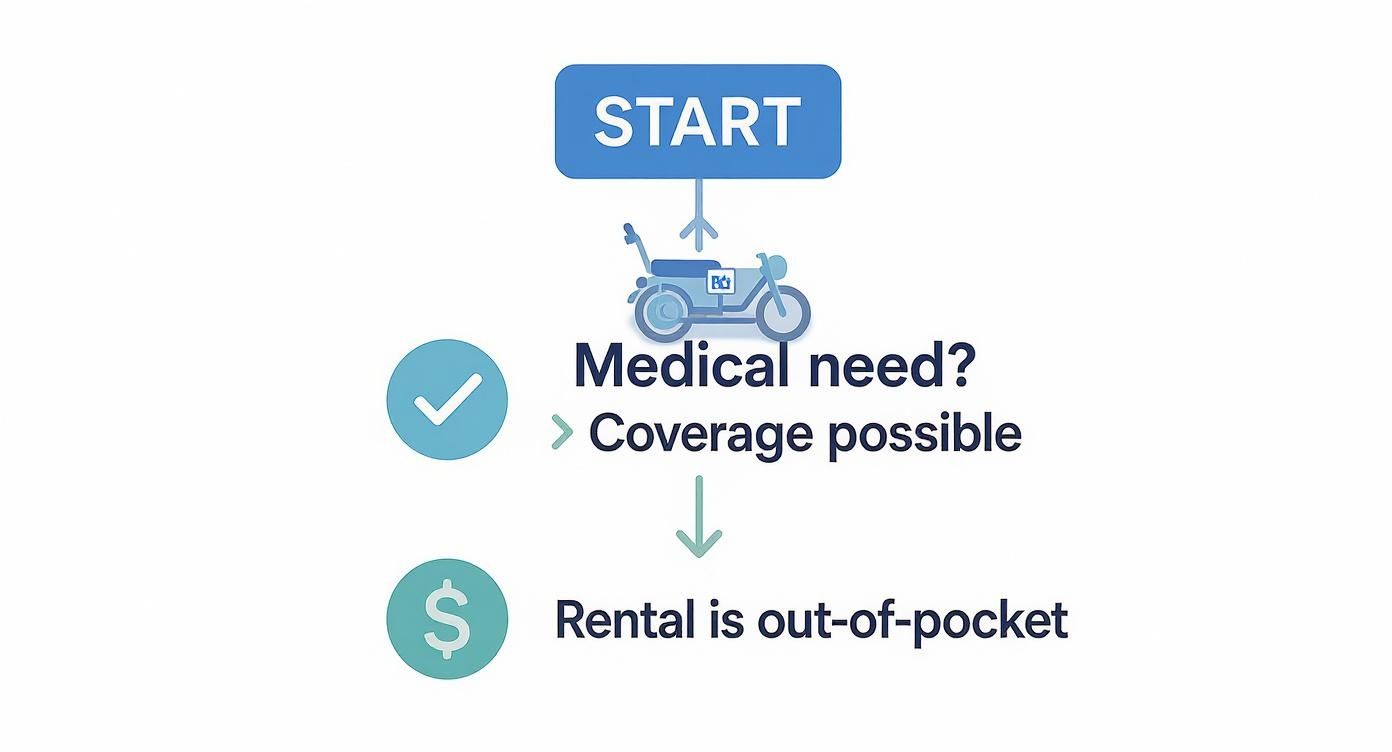
Ultimately, if your need isn't considered "medically necessary" by insurance, you're looking at an out-of-pocket expense. That's when thinking about the most cost-effective solution, like renting for the short term, really comes into play.
On the flip side, buying a scooter becomes the clear financial winner when your need for mobility help is long-term or permanent. The upfront cost is definitely higher, but it can save you thousands of dollars over the years compared to renting month after month.
Owning a mobility scooter can run you anywhere from $500 for a basic, no-frills model up to $5,000 or more for a heavy-duty, all-terrain machine. For example, a simple 3-wheel scooter for indoor use might be $500 to $1,200, while a more rugged 4-wheel model for outdoor adventures could be $1,000 to $2,000.
If you plan on using a scooter every day, buying is almost always the right move. After just a few months, the money you'd spend on renting can easily add up to more than the purchase price of a brand-new scooter.
To make things even clearer, let's put renting and buying side-by-side. Sometimes seeing the details laid out like this is the best way to figure out which path lines up with your needs and your wallet.
| Consideration | Renting | Buying |
|---|---|---|
| Upfront Cost | Low (daily, weekly, or monthly fee) | High (full purchase price) |
| Long-Term Cost | Becomes expensive over time | More economical for long-term use |
| Maintenance | Included; rental company handles repairs | Owner's responsibility |
| Flexibility | High; easily swap models for needs | Low; committed to one model |
| Customization | Not an option | Full ability to add accessories |
| Best For | Short-term needs, travel, recovery | Daily, long-term, and permanent use |
Looking at this, you can see how renting shines for its low initial cost and flexibility, making it ideal for temporary situations. But if you’re in it for the long haul, buying is the more sustainable and cost-effective choice that puts you in complete control.
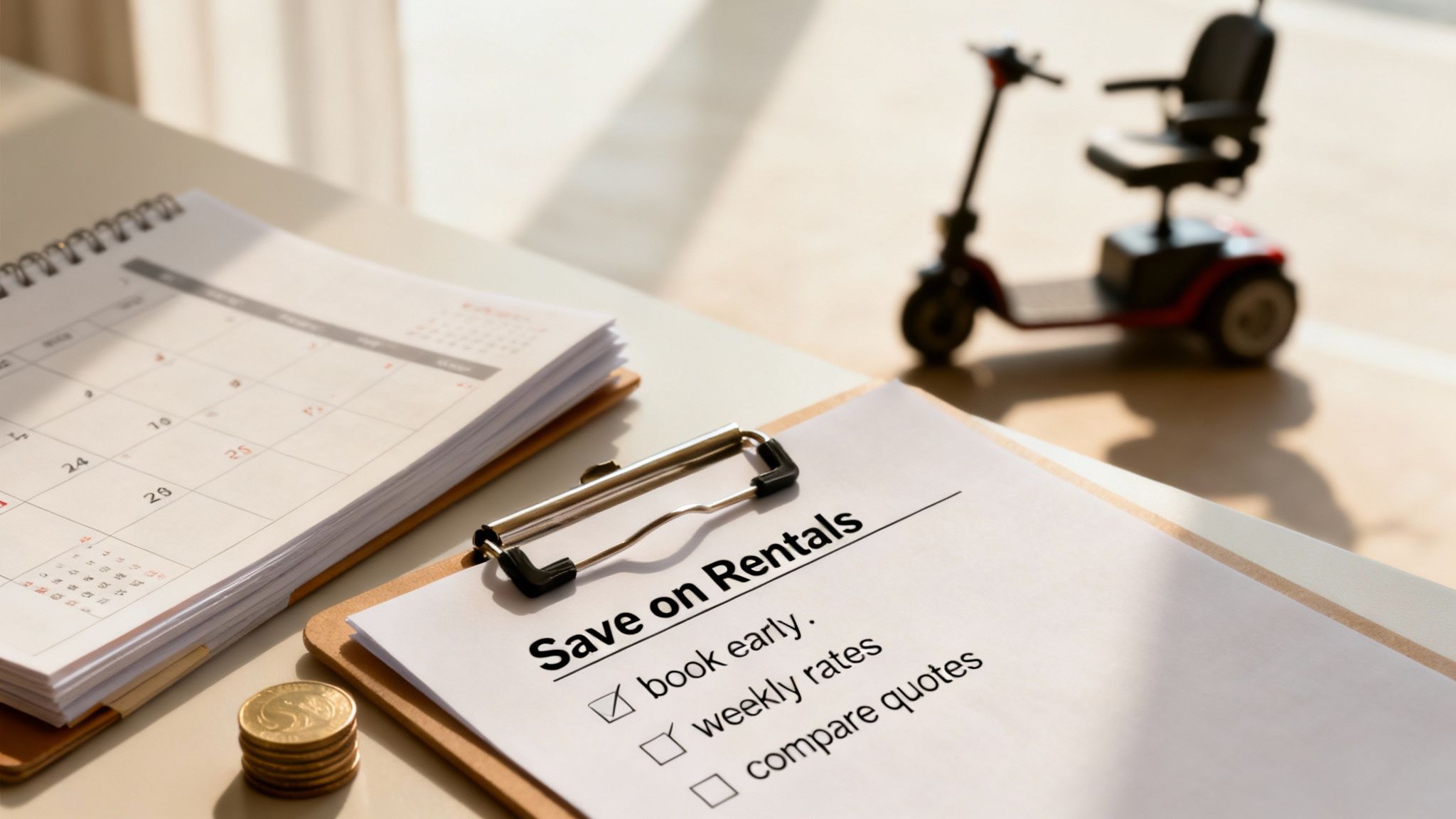
Knowing the rental price range is a great first step, but the real magic is figuring out how to get the best deal without a ton of effort. Getting an affordable rental isn't about stressful negotiations; it’s all about smart planning. With a few key moves, you can cut your costs significantly without giving up a quality scooter or the convenience you need.
It’s a lot like booking a flight. The person who plans ahead and shops around almost always pays less than the one buying a last-minute ticket at the airport. Those same rules apply here, and they can help you keep more money in your wallet.
Procrastination is the enemy of a good deal. Seriously, one of the easiest and most effective ways to save is to book your mobility scooter rental well in advance. This is especially true if you’ll need it during peak season—think major holidays, summer vacation months, or big events in popular destinations.
During those busy times, demand goes through the roof, and rental companies are dealing with a flood of requests. Booking early doesn’t just guarantee you’ll get a scooter; it often locks in a lower rate before prices creep up with demand. If you wait until the last minute, you could face surge pricing or find that every last scooter is already spoken for.
Securing your rental a few weeks or even months ahead is a simple yet powerful strategy. It gives you peace of mind and the best chance at a favorable price, ensuring you're not left scrambling and overpaying when you arrive at your destination.
As we've seen, rental companies reward longer commitments. While a daily rental is perfect for a single-day event, it’s always the most expensive on a per-day basis. If you think you'll need the scooter for more than a day or two, it’s worth looking at weekly or monthly packages.
The math is pretty straightforward. A weekly rental can often cost about the same as just four or five separate daily rentals. Go for a monthly package, and the discounts get even deeper, sometimes slashing the effective daily rate by more than 50%. Be realistic about your timeline—choosing a longer plan from the start is one of the simplest ways to lower your overall cost.
You should never, ever settle for the first price you see. Take a little time to shop around and get quotes from at least three different providers. Check with local DME stores, national rental chains, and specialized online companies to get a clear picture of the going rate in your area.
The scooter rental market is booming. The global bike and scooter rental market on futuremarketinsights.com is projected to hit around USD 7.1 billion in 2026 and is expected to soar to nearly USD 29 billion by 2035. More competition is great news for you, as it means you have more options and leverage.
When you're comparing those quotes, make sure you're looking at the total cost. A cheap daily rate can be misleading if it comes with hefty delivery fees or expensive mandatory insurance. Use this quick checklist to make sure you're comparing apples to apples:
When you have all this information laid out, you can confidently pick the provider that truly offers the best value for your money.
When you’re thinking about renting a mobility scooter, it's natural for a bunch of "what if" scenarios to start running through your head. Beyond the price tag, you’re probably wondering about the real-world stuff—like can I take this thing on a cruise? What happens if it breaks down? Do I need a special license?
Getting these questions answered upfront makes the whole process feel less like a gamble and more like a smart decision. We've been there, and we've heard it all. So, we’ve put together some of the most common questions we get to give you clear, straight-up answers and help you rent with total confidence.
Yes, you sure can, but a little bit of planning is your best friend here. Most rental scooters are built with travel in mind. The key is to give both the rental company and your airline or cruise line a heads-up well in advance.
Airlines have pretty specific rules about batteries. They’ll usually give the green light to sealed lead-acid (SLA) or certain lithium-ion batteries, but they need to know the details. Your rental provider can arm you with all the necessary paperwork—like battery specs and scooter dimensions—that the airline will ask for. A quick call ahead of time saves a massive headache at the check-in counter.
This is a big one, and a legitimate concern! Any reputable rental company will have a solid plan for this. They should give you a dedicated phone number to call for immediate help if you run into trouble. A lot of the time, it’s a simple fix that can be sorted out right over the phone.
If it’s something more serious, the company will typically get a replacement scooter out to you as fast as possible. Before you sign on the dotted line, always ask about their specific breakdown policy and make sure you understand their service area. You don’t want to be left stranded.
Key Insight: A good rental company doesn't just drop off a scooter and disappear. Their support during your rental, especially how they handle breakdowns, tells you a lot about their quality and how much they actually care about their customers.
Nope, not at all. You do not need a driver’s license to rent or operate a mobility scooter. These are legally classified as personal mobility aids, putting them in the same category as a wheelchair, not a car or motorcycle. That means they’re designed for sidewalks and other pedestrian areas.
When the scooter is delivered, the technician will walk you through exactly how to use it safely. They’re designed to be super user-friendly with intuitive controls, so even if you’ve never driven one before, you’ll get the hang of it in no time.
Of course! It’s incredibly common to rent a scooter for a parent, grandparent, or a friend who’s visiting. You can take care of the entire booking process yourself, from picking the right model to handling the payment and delivery details.
The two most important pieces of information you’ll need are the user's height and weight. This is non-negotiable, as it ensures you get a scooter with the right size and weight capacity for their safety and comfort. Just be sure the person who will actually be using the scooter is there for the delivery so they can get the hands-on operating tutorial from the technician.
At Electric Wheelchairs USA, we believe that clear information leads to confident decisions. If you have more questions or are ready to find the perfect mobility solution, our experts are here to help. Explore our wide selection of mobility scooters or schedule a free consultation today.
Find your ideal mobility scooter at https://www.electricwheelchairsusa.com.


Leave a comment