(800) 682-9444
Call Now


When you hear "folding mobility scooter," what comes to mind? A lot of people picture something that's compact, lightweight, and collapses down to about the size of a suitcase. And they're right—that's exactly what these scooters are designed for. They offer a real solution for staying active and independent without being weighed down by a bulky, traditional model.
Imagine strolling through a bustling farmer's market on a sunny afternoon or finally saying "yes" to that family vacation without a second thought about keeping up. A folding mobility scooter isn't just a piece of equipment; it's your ticket to that kind of freedom.
Making the decision to get a scooter can feel overwhelming, but it's really an empowering choice. Think of this guide as your personal consultation. We're here to pull back the curtain on these innovative devices and show you how they can fit into your life.

Our goal is simple: to help you understand how these scooters work and, more importantly, which features actually matter for your day-to-day. We want you to walk away feeling clear and confident about your options.
We've designed this guide to build your knowledge one step at a time. We'll start with the fundamentals and work our way up, so you can make a choice that truly aligns with your lifestyle.
Here’s a sneak peek at what we’ll cover:
Choosing the right device is a big step, especially for older adults and their families. If you're helping a loved one, our in-depth look at mobility scooters for seniors provides tips for aging parents and offers some extra perspective.
A folding mobility scooter is more than just a piece of equipment; it's a tool that reopens a world of possibilities, from simple daily outings to ambitious travel plans.
Ultimately, picking the right scooter is about matching the technology to your personal goals. We'll explore everything from automatic folding systems to airline-approved batteries, making sure you have all the info you need. By the end, you won't just be buying a scooter—you'll be investing in a machine that enhances your lifestyle and brings back true freedom and mobility.
So, what’s the big deal with folding mobility scooters compared to the traditional ones? Picture a sturdy, reliable scooter that can shrink down to the size of a carry-on suitcase in seconds. That’s the magic. It’s ready to be popped into a car trunk, a hall closet, or even taken on a plane. This incredible convenience comes from some really smart engineering that perfectly balances strength, portability, and ease of use.
Let's pull back the curtain and see how these things actually work, in simple, no-nonsense terms. We'll look at how lightweight frames, long-lasting batteries, and simple controls all come together to give you a dependable ride for your next adventure. Getting a handle on these basics will help you see just how easily one of these scooters can fit into your life.
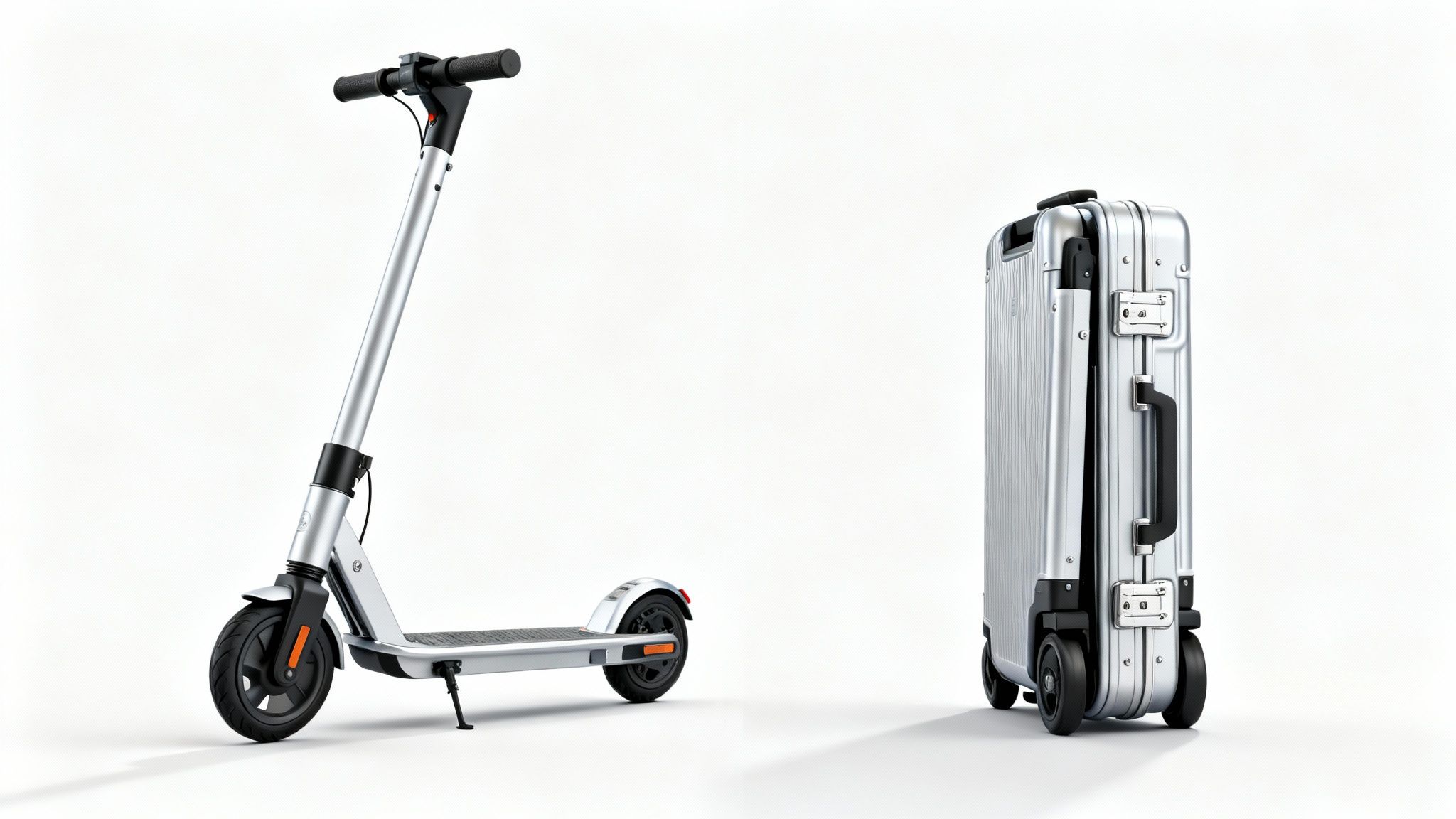
The real heart of a folding scooter is, you guessed it, its folding mechanism. It might seem like complex wizardry, but it really boils down to two main types: manual and automatic. Each one has its own perks, designed for different needs and physical abilities.
Choosing between them isn't about which one is "better," but about which one feels right for you. It’s a key step in finding the perfect travel partner.
Think of a manual folding scooter like one of those high-end, modern baby strollers. They’re designed to be super intuitive. You’ll usually find a simple lever or a single latch that lets the whole frame collapse in one smooth motion.
With a bit of practice, you can have most manual models folded or unfolded in under 10 seconds. They also tend to be lighter than automatic ones because there are no extra motors or electronics to weigh them down. If your main goal is getting the absolute lightest scooter possible for lifting, this is a fantastic option.
For the ultimate push-button convenience, automatic folding scooters are the way to go. They work a lot like a remote-controlled garage door. Just press a button on a key fob or the scooter's dashboard, and the machine does all the work, folding or unfolding itself completely in just a few seconds.
This feature is a total game-changer for anyone who has trouble bending over or doesn't have the upper body strength to handle a manual fold. They do weigh a few pounds more because of that folding motor, but the trade-off is an incredible ease of use that makes spontaneous trips easier than ever.
To help you visualize the difference, here's a quick side-by-side look.
| Feature | Manual Folding Scooters | Automatic Folding Scooters |
|---|---|---|
| Operation | Requires physical effort (levers, latches) | Folds/unfolds with a button press |
| Weight | Typically lighter | Slightly heavier due to motor |
| Best For | Users who can bend and lift easily | Users with limited strength or mobility |
| Power Source | No power needed to fold | Requires battery power to operate |
| Cost | Generally more affordable | Often a more premium option |
Ultimately, whether you choose the hands-on control of a manual scooter or the effortless convenience of an automatic one, you're getting a machine designed to make life easier.
Beyond the cool folding part, three main components work together to give you a safe, reliable, and comfortable ride: the frame, the battery, and the tiller. Each is specifically engineered to be both portable and high-performing.
The innovation here is what's really driven the explosive growth in the folding scooter market. It’s now valued at around $4 billion annually, and lightweight folding models make up a massive 60% of all sales. It’s clear people want solutions they can take anywhere, which is why our team at Electric Wheelchairs USA is so focused on helping you find the perfect match for your travels.
Here's a quick rundown of what makes them tick:
If you're curious about how this all fits into the bigger picture of electric transportation, you might find it interesting to see how the same core ideas apply to electric cars. You can delve deeper into vehicle technology to explore how similar principles of battery power and motor control are used on a much larger scale.
Trying to choose the right folding mobility scooter can feel like you're learning a new language. You'll see terms like "range," "capacity," and "turning radius" thrown around, and it's easy to get lost in the tech-speak. Let's cut through the noise. This section is your practical checklist, designed to translate those specs into real-world benefits that actually impact your freedom and daily life.
We're going to move beyond the jargon and look at what these numbers truly mean for you. Once you understand how each feature serves a purpose, you can confidently figure out what's essential for your lifestyle, whether you're planning a trip across the country or just down to the local grocery store.
There's no doubt these convenient machines are becoming more popular. The global market for folding mobility scooters, valued at around $2.8 billion in 2025, is expected to race past $5 billion by 2033. This boom is largely driven by a global aging population—experts predict one in six people will be over 60 by 2030, creating a huge need for mobility solutions that don't tie you down. You can discover more insights about this market trend at Market Report Analytics.
First things first: the weight capacity. This is the absolute maximum weight the scooter can safely handle, and that includes you plus anything you're carrying—groceries, a handbag, you name it. This isn't just a suggestion; it's a critical safety feature tied directly to the scooter's frame, motor, and brakes.
Always, always pick a scooter with a capacity that's comfortably above your own weight. A good rule of thumb is to find a model that can handle at least 25 to 50 pounds more than your body weight. This extra buffer ensures you aren't constantly pushing the scooter to its limit, which means a safer, more reliable ride and a much longer life for your machine.
Battery range is usually listed in miles, but what does that really mean for your day? Think of it as the scooter's fuel tank. A range of 8-10 miles is plenty for shorter outings, like getting around a large resort or running a few errands in your neighborhood.
But if you're dreaming bigger—like a full day exploring a museum, a theme park, or a new city—you'll want to look for a scooter with a range of 12-18 miles or more. That extra juice buys you peace of mind, so you're not left hunting for a power outlet halfway through your adventure.
Key Takeaway: Match the battery range to your ambitions. A smaller range is fine for local use, but a larger one is essential for all-day travel and spontaneous detours.
It's also worth remembering that things like your weight, the terrain you're on, and even the temperature can impact the actual range you get. Hills and heavier loads will drain the battery faster, so plan accordingly.
Most folding mobility scooters cruise at a top speed between 3.5 and 5 miles per hour. That might not sound like much, but it's roughly a comfortable walking or jogging pace. It's more than fast enough to keep up with friends and family while strolling through a park or browsing in a shopping center.
Think about where you'll be riding most often:
A scooter with variable speed control is a must-have. It lets you dial in the perfect pace for your surroundings, making the whole experience safer and more enjoyable.
While your scooter's job is to carry you, there will be times when you (or a companion) have to carry it. The scooter's own weight—often called its "unit weight"—is a huge deal when it comes to portability. This number determines how easily you can lift it into the trunk of a car, carry it up a few steps, or tuck it away for storage.
The lightest models usually weigh between 40 and 60 pounds. Some can even be broken down into smaller, more manageable pieces, with the weight of the "heaviest part" listed as a separate spec. If lifting is a potential issue for you, every single pound matters.
Finally, let's talk about what connects your scooter to the ground: the tires and drive system. These components are responsible for the quality and smoothness of your ride, affecting both stability and comfort on different surfaces.
You'll generally find two types of tires:
The drive system is also a key player. Most folding scooters use a front-wheel drive, which gives them great stability and makes them easy to maneuver in tight spots. To get a better feel for how different setups impact performance, take a look at our guide on front-wheel, mid-wheel, or rear-wheel drive systems. Each of these features adds up, and understanding them is the key to finding the perfect scooter for your unique needs.
Let’s be honest, for many people who get a folding mobility scooter, the real prize is the freedom to travel again without limits. A good folding scooter can turn a trip that once felt impossible into an exciting new adventure. Think of this section as your roadmap to taking your scooter on the road, especially when it comes to flying. We’ll break it all down so you can explore the world with confidence.
Taking a mobility device on a plane can seem like a huge hassle, but it doesn’t have to be. With a little bit of prep, the whole process is surprisingly smooth. Airlines are very used to helping passengers with mobility aids, and just knowing the rules ahead of time takes almost all the stress out of the equation.
The secret to a stress-free airport experience? A little communication. Most modern folding scooters are built for travel, with lightweight frames and, most importantly, airline-approved batteries. The Federal Aviation Administration (FAA) has specific rules for the lithium-ion batteries found in today's best scooters, and manufacturers design them to comply.
You can typically ride your scooter right through the airport, from check-in all the way to your gate. This is a game-changer, letting you save your energy for the fun part of your trip. Once it’s time to board, you’ll just "gate-check" your scooter. An airline employee will take it from you at the jet bridge, store it safely in the cargo hold, and have it waiting for you in the same spot when you land.
This flowchart breaks down the core things to think about—weight capacity, range, and the scooter's own weight—which are crucial for picking a scooter that’s ready for any journey.
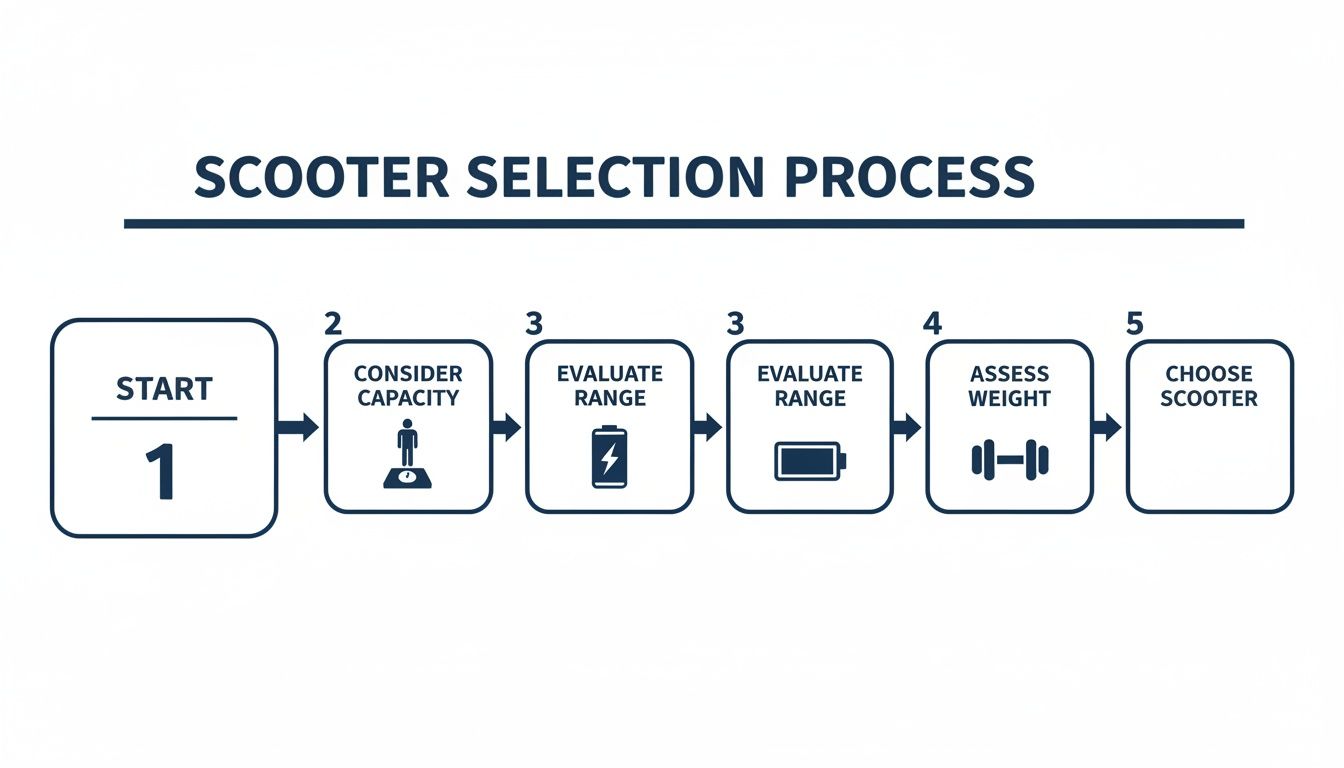
Seeing it laid out like this helps you understand how balancing these three factors ensures your scooter meets both your daily needs and your travel dreams.
A little planning makes a world of difference. Follow this checklist before any trip, and you’ll feel organized, prepared, and ready to go without any of that last-minute travel anxiety.
Tell Your Airline Early: When you book your flight, let the airline know you’re bringing a mobility scooter. They’ll add a note to your reservation and can answer any specific questions about their process. This one simple call prevents any surprises on travel day.
Have Your Battery Info Ready: Keep the spec sheet for your scooter's battery handy. You can have a paper copy or just a screenshot on your phone. This document proves it meets FAA rules (usually under 300 watt-hours). Showing this to the airline staff can really speed things up.
Arrive Fully Charged: Make sure your scooter’s battery is fully charged before you head to the airport. You’ll have plenty of juice to get through the terminals without worry. Just be aware that some airlines might ask you to disconnect the battery before they take it, so it's a good idea to know how to do that.
Label Your Scooter Clearly: Slap a tag on your scooter with your name, phone number, and address. It’s rare for things to get mixed up, but this makes sure your scooter is easy to identify and gets back to you safely.
For a deeper dive, our guide offers 10 handy tips when flying with a mobility scooter that cover every little detail from booking to boarding.
The incredible convenience of a folding scooter doesn’t stop at the airport. Their compact design makes them the perfect sidekick for all kinds of trips, opening up a world of possibilities both near and far.
Think of your folding mobility scooter as more than just a device—it’s your passport. It gives you the power to say "yes" to new experiences, knowing you have the reliable support to explore every corner of your destination with comfort and independence.
The "best" folding scooter isn't about having the most features—it's about having the right features for you. It’s easy to get lost in a sea of technical specs, but the real magic happens when you connect those numbers to your actual, everyday life. Sometimes, the best way to figure out what you need is to see a bit of yourself in someone else's story.
Let’s meet a few people. By looking at their lifestyles, you can start to see which priorities—like being super portable, comfortable for all-day use, or tough enough for the outdoors—really matter to you. This little exercise can turn a confusing list of options into a clear, confident choice that fits your life perfectly.
First up, imagine someone whose passport is always ready and whose bucket list is a mile long. "The Avid Traveler" needs a mobility partner that’s just as eager to explore as they are. When you’re navigating a busy airport or a sprawling cruise ship, every single ounce and inch matters. Their number one priority is a scooter that makes travel feel effortless, not like a chore.
This person isn’t just looking for convenience; they need pure efficiency. Their perfect scooter has to be incredibly lightweight, often tipping the scales at under 50 pounds, and fold down into a compact, suitcase-like shape in just a few seconds. An automatic folding feature is a game-changer here, letting them collapse the scooter in a flash at a crowded train station or airport gate.
Key priorities for The Avid Traveler include:
For this person, giving up a bit of battery range is a smart trade-off for getting maximum portability. Their scooter is a tool for seeing the world, not necessarily for running errands all day back home.
Now, let’s picture "The Daily Cruiser." This person relies on their scooter for their day-to-day independence. Their week is a whirlwind of errands, popping over to visit family, and heading out to local events. For them, it’s all about reliability, comfort, and a battery that just won't quit.
The Daily Cruiser needs a scooter that feels more like a trusted sidekick, one that’s ready for a full day of action without constantly needing to be plugged in. A plush, supportive seat is a must, since they might be riding for hours at a time. They aren’t folding it up and down all day, but they need it to be ready to go whenever they are.
For the Daily Cruiser, the scooter isn't a travel gadget. It's an essential part of their daily routine, giving them consistent, dependable freedom right in their own community.
They’re focused on features that make a busy, local life easier:
Finally, let’s meet "The Weekend Adventurer." This person lives for their days off. You can find them navigating a local park, browsing a craft fair, or cheering from the sidelines at a grandchild’s soccer game. They need a scooter that can handle more than just the smooth, polished floors of a mall.
While they still want a scooter that folds down to pop in the car, their main focus is on a sturdier build and a more rugged design. They’re looking for a little more oomph and a smoother ride on surfaces that aren't perfectly paved—think grass, gravel paths, or those cracked sidewalks you find everywhere.
Key features for The Weekend Adventurer are:
By figuring out which of these profiles—The Traveler, The Cruiser, or The Adventurer—sounds the most like you, you can immediately start focusing on the folding mobility scooters for adults that are actually built to improve your life.
To make it even clearer, let's break it down in a table.
This table will help you quickly match your own needs to the right type of scooter, cutting through the noise and getting straight to what matters for your lifestyle.
| User Profile | Primary Needs | Key Features to Prioritize |
|---|---|---|
| The Avid Traveler | Ultimate portability for air, sea, and train travel; quick and easy folding for seamless transitions. | Airline-approved battery, ultra-lightweight frame (under 50 lbs), compact folded size, automatic folding. |
| The Daily Cruiser | All-day comfort, reliability, and long range for errands, social visits, and local community life. | Extended battery range (12+ miles), plush padded seat with armrests, onboard storage (basket). |
| The Weekend Adventurer | Durability and stability for outdoor use on varied terrains like parks, grass, and gravel paths. | Sturdier tires (pneumatic or large solid), robust motor, good ground clearance, durable frame. |
Seeing it laid out like this makes it much easier to pinpoint what you should be looking for. Whether you’re a globe-trotter, a town-cruiser, or an outdoor explorer, there’s a folding scooter designed just for you.
Your new folding scooter has arrived, and the adventure is just beginning! But getting it out of the box is only step one. Think of your scooter as a trusted partner in your independence—the better you treat it, the more reliable it will be for years to come.
A little bit of simple care, combined with safe riding habits, goes a long way. It protects your investment and makes sure your scooter is always ready to roll, whether you’re just popping down to the shops or jetting off on a dream vacation.
You definitely don't need to be a mechanic to keep your scooter running like new. Just a few routine checks can head off most common problems and seriously extend the life of your machine. It’s no different than the basic upkeep you'd do for a car.
A few minutes of attention here and there will ensure a smooth, dependable ride every time. Here’s where to focus:
Knowing how to operate your scooter safely is just as important as keeping it maintained. Simply being aware of your surroundings and understanding how to handle different situations is key for your safety and for everyone around you.
When you're out and about, keep an eye on your speed, particularly in crowded places like malls or busy sidewalks. Always approach ramps, hills, and curbs slowly and straight-on to stay stable. And when you get to a busy intersection, try to make eye contact with drivers to be sure they’ve seen you before you cross.
Your scooter gives you incredible freedom, but with that comes the responsibility to be a safe and courteous operator. A defensive and aware mindset is your best tool for avoiding accidents.
Finally, where you buy your scooter really does matter. When you purchase from an authorized dealer like Electric Wheelchairs USA, you get a crucial safety net. It's your guarantee that you’re getting a genuine product backed by a full manufacturer’s warranty.
That warranty is your protection against any defects in materials or workmanship. It often covers parts and sometimes even includes in-home service for the first year. Even better, it connects you with a team of experts who can answer your questions, help you troubleshoot problems, and guide you through anything that comes up. That kind of peace of mind is priceless, giving you reliable support for the entire life of your scooter.
When you’re close to making a decision, a few final questions always pop up. It’s completely normal. To help you get those last bits of clarity and feel 100% confident in your choice, we’ve put together answers to the questions we hear most often.
This is a tricky one, and the honest answer is: it depends. While Medicare Part B does cover some scooters under its "durable medical equipment" (DME) rules, they have very strict requirements. You typically have to prove the scooter is a medical necessity for use inside your home.
Since most folding models are built for travel and getting out and about, they’re often seen as lifestyle products and usually don't qualify under those strict rules. Your best bet is always to check directly with your private insurance provider to see what their specific policies are. Since coverage isn't a guarantee, we offer flexible financing options to make sure you can get the scooter you need without the financial stress.
This really comes down to the scooter’s design and what you’re comfortable lifting. Most lightweight folding mobility scooters for adults weigh somewhere between 40 to 60 pounds. The good news is, many are designed to be broken down into a few lighter pieces, making them much easier to handle one part at a time.
A great tip when you’re shopping is to look for two numbers: the "total weight" and the weight of the "heaviest part." This gives you a much more realistic idea of what you’ll actually be lifting into your car.
If lifting is a major concern for you, don't worry—you have options! An automatic folding scooter can be a game-changer, or you might look into a vehicle lift. Our team here at Electric Wheelchairs USA is fantastic at helping people find a model that fits their strength and lifestyle perfectly.
Most folding scooters have sensitive electronics that just don’t mix well with a downpour. Think of it like your laptop—a little sprinkle won't hurt, but you wouldn’t leave it out in a storm. A light drizzle is generally fine, but you should definitely avoid riding through puddles or heavy rain to keep the dashboard, tiller, and battery safe from water damage.
If you get caught in an unexpected shower, the best thing to do is wipe the scooter down with a dry cloth as soon as you get inside. For a little extra peace of mind, you can also grab accessories like weatherproof covers that protect the controls.
Ready to find the perfect scooter that fits your life and answers all your questions? The experts at Electric Wheelchairs USA are here to provide a free, no-pressure consultation to guide you through every step.
Explore our curated collection of folding mobility scooters at https://www.electricwheelchairsusa.com.


Leave a comment