(800) 682-9444
Call Now


End of the Year Holiday Deals!
No, you do not have to be officially "disabled" to use a mobility scooter. That’s a common misconception. The real question isn’t about a specific diagnosis or label, but about functional need.
If you have a mobility challenge that makes walking long distances difficult, painful, or even unsafe, a scooter can be a fantastic tool to reclaim your independence.
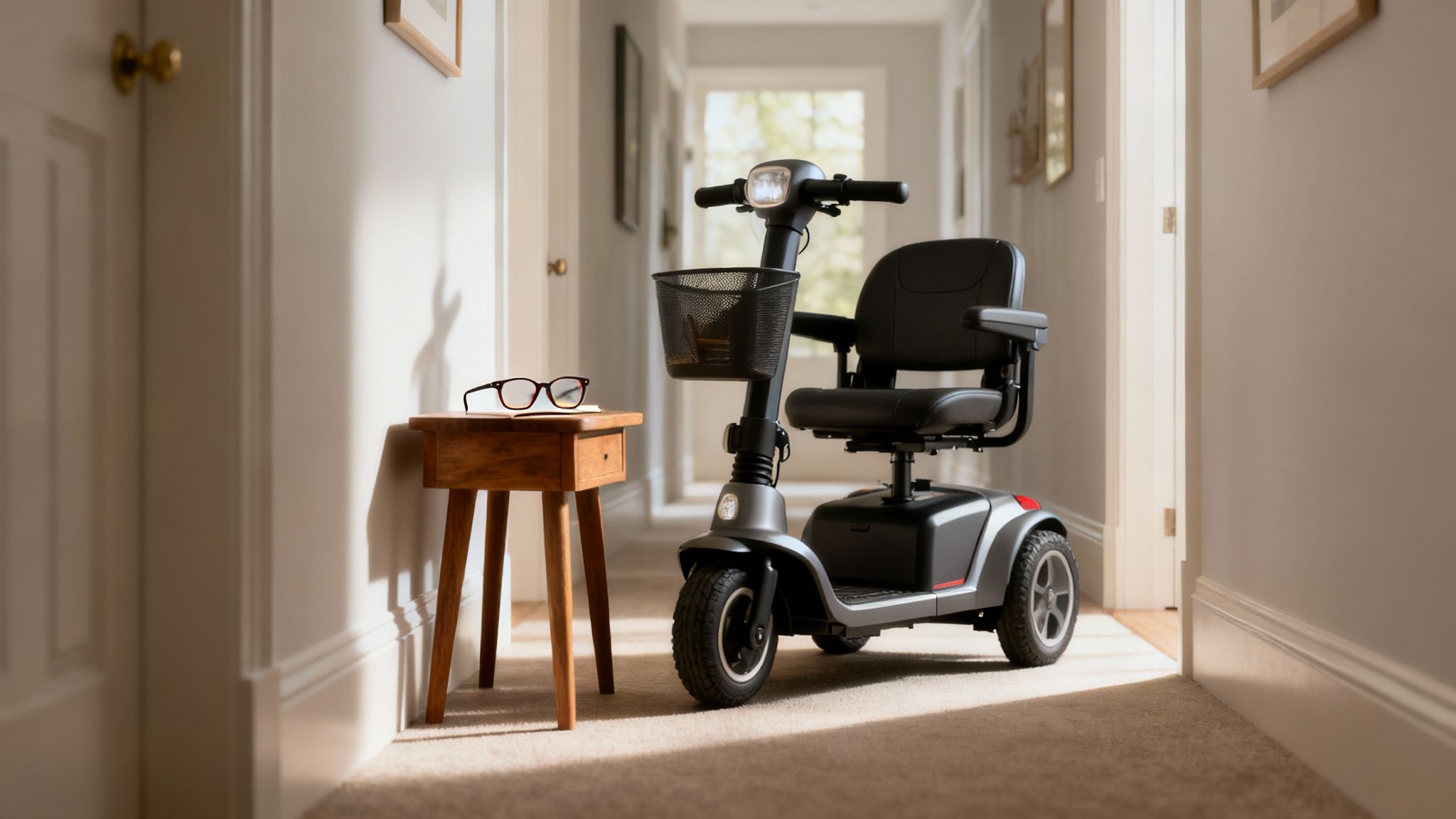
So, who gets to use a mobility scooter? This question creates a lot of confusion. Many people think these devices are strictly for individuals with a formal disability status, but the reality is much more about practical, real-world needs.
It’s a bit like reading glasses. Some folks need a strong, custom prescription from an eye doctor for a diagnosed vision problem. Others just grab a pair of "cheaters" from the drugstore to make reading small print a little easier. Both uses are completely valid because they solve a functional problem.
Mobility scooters work on a similar principle. They bridge the gap between being fully mobile and needing more significant assistance.
To make this clearer, let's break down the two main reasons someone might choose a scooter.
| Aspect | Medical Necessity | Personal Convenience |
|---|---|---|
| Primary Reason | A diagnosed condition or injury makes walking difficult or unsafe. | To conserve energy or navigate large venues like theme parks or festivals with ease. |
| Common Scenarios | Arthritis, COPD, recovering from surgery, chronic pain, balance issues. | Attending a large outdoor event, navigating a sprawling mall, vacationing. |
| Requirements | A prescription is often required for insurance coverage (Medicare, VA, etc.). | No prescription needed; the scooter is purchased or rented out-of-pocket. |
| Goal | To maintain independence for essential daily activities like grocery shopping. | To enhance an experience that would otherwise be physically taxing. |
As you can see, the reasons for using a scooter can vary quite a bit. One path is driven by a medical professional's recommendation, while the other is a personal choice to make life easier and more enjoyable.
Your need for a scooter might not fit neatly into a "disabled" category, but that doesn’t make it any less real. Many situations can seriously affect your ability to get around:
The bottom line is this: if a scooter helps you do things that would otherwise be too difficult or impossible, it's the right tool for the job.
While most of the conversation revolves around medical needs, there's growing recognition for the casual use and rental of motorized scooters for public events, showing that the discussion is expanding. And if you're trying to figure out which device is right for you, our guide on electric wheelchairs vs. mobility scooters is a great place to start.
Let's be honest, the word "disabled" often paints a very rigid, all-or-nothing picture in our minds. But when it comes to needing a mobility scooter, the reality is much more of a gray area. It’s less about a specific label and more about a practical idea: functional limitation.
A functional limitation is just a simpler way of saying you have trouble doing an activity that most people can do without thinking twice. Maybe you navigate your own home just fine, but the idea of walking through a huge grocery store or a sprawling museum is completely exhausting. That’s a perfect example.
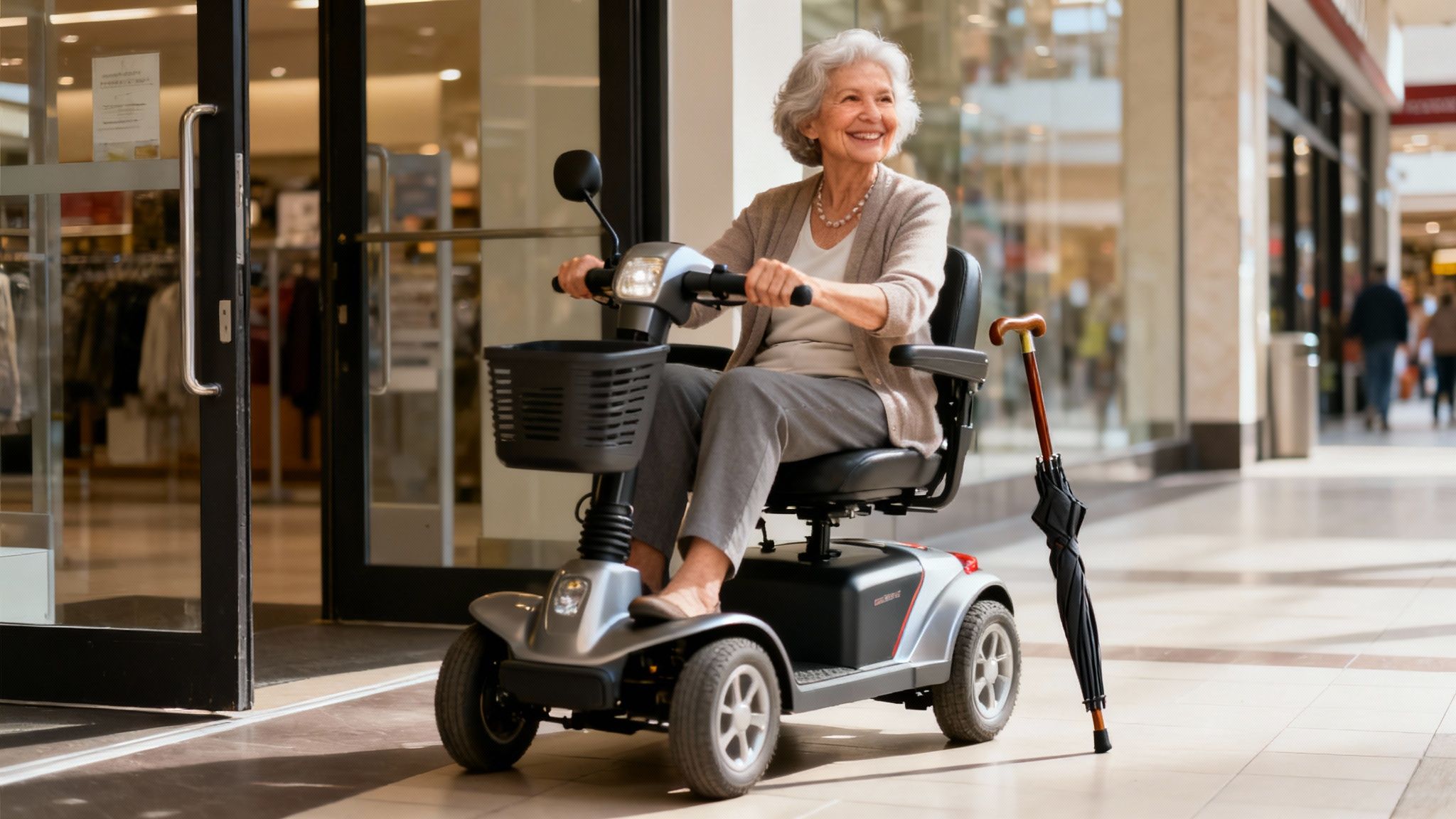
Think of a grandmother with chronic arthritis. She’s fiercely independent at home, but the pain means she has to turn down trips to the mall with her family. In this case, a scooter isn't for a "disability"—it's a tool that lets her be part of the fun again. Or what about someone recovering from knee surgery? They need a temporary boost to stay mobile and independent while they heal.
The conversation is shifting. We're moving away from asking, "Are you disabled enough?" and toward a more helpful question: "How does a mobility challenge—temporary or permanent—actually affect your day-to-day life?" It's not the diagnosis that matters; it's the activities it keeps you from enjoying.
This isn’t just a new way of thinking; it reflects who is actually using these devices. Mobility scooter users in the U.S. are an incredibly diverse group. Of course, this includes people with permanent disabilities, but it also covers a huge range of individuals managing everything from post-surgery recovery to chronic pain and age-related fatigue.
At its core, a scooter is about one thing: restoring freedom. If a physical challenge is keeping you from connecting with your community, shopping for yourself, or simply enjoying a day out, then a real need exists—no official label required.
This mindset helps people look at their own situation more clearly, without feeling like they have to fit into a specific box. It's about solving a problem, plain and simple. If you're weighing your options, learning how to choose a mobility scooter for a temporary disability can offer some great, targeted advice for your unique circumstances.
While you don't need a formal disability diagnosis to buy and use a scooter in public, the rules flip entirely when you want someone else to foot the bill. For insurers like Medicare, the VA, or private companies, everything hinges on one key phrase: medical necessity.
This isn't about general convenience or making trips to the mall a little easier. It’s a specific, high-level standard that proves you have a documented inability to safely handle essential tasks inside your own home. Insurers need solid proof that the scooter is required for your fundamental daily life, not just for getting out and about.
To get this proof, the first step is a face-to-face evaluation with your doctor. They will assess your ability to manage Activities of Daily Living (ADLs)—core tasks like getting to the bathroom, preparing a meal, or simply moving from one room to another.
If that evaluation shows you can't safely manage these ADLs without help, your doctor will then write a formal prescription. This document is often called a Certificate of Medical Necessity (CMN), and it's the official evidence that your need for a scooter is a medical requirement, not a preference.
Think of this paperwork as the absolute cornerstone of your insurance claim. Without it, getting coverage is nearly impossible.
A doctor’s prescription for a mobility scooter is like a key. You don't need it to own the scooter, but you absolutely need it to unlock financial assistance from medical and insurance systems.
Getting this approval can be a tricky process. To really understand how these systems decide who qualifies, it's helpful to know about concepts like what is prior authorization in healthcare, as this hurdle often determines whether you get coverage.
Ultimately, the system is designed to separate personal choice from a professionally verified need. While anyone can buy a scooter to regain their freedom, only those with a documented medical necessity can typically get it covered. If you're exploring this path, our detailed guide on whether insurance will pay for a mobility scooter breaks down these requirements even further.
So you've got your mobility scooter. Now what? Can you actually take it into the grocery store, a restaurant, or even a museum? It's a common question, and the answer is almost always a resounding yes, thanks to some powerful legal protections on your side.
In the United States, your biggest ally is the Americans with Disabilities Act (ADA). Think of the ADA as your golden ticket. This federal law mandates that public places—stores, hotels, theaters, you name it—must be accessible to people with disabilities. And here's the crucial part: the ADA's definition of mobility devices includes both wheelchairs and scooters.
This means if you're using a scooter because of a mobility impairment, you have every right to enter these establishments. A business owner can't legally ask for "proof" of your disability or turn you away just because you're on a scooter.
While the ADA is your foundation, there are a few practical things to keep in mind. The law does allow a business to ask you to remove your scooter, but only if it poses a genuine safety threat or is too large to be accommodated. Honestly, for standard mobility scooters, this is incredibly rare.
It's also a good idea to be aware of any local city rules. Some towns might have specific guidelines for using scooters on sidewalks, mainly to keep things safe for pedestrians.
At its heart, the ADA is all about equal access. Your mobility scooter is seen as an extension of you, and public spaces have to treat it that way. It’s what ensures you can get out and be part of the community just like everyone else.
Things can get a little different if you travel internationally. The UK, for instance, has its own system:
Knowing these little details helps you stay safe and on the right side of the law, whether you're at home or exploring abroad. To get a really thorough understanding of these rules, you can learn more about the law and mobility scooters and ride with complete confidence.
Just because you’re facing a mobility challenge, that doesn't automatically mean a scooter is the answer. The best device is the one that truly fits your life, not just a medical checklist. It’s about finding the right tool for the job, and a mobility scooter is just one of several fantastic options out there.
Think about your day-to-day reality. How’s your upper body strength? Are you constantly on the go, traveling in a car? Where will you be using it most—navigating tight corners at home or cruising down long paths at the park? Each mobility aid has its own personality, with real strengths and weaknesses that matter.
It’s easy to get fixated on a scooter, but it's smart to line it up against the other players. A power wheelchair, for instance, is the king of indoor navigation. Its tight turning radius can effortlessly handle narrow hallways and sharp corners where a scooter might struggle. Scooters, on the other hand, with their tiller steering and longer frames, really shine outdoors, covering longer distances with ease.
Then you have manual wheelchairs and walkers. These definitely require more oomph from your upper body, but what you get in return is unmatched portability and simplicity. The goal is to find that perfect match between the device's capabilities and your own.
This diagram helps visualize the legal protections in place for people using different mobility devices.
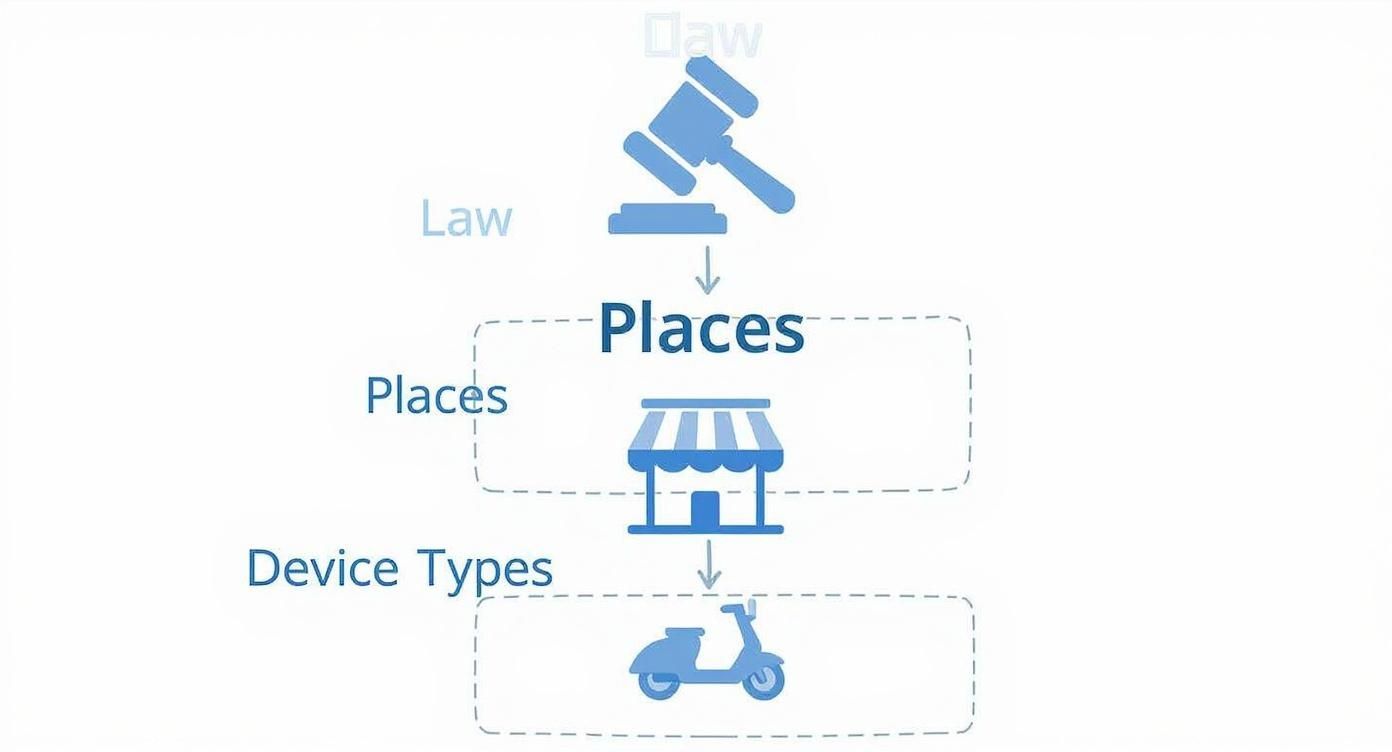
As you can see, federal laws like the ADA form the bedrock of your rights, ensuring access in public spaces for approved devices like your scooter.
To help you sort through it all, let’s compare these aids side-by-side.
Choosing a mobility aid isn't just about getting from point A to point B. It’s about selecting the right tool that enhances your independence and integrates seamlessly into your life, whether you're at home or exploring the community.
Thinking through the pros and cons of each option is the best way to land on the right device. This table breaks down the key differences to help you see which one aligns with your needs.
| Feature | Mobility Scooter | Power Wheelchair | Manual Wheelchair | Walker/Rollator |
|---|---|---|---|---|
| Ideal Use | Outdoors, long distances, shopping | All-day use, indoors and out | Part-time use, travel, portability | Short distances, balance support |
| Maneuverability | Good, but wider turning radius | Excellent, tight turning radius | Excellent, very nimble | Good, for walking support |
| Portability | Varies; some models disassemble | Can be heavy and difficult to transport | Excellent; often lightweight and foldable | Excellent; lightweight and foldable |
| Upper Body Strength | Minimal; requires arm strength for steering | Minimal; joystick controlled | Significant strength required | Moderate; for pushing and stability |
| Support Level | Good for torso stability | High; offers full-body support | Varies; user-dependent | Provides walking stability and balance |
Ultimately, the best choice depends entirely on your personal situation. A mobility scooter is fantastic for someone with good torso stability who wants to cover ground outdoors. But if you need round-the-clock support and superior indoor maneuverability, a power wheelchair might be a better fit. It’s all about finding the tool that gives you back your freedom in the ways that matter most to you.
Choosing a mobility scooter isn't just a personal decision anymore; it's part of a massive worldwide shift in how we look at getting older, staying independent, and living a full life. The whole question of "do you have to be disabled to use a mobility scooter" is starting to feel a little dated as people everywhere are choosing personal freedom over old-fashioned labels. A lot of this change is happening because of aging populations in places like Japan, Germany, and the UK.
In those countries, and plenty of others, there's a huge push for what's called "aging-in-place." The idea is simple: help seniors live comfortably and independently in their own homes for as long as possible. Mobility scooters are a huge piece of that puzzle. They're seen less like medical devices and more like everyday tools that keep people connected to their friends, families, and communities.
You can see this shift in the numbers, too. The global mobility scooter market is booming, and it's expected to hit USD 5.2 billion by 2026. This growth is all about an older population that wants—and expects—to stay mobile on their own terms, especially in countries that really value elder care. You can dig deeper into the numbers in this global mobility scooter market report.
This international trend is fantastic because it helps get rid of any awkward feelings or stigma. When you see scooters being used all over the world, it reframes the whole idea. It’s not about giving up; it’s about making a smart, proactive choice to hold onto your freedom.
Hopping on a scooter is a statement of capability, not inability. It says, "I'm choosing to stay active, engaged, and independent on my own terms," and you're joining a huge, global community of people doing the same thing.
Seeing this happen on a global scale really drives the point home: needing a little help to get around is a normal part of life for millions of people. It makes using a scooter feel completely normal for anyone and everyone who can benefit from one.
Thinking about a mobility scooter brings up a lot of practical, day-to-day questions. It's totally normal. Let's tackle some of the most common things people wonder about before they take their first ride.
You absolutely can. Here in the US, the Americans with Disabilities Act (ADA) ensures you have the right to use your mobility device in public places, from shopping malls to the local grocery store. If your scooter is helping you manage a mobility impairment, you must be allowed access.
Nope, you don't need a driver's license for a standard mobility scooter you'd use on sidewalks or indoors. Some other countries, like the UK, have specific rules for "Class 3" road-legal scooters that require registration, but for typical use, a license isn't part of the picture.
The most important thing to remember is that mobility needs are often invisible. Your reason for using a scooter is valid, and the growing acceptance of these devices means most people are understanding and respectful. Focus on the freedom it gives you.
This is a real and understandable worry for a lot of people. The truth is, so many conditions that limit mobility aren't things you can see just by looking at someone. The good news is that the culture around scooters is shifting—they're seen less as just a medical device and more as a powerful tool for independence. Most people won't give it a second thought.
For the most part, no. Most modern buses and trains are built with accessibility in mind, usually featuring ramps and dedicated spots for mobility devices. That said, it's always a smart move to give your local transit authority a quick call or check their website. They can give you the specifics on their size and weight limits before you head out.
At Electric Wheelchairs USA, we believe in empowering you with the right information and the best mobility solutions for your needs. Explore our collection of mobility scooters today.


Leave a comment