(800) 682-9444
Call Now


Thinking about taking a train trip with your electric wheelchair? You might be wondering if it's even possible. The short answer is a resounding yes! In fact, rail travel is one of the most accessible ways to get around, and your right to do so is legally protected in many places.
A little bit of prep work goes a long way, though.

Think of it like getting ready for a flight—a little planning beforehand makes all the difference and helps you avoid any surprises at the station. While you absolutely can bring your electric wheelchair on board, a smooth journey depends on the specific rules of the train company, the size of your chair, and the type of train car you'll be in.
This guide will walk you through everything you need to know, step by step, so you can trade travel anxiety for pure confidence. We'll cover all the essentials to make sure you're ready for your adventure.
To make sure your trip is hassle-free, you'll want to get the details on a few key areas. Every train operator has its own rules, but they all boil down to the same basic safety and accessibility requirements.
Here’s what we'll dive into:
To make things even easier, here's a quick checklist you can use before you book your next trip.
| Checklist Item | Key Consideration | Why It's Important |
|---|---|---|
| Measure Your Wheelchair | Check the width, length, height, and weight of your chair. | Ensures your wheelchair will fit on the train's ramp, lift, and in the designated accessible space. |
| Check Battery Type | Identify if your battery is non-spillable (sealed) or lithium-ion. | Most trains require non-spillable batteries. Lithium batteries often have specific rules you must follow. |
| Contact the Train Operator | Call at least 48 hours in advance to book assistance. | This guarantees staff will be ready with a ramp and will reserve an accessible seat for you. |
| Review Operator Policies | Look up the specific accessibility guide for the train line you're using. | Every company has slightly different rules for size, weight, and securing your chair during travel. |
| Prepare Documentation | Have your wheelchair manual or battery specifications handy. | In rare cases, staff might need to verify your battery type is safe for travel. |
This checklist covers the big-ticket items that will make your journey smooth from start to finish.
The great news is that train accessibility is a priority all over the world. While the specific rules change from country to country, electric wheelchairs are widely welcomed on trains.
Major travel hubs in the U.S., Europe, and Japan have laws requiring trains to be accessible. For example, the Americans with Disabilities Act (ADA) in the U.S. ensures that trains have ramps, lifts, and dedicated spaces for wheelchair users. You can find out more about how different countries are working toward barrier-free tourism and transit.
Getting ready for your train journey is all about empowerment. When you know the rules and plan ahead, you're in control of your travel experience. It’s not just about making the trip possible—it's about making it enjoyable and completely stress-free.
This guide will break everything down into simple, actionable steps. From measuring your chair to reading battery labels and making that all-important call to the train company, we've got your back. Your next adventure is just a train ride away
Think of traveling by train with your electric wheelchair like driving into a new parking garage. The first thing you do is look for that clearance sign, right? You need to know if your vehicle will fit. It's the exact same idea with trains—you have to make sure your wheelchair's dimensions and weight are compatible with their equipment.
Every train operator has its own specific limits, and they're not just pulling numbers out of a hat. These rules are all about safety and making sure the boarding process is smooth for everyone. They're dictated by the design of their boarding ramps, platform lifts, and the dedicated wheelchair spaces inside the train cars. A chair that’s too wide might not squeeze through the doorway, and one that’s too heavy could push a mechanical lift past its safety limit. Getting to know your wheelchair's specs is always step one.
Before you even think about booking a ticket, it’s time for a quick check-up on your chair’s vital stats. Grab a tape measure and find your user manual if you have it. You'll need three key measurements plus the total weight.
Having these numbers handy is a must. For example, Amtrak generally accommodates wheelchairs up to 30 inches wide and 48 inches long. The combined weight of the user and the chair can be up to 600 pounds. While this is a pretty common standard, you’ll find that it can vary, especially with older trains or smaller regional rail lines.
Getting this sorted out ahead of time makes all the difference. In the U.S., about 12.1% of adults live with serious mobility challenges, making public transit like trains an absolute lifeline. You can dig deeper into the data by checking out the full travel patterns with disabilities research.
Finding out your wheelchair is a bit bigger or heavier than the standard limits can feel like hitting a wall, but it’s usually not a dead end. It just means you need to do a little extra planning.
The most important thing is to never assume you can't be accommodated. Your first move should be to call the rail operator’s dedicated accessibility department—not the general customer service number. These are the folks who know the ins and outs of every train and station in their system. They are your best resource for finding a solution.
Here are a few things they might be able to do for you:
The bottom line is this: call early and have your details ready. When you get them on the phone, give them your wheelchair’s exact width, length, and weight. This helps their accessibility team give you the right answers and find the best way to get you on your way.
Ultimately, knowing these size and weight rules puts you in the driver's seat. It lets you plan with confidence and turns a potential headache into just another item on your travel checklist.
Once you've confirmed your wheelchair’s size and weight are good to go, the next big hurdle is the battery. Honestly, this is where most people get tripped up when planning a train journey, but it doesn’t have to be a headache. Just think of your battery as your wheelchair's passport; the train staff just need to quickly verify it's safe for travel.
All the rules are in place for everyone’s safety, and they really boil down to one main concern: could the battery spill or leak? That’s why you'll see different policies for different battery types. Knowing what kind of battery powers your chair is the single most important key to a smooth, stress-free trip.
Most electric wheelchairs run on one of two battery types, and the rules for each are pretty different. Figuring out which one you have is usually simple and it's the first step to making sure you're compliant.
Knowing your battery type is crucial. You can almost always find this information printed right on the battery's label, in your wheelchair's user manual, or on the manufacturer's website. For more tips on keeping your power source in top shape, check out our guide to the best practices for your mobility scooter or power chair batteries.
This decision tree gives you a simple visual on how to approach your train journey prep, starting with the most important step: checking your wheelchair's size.
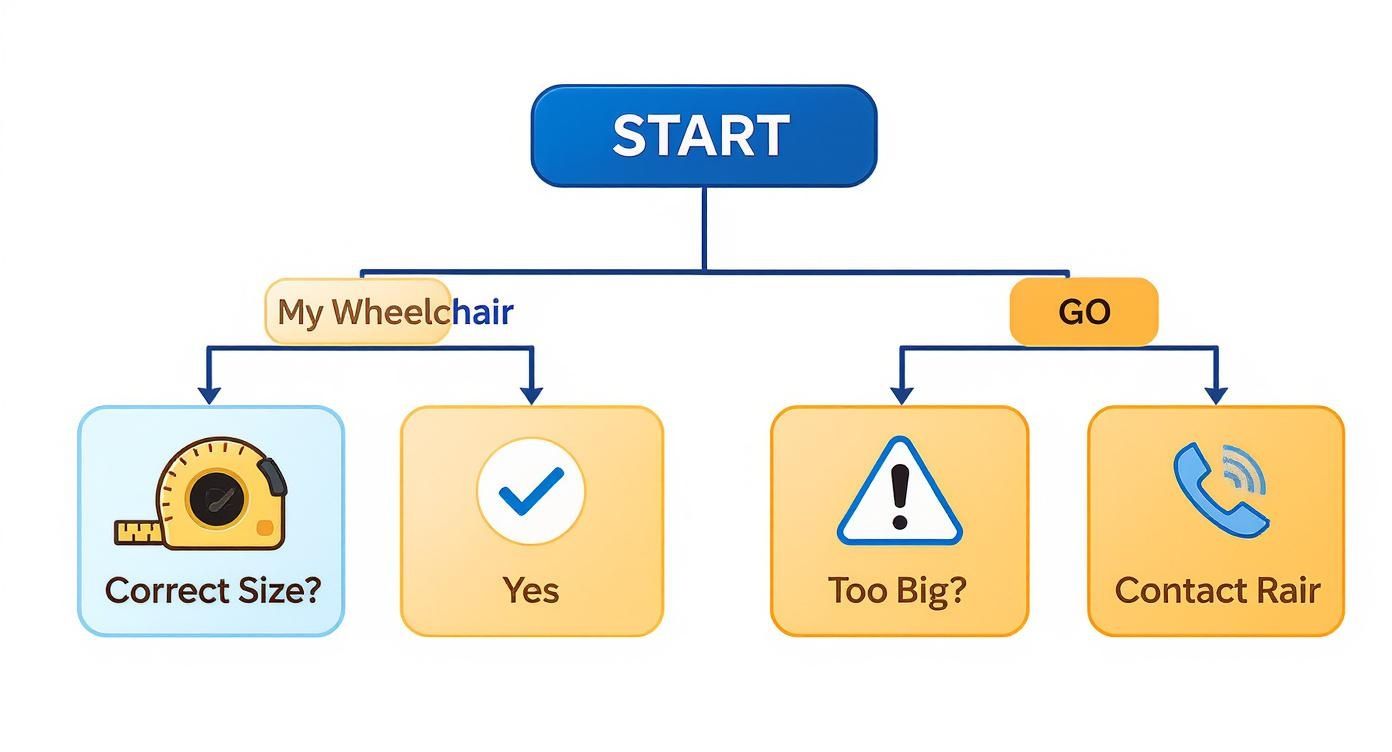
As the flowchart shows, the first move is always to measure your wheelchair and compare it against the rail company’s rules, since that's a non-negotiable for getting on board.
Let's break down the battery policies you're likely to encounter.
| Battery Type | Common Train Policy | Action Required |
|---|---|---|
| Sealed Lead-Acid (SLA/Gel/AGM) | Generally accepted with no issues. Considered non-spillable and safe for travel. | Ensure the battery case isn't cracked. No special documentation is usually needed. |
| Lithium-ion (Li-ion) | Accepted, but with restrictions. Often limited to 300 Wh or less per battery. | Know your battery's Wh rating. Carry documentation (spec sheet) just in case. |
This table sums it up nicely: sealed batteries are a breeze, while lithium-ion batteries just require a little more prep work to ensure you meet the safety guidelines.
Once you know your battery type, a few simple preparations will make sure you’re ready for any inspection by the train staff. Think of it as getting your travel documents in order before you head to the station.
With sealed lead-acid batteries, there’s usually not much you need to do. Because they’re already classified as non-spillable, they meet the standard safety requirements for most rail lines. The only thing to double-check is that the battery casing isn’t cracked or damaged in any way.
Lithium-ion batteries require a bit more attention. Here’s a quick checklist:
Your goal here is to make the boarding process as smooth as possible for both you and the train crew. Having your battery information handy shows you’ve done your homework and helps them do their jobs, getting you on your way without any delays.
For those who want to dive a little deeper into battery technology, this resource with general electric vehicle battery information is a great place to start. By taking the mystery out of these battery rules, you can head into your next train journey with total confidence, knowing you’re all set for a safe and fantastic ride.
Successfully navigating the rails with an electric wheelchair really just comes down to having a solid game plan. This guide is your roadmap, breaking the whole process down into clear, manageable chunks. If you follow this plan, you can swap any travel anxiety for the confidence that comes from being totally prepared.
Let's walk through everything from the first planning stages to the moment you're settled in your seat, ready for the journey.
The smoothest trips always begin long before you even get to the station. Honestly, this initial planning phase is the most important part of making sure your journey goes off without a hitch.
Your first step should be to contact the rail operator directly. While their websites have good general info, there's no substitute for speaking with an accessibility specialist. Most operators, like Amtrak, ask for at least 24-48 hours notice to guarantee they can have boarding assistance ready for you, so it's a good idea to call as soon as your travel dates are set.
When you call, have these details handy:
Giving them this information lets them confirm your chair meets their rules and, crucially, reserve a designated wheelchair space on the train for you. This is also the perfect time to ask about things like elevator access and accessible restrooms at the stations you'll be using.
Pro Tip: After the call, always ask for a confirmation number or the name of the agent you spoke with. Having this handy can be a lifesaver if any issues pop up on your travel day, giving you a clear record of the arrangements you made.
On the day you're set to travel, a few simple preparations can make a world of difference. The goal here is to arrive at the station feeling calm, organized, and ready to roll.
First things first, fully charge your electric wheelchair the night before. You probably won't be driving it for miles, but a full battery just gives you peace of mind, especially if there are unexpected delays or you have to navigate some long platforms.
Next, get your essential documents together. I like to keep a small folder with:
Being prepared is more important than ever as the accessible travel market grows. While around 15% of people globally live with a disability, many travel services still lack clear information. By having your details ready, you're helping bridge that gap. For more tips on getting your chair ready, check out our guide on how to transport a power wheelchair safely.
Make sure to plan on arriving at the station earlier than you normally would. A good rule of thumb is at least 60 minutes before your departure. This buffer gives you plenty of time to find the accessibility desk or station staff without feeling rushed.
Once you've arrived and checked in with the station staff, the last step is actually getting on the train. The crew is there to make this part safe and efficient for you.
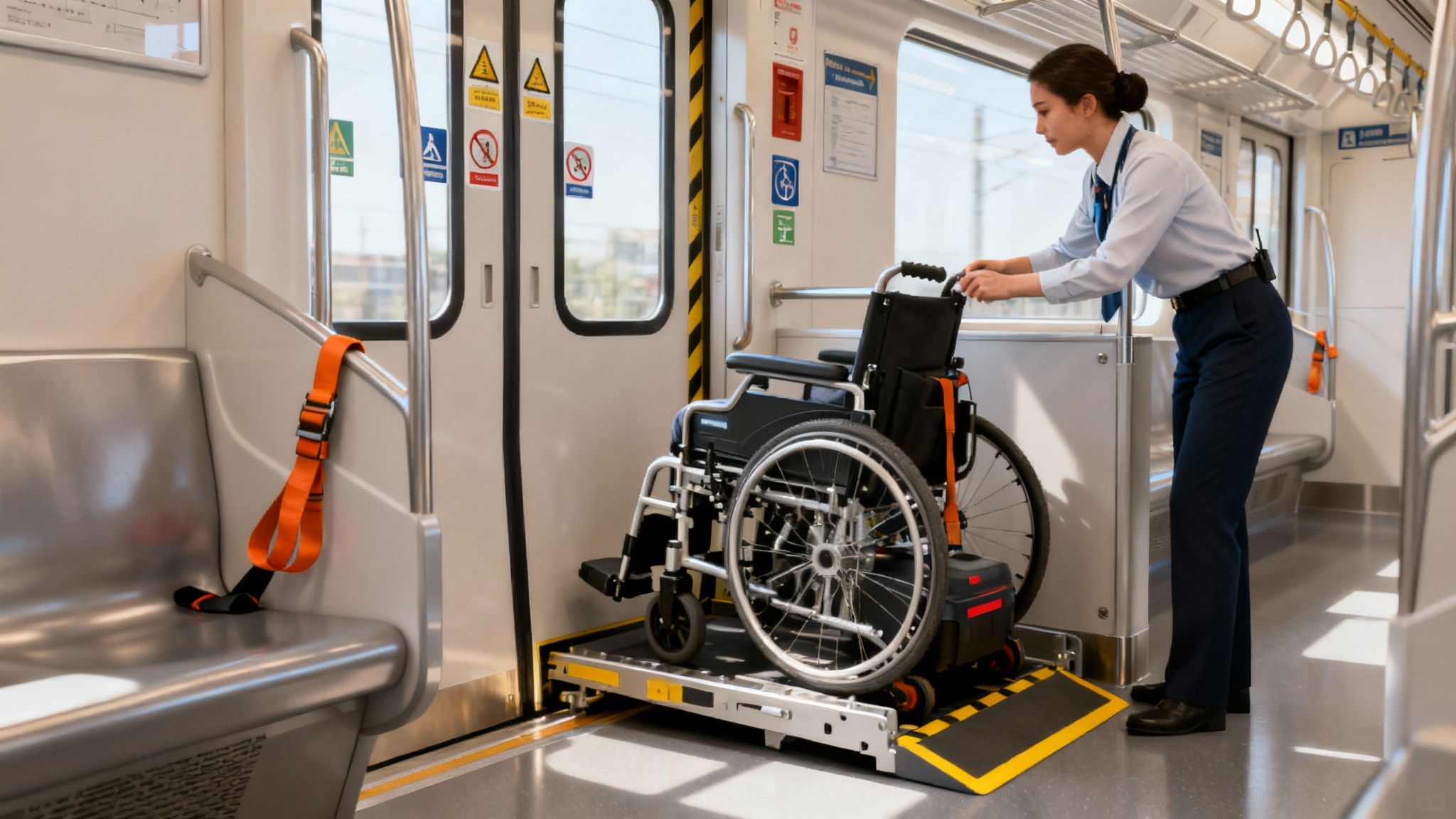
When it's time to board, a staff member will escort you to the right platform and train car. They'll use either a ramp or a mechanical lift to bridge the gap between the platform and the train door.
Just follow their instructions carefully as you move onto the ramp or lift. Once you're inside, they will guide you to the designated wheelchair space. These areas are specifically designed with extra room and features to keep you secure during the trip.
Securing your wheelchair is the final step. The exact process can vary, but it usually involves these four things:
With your wheelchair safely secured and the power off, you can finally sit back, relax, and enjoy the ride. You've earned it
Even with the best-laid plans, a travel day can throw you a curveball. The trick isn't to panic, but to have a calm, clear strategy ready to go. Think of this as your personal troubleshooting guide for turning those potential travel headaches into nothing more than small bumps in the road.
Knowing who to talk to and how to advocate for yourself can fix most problems in a snap. Let's walk through a few common situations you might run into and the best way to handle them.
You get to the station, and your heart sinks—the elevator is out of service. It’s frustrating, for sure, but it’s a solvable problem. First things first: stay calm and find a member of the station staff or head straight for the main information desk.
Politely explain what's going on. Station employees are trained for these kinds of hiccups and have backup plans. Their solution might be one of a few things:
The key is to communicate the issue right away. Don't waste your energy trying to figure it out on your own; the station staff are your best resource here.
So you made all the right calls and booked assistance, but when you arrive, the platform staff look at you like they've never seen you before. It can feel disheartening, but it's usually just a simple communication breakdown.
Start by calmly showing them your booking confirmation number or mentioning the name of the person you spoke with on the phone. This paperwork is your proof that you did everything right.
If the local staff are still scratching their heads, ask to speak with the Station Manager or find the Train Conductor. These are the people with more authority, and they can get on the radio to round up the crew needed to get the ramp or lift ready for you. Remember, be firm but polite while you explain that you followed all the proper steps.
Advocacy is really just about clear communication. Stick to the facts: state what you requested and show the confirmation you received. This approach frames you as a prepared traveler who just needs the help that was already agreed upon, not as someone causing a delay.
This simple, proactive approach can turn a moment of confusion into a clear plan, getting you boarded without any unnecessary stress.
You finally make it onto the train, only to find the reserved wheelchair space is clogged up with luggage or another passenger. This is another one of those times where the train crew is your best friend.
Don't try to handle this yourself. Immediately find a member of the train crew or the conductor and let them know. It is their job to make sure designated accessible spaces are clear for the passengers who need them.
They’ll take care of it by:
The crew is trained to manage these conversations professionally and without a big fuss. By letting them take the lead, you avoid any potential awkwardness and get the situation resolved based on the rail operator’s own rules. Just stay calm and let the crew use their authority—it's the fastest way to get settled in for your journey.
If there's one thing to take away from this guide, it's that traveling by train with your electric wheelchair is absolutely, 100% doable. A successful trip isn't a matter of luck; it all comes down to a little bit of smart preparation.
You now have a simple, repeatable game plan for a smooth journey. It really just starts with getting to know your own equipment. Taking a few minutes to measure your wheelchair's dimensions and weight, and figuring out its battery type, is the first step. This simple check-up prevents just about any surprise you could run into at the station and lets you speak confidently with the rail operator.
That one pre-travel phone call? It’s probably the most powerful tool you have. It’s your chance to confirm your chair is a good fit for the train, book that dedicated space, and line up any help you might need getting aboard. It turns a journey full of unknowns into a coordinated, stress-free plan.
Once you’ve got these simple steps handled, you can show up on travel day feeling ready and in control.
Train travel isn’t a barrier; it's an open door to new adventures. Each journey you plan and take builds confidence, proving that your mobility device is a tool for exploration, not limitation.
So, when you ask yourself, can you take an electric wheelchair on a train, you can now answer with a definite "yes." The freedom of the rails is waiting for you. Go ahead and start planning that next trip today
Even with the best planning, a few questions always pop up. Here are some quick answers to the most common things we get asked by electric wheelchair users getting ready for a train trip.
Yes, absolutely! The designated wheelchair spaces on trains are built specifically for you to stay comfortably and safely in your chair for the whole journey.
These spots have plenty of room and are equipped with securement straps to make sure your chair doesn't move an inch. The train crew is there to help get you secured, so don't hesitate to ask. It’s the standard way to travel on almost every train line.
You probably won't be asked for any paperwork, but it never hurts to be prepared. Think of it as a little peace of mind in your pocket. We suggest keeping a folder on your phone or in your bag with:
Having these ready can smooth over any potential hiccups and get you on your way faster.
Nope, not a penny. Under laws like the Americans with Disabilities Act (ADA), your electric wheelchair is considered an essential mobility device, not a piece of luggage. You’ll never be hit with an extra fee for bringing it on board. You just pay the same fare as any other passenger.
Think of it this way: your mobility device is an extension of you. Train operators are legally required to accommodate both you and your chair without tacking on extra charges. It's all about ensuring everyone has the same access to travel.
This is a fantastic question and really highlights why planning ahead is so important. If your trip requires you to change trains at two different stations within the same city (like arriving at Grand Central and departing from Penn Station in New York), you'll need a plan for that transfer.
Make sure you tell the rail company your entire itinerary when you book. They can help figure out the best accessible options, which might even include arranging an accessible taxi to get you from one station to the other. Just be sure to build that extra transfer time into your schedule.
While they're both mobility aids, the rules can sometimes be a little different. Electric wheelchairs are almost universally accepted because they're seen as a medical necessity. Some smaller or older trains might have tighter restrictions on mobility scooters because of their size or turning radius.
If you happen to use both, you might find our guide on taking mobility scooters on trains really useful. It breaks down the specific rules so you're ready to roll, no matter which device you're using that day.
Ready to find a travel-friendly chair for your next adventure? At Electric Wheelchairs USA, we offer a wide range of models that meet train and airline regulations, backed by our lowest price guarantee and free shipping. Explore our collection and start planning your journey today.


Leave a comment