(800) 682-9444
Call Now


Yes, you can absolutely bring a mobility scooter on most trains, but it’s not quite as simple as just rolling up to the platform and hopping on. Think of it less like catching a city bus and more like preparing for a flight—there are specific rules you need to follow, and a little planning goes a long way.
Taking your scooter on the train can open up a whole new world of travel, and the great news is that modern train networks are better equipped than ever to accommodate mobility devices. But this accessibility comes with a clear set of rules designed to keep everyone safe.
Success really boils down to making sure your scooter fits the train company’s specific guidelines. These aren't just suggestions; they’re requirements to ensure your scooter can safely get up the ramp, fit into its designated spot, and move through the carriage without blocking aisles or emergency exits. Just like an airline has strict size limits for carry-on bags, train operators have their own non-negotiable rules for mobility aids.
So, how do you know if your scooter is ready for the rails? It all comes down to three key checkpoints that virtually every train operator will look at before giving you the green light.
Before we get into the nitty-gritty for different train lines, here’s a quick table that sums up the most common requirements you'll run into.
This table breaks down the usual rules you'll encounter. It’s always best to double-check with the specific train company you're traveling with, but this gives you a solid starting point to see if your scooter is likely to be compliant.
| Requirement | Common Rule | Why It Matters |
|---|---|---|
| Size & Dimensions | Typically under 1200mm long and 700mm wide. | Ensures the scooter can fit on boarding ramps and in the designated wheelchair space without obstructing aisles. |
| Total Weight | Varies, but often a combined limit (scooter + rider) of around 300kg (660 lbs). | Ramps and lifts have maximum weight capacities to operate safely. |
| Turning Radius | Must be able to turn within a small, specified area. | Critical for maneuvering through tight corners inside the train carriage. |
| Battery Type | Must be a dry-cell, non-spillable type (SLA, Gel, Lithium-ion). | Prevents dangerous acid spills, which is why older "wet-cell" batteries are universally banned. |
Getting these four things right is more than half the battle. If your scooter checks these boxes, you’re well on your way to a smooth and hassle-free journey.
So, you want to take your scooter on a train trip? Fantastic idea. But before you head to the station, it’s crucial to understand that every train operator plays by its own rulebook. Answering "can mobility scooters go on trains?" isn't a simple yes or no—it really depends on where you are and whose train you're boarding.
Think of it like different airlines and their carry-on rules. One might be fine with your bag, while another has stricter size and weight limits. What gets a green light on an Amtrak train in the U.S. might not fly on the UK's National Rail network. Knowing the rules ahead of time is the key to a stress-free journey.
In the United States, Amtrak is pretty clear about what they allow. Their main focus is making sure your scooter can safely get on and off the train and fit into the designated accessible areas.
For the most part, your scooter needs to meet these key requirements:
These aren't random numbers; they’re based on the physical limits of the boarding ramps and the space available on the train cars. It's always a smart move to double-check Amtrak's latest accessibility guidelines before you book, just in case things have changed.
When you travel in the United Kingdom and across Europe, you'll find a slightly different setup. The core principles of size, weight, and safety are the same, but how they're managed can vary.
A great system in the UK is the "Scooter Card" scheme. Think of this permit as a passport for your scooter. It officially confirms your device has been checked and is approved for travel on trains that participate in the scheme. To get one, your scooter usually needs to be a Class 2 model, shorter than 1000mm, narrower than 600mm, and have a turning radius under 1200mm.
This card system is a game-changer. It creates one standard that most operators recognize, so once you have the permit, you can travel with confidence without getting your scooter re-checked for every single trip.
If you’re traveling within London, Transport for London (TfL) has its own rules for the Tube, Overground, and buses. Not every Tube station is fully accessible, so planning your route with TfL’s own accessibility guides is a must.
No matter where you are in the world, train operators tend to focus on the same three things: dimensions, turning ability, and battery type. This infographic breaks it down nicely.
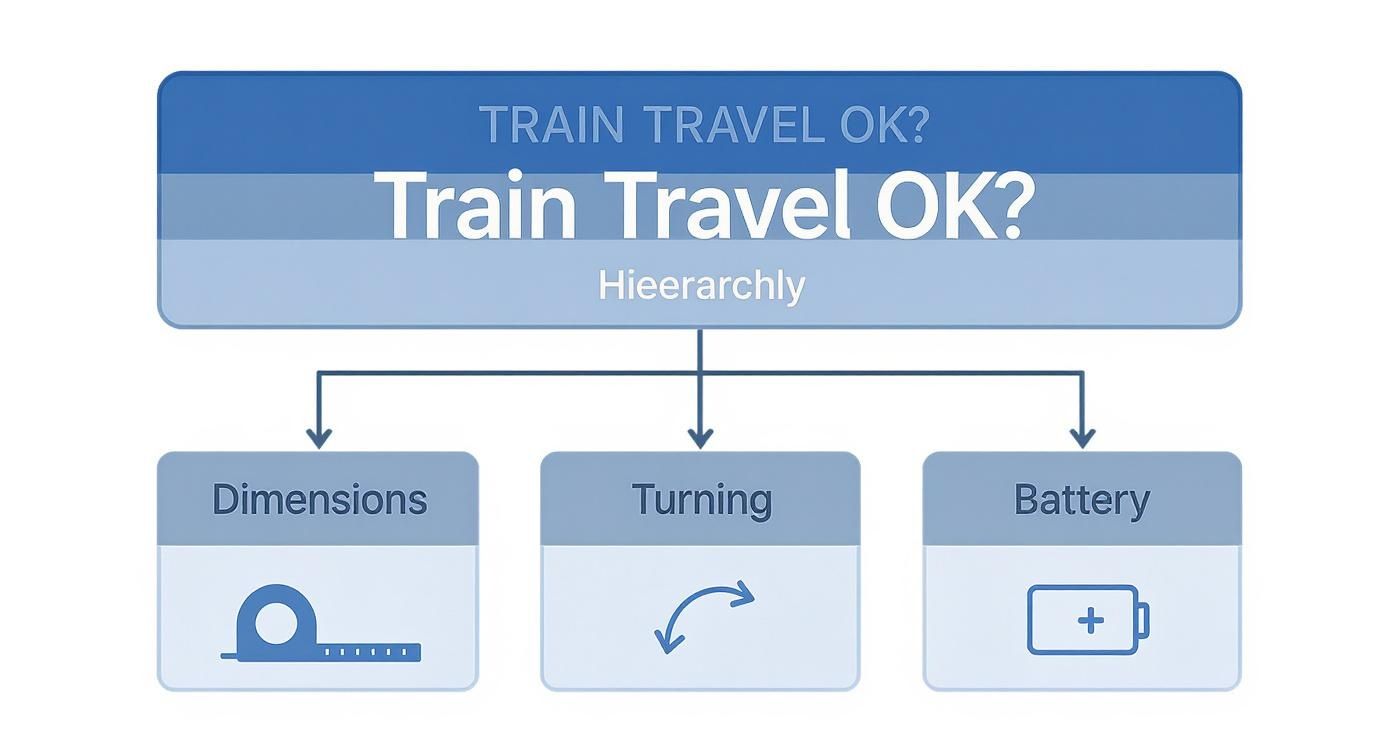
This visual shows the simple checks that determine if your scooter is good to go. By getting a handle on these universal factors and any local quirks, you’ll be ready to hit the rails anywhere.
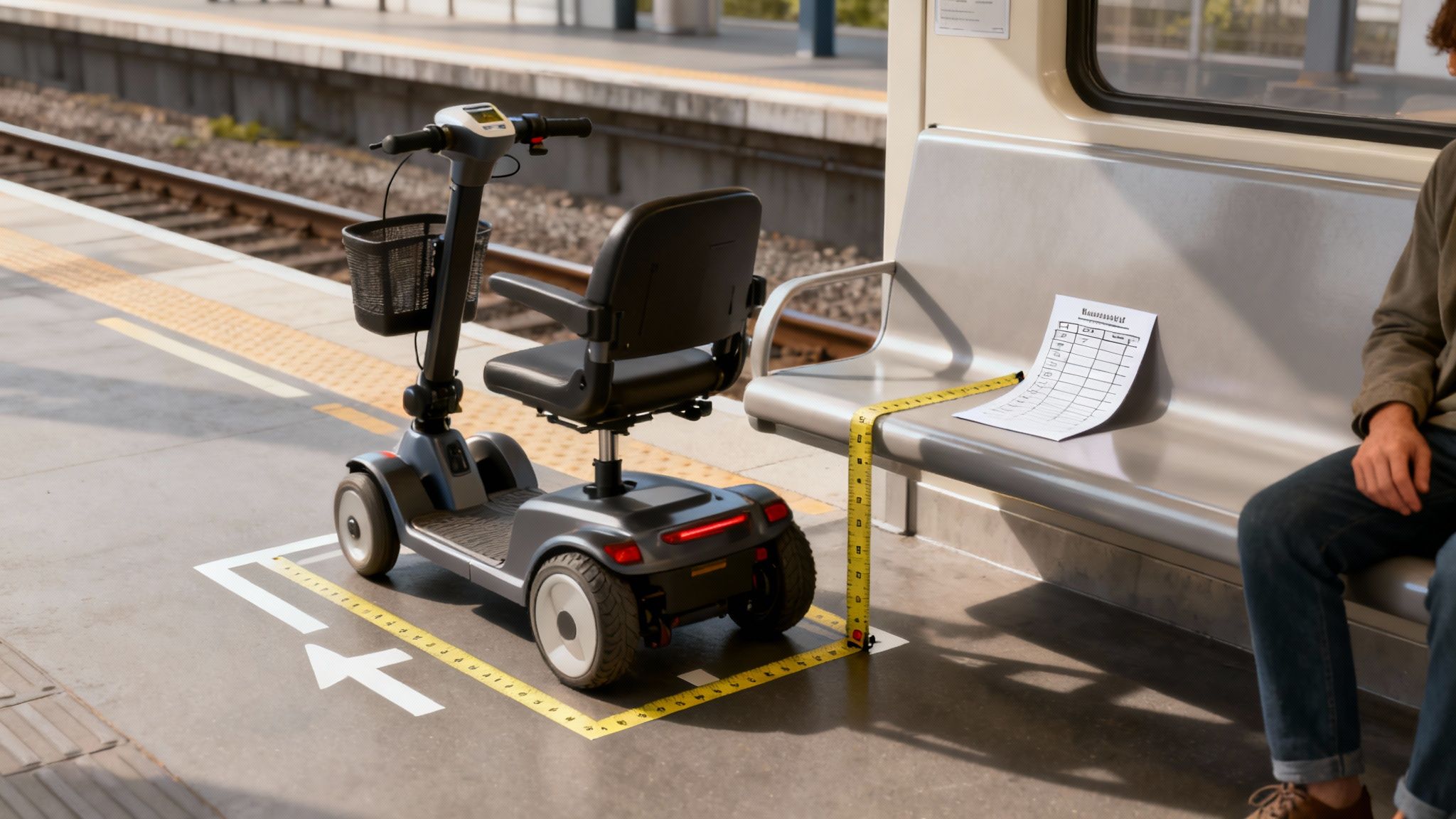
When a train operator lists size and weight limits, those numbers aren't just pulled out of thin air. They're based on the real-world physics of the train itself—the width of the corridors, how much a boarding ramp can hold, and the exact dimensions of the dedicated wheelchair spaces. The question "can mobility scooters go on trains?" often boils down to one simple thing: maneuverability.
It’s a bit like trying to get a new sofa through a tight doorway. The sofa might technically be shorter than the hallway, but if you can’t pivot it around the corner, it’s not making it into the living room. It's the same deal with a scooter. It doesn’t just need to fit in a straight line; it has to handle the tight turns to get on the train and into its designated spot. This is why a scooter’s turning radius is often just as important as its length and width.
Train companies aren't trying to be difficult with their rules; they're following precise engineering and safety guidelines. That weight limit, for example, is tied directly to the maximum load a mechanical lift or ramp can handle safely. The length and width restrictions make sure your scooter can fit into the accessible area without blocking aisles, which is a huge safety issue in an emergency.
A scooter that's too long or wide can become a genuine hazard, preventing other passengers or the train crew from moving through the carriage. These rules are there to keep the journey safe and smooth for everyone.
The best way to avoid a nasty surprise at the station is to get familiar with your scooter's exact dimensions beforehand. You don't need any special tools—just a tape measure and a quick look at your owner's manual.
Here’s what you need to check:
Knowing these three measurements is your ticket to a stress-free trip. Before you book anything, pull up the train company's accessibility policy on their website and compare your scooter's numbers.
Doing this quick check confirms your scooter isn't just allowed in theory, but that it will practically work on the rails. As train travel continues to boom, with passenger numbers expected to hit 1,281 million by 2029, operators are working hard to make these accessibility standards clear and consistent. A little prep work makes all the difference.
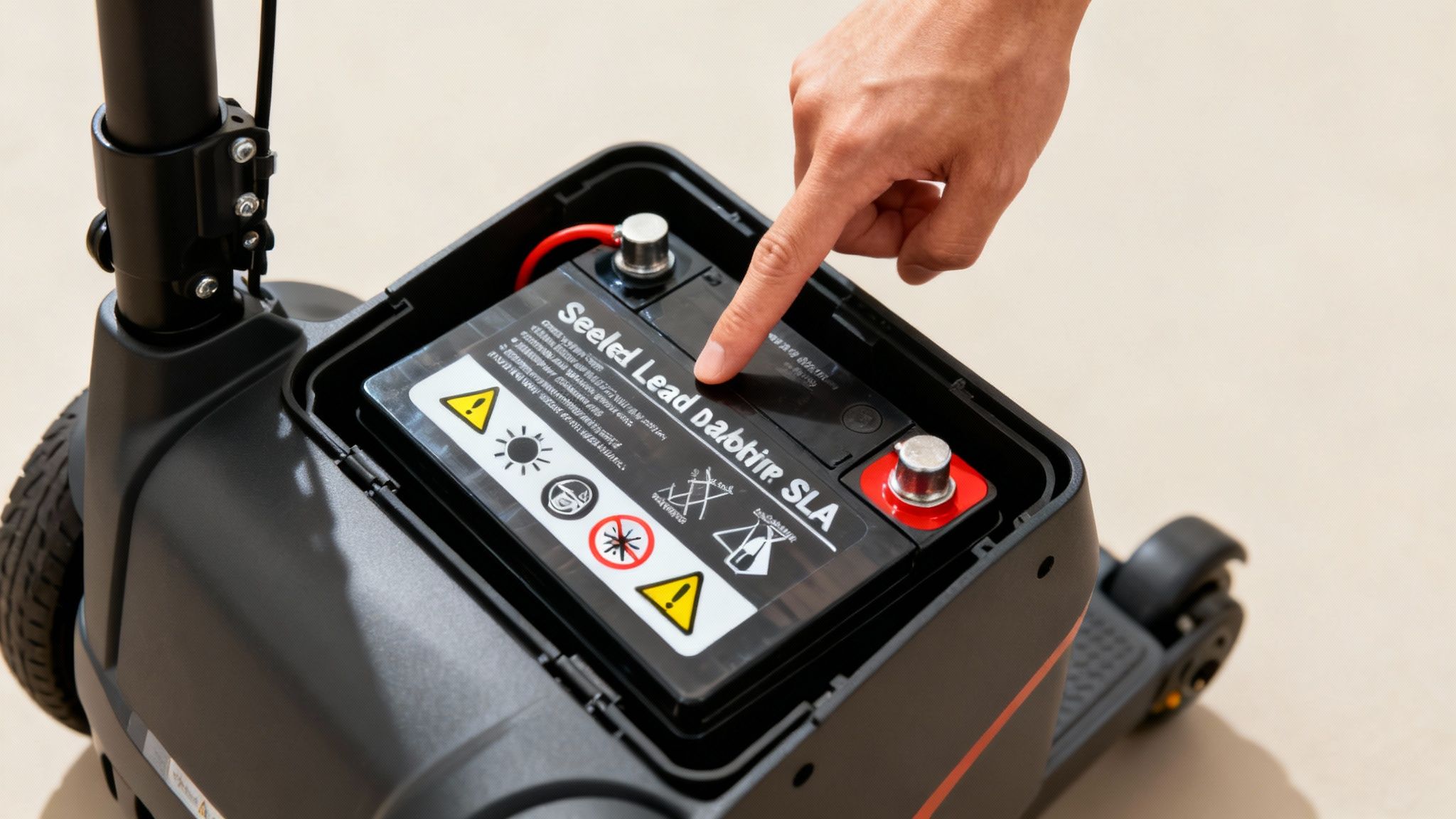
It’s not just about your scooter's size and weight. What powers it is a huge safety concern for any train operator. These rules aren't meant to make your life difficult; they exist to prevent any nasty surprises or hazards on board. Getting a handle on these battery restrictions is a must for a smooth journey.
Think about it: a train is a closed space that's constantly moving and vibrating. The last thing anyone wants is a battery leaking corrosive acid all over the floor. This is exactly why old-school wet-cell batteries are universally banned. They’re a lot like older car batteries and just aren't stable enough for this kind of travel.
So, what kind of battery will get the green light? Train operators pretty much always approve non-spillable batteries. Because they are sealed tight, they won’t leak even if they get tilted or bumped around during the trip.
Your scooter will almost certainly be good to go if it uses one of these:
Modern lithium-ion batteries are also accepted on most networks. The key condition is that the battery must be securely installed within the scooter's frame, protecting it from any potential bumps or damage. You generally can't bring loose or spare lithium batteries with you unless the train company has a specific policy that allows it.
The rule of thumb is simple: if the battery can't spill, you're probably in the clear. Staff just need to know your scooter’s power source is safe for everyone.
Not sure what’s powering your scooter? The first place to check is the user manual. It should tell you the exact battery type and often mentions whether it's approved for travel.
If you've lost the manual, don't worry. Take a look at the battery itself. There’s usually a label that identifies it as SLA, Gel, AGM, or lithium-ion. Keep an eye out for phrases like "non-spillable" or "air-travel safe," as these certifications are big pluses for train operators, too.
For a deeper dive into battery care and identification, our guide on the best practices for your mobility scooter batteries can give you more confidence. Knowing your stuff will help you answer any questions from staff and prove your scooter is ready to ride the rails.
A great train trip with your mobility scooter doesn't just happen; it starts long before you even get to the station. A little planning can transform what feels like a stressful puzzle into a calm, predictable day out. When you know exactly what to do and when, you can leave the logistical worries behind and just enjoy the ride.
Think of it this way: a little prep work up front ensures both you and the train staff are on the same page. No last-minute surprises, no frantic scrambling. Just a smooth journey from start to finish.
This is the single most important thing you can do. Most train operators, from Amtrak in the US to National Rail in the UK, need you to arrange assistance at least 24 to 48 hours before you travel. This service is usually called "Passenger Assist" or something similar.
Why is this so critical? Contacting them early lets the rail staff:
This one phone call or online booking is your golden ticket to a hassle-free trip. Never just show up and hope for the best; staff might not be available without that heads-up.
The day before you head off, do one last quick check. Pull up the train operator's accessibility policy on their website and give it a final once-over. Double-check your scooter's length, width, and battery type against their requirements.
This is also the perfect time to make sure your scooter is fully charged. You almost never get a chance to plug in on board, so starting with a full battery is a must. For more general advice, check out our comprehensive tips for transporting your mobility scooter.
Rushing is the enemy of a calm travel day. Seriously, give yourself more time than you think you need. Plan to get to the station 45 to 60 minutes before your train is scheduled to leave. This extra time is your best friend.
It gives you a comfortable cushion to find the accessibility staff you booked, navigate the station without feeling like you're in a race, and get to the right platform. It's also a good idea to look up specific station info beforehand, like this helpful Norwich Train Station guide, to know what to expect.
Arriving early isn't just a suggestion; it's a strategy. It gives staff plenty of time to get the boarding ramp in place and guide you onto the train before the main rush of passengers, making everything a whole lot easier for everyone involved.
When it's your turn to board, the staff will bring out a ramp. Just listen to their instructions—they do this all the time and will guide you on safely. Once you're in the designated accessible space, there's just one last thing to do.
To get your scooter ready for the journey, you'll want to:
This ensures your scooter stays put while the train is moving. With that done, you can finally sit back, relax, and enjoy the view, knowing you planned a perfect trip. As more people travel this way, these procedures are becoming even more important—the mobility scooter market is projected to hit USD 3.66 billion by 2034, showing just how vital accessible travel is. Find out more about the growth of the mobility scooter market.

If you plan on taking the train often, picking the right scooter is the difference between a breezy trip and a stressful mess. Let's be honest, not all scooters are built for the tight squeezes and unique demands of rail travel. Thinking about train-friendly features from the get-go makes your scooter an asset, not an obstacle.
The best options for train travel are almost always lightweight, compact, and built for portability. There’s a reason they’re called travel scooters! They’re engineered to fold or come apart easily, which is a massive help in crowded stations or when you need to store them. Their smaller footprint is a huge advantage.
When you're shopping around, you want to zero in on the specs that actually matter for getting on and off a train. A nimble little scooter with a tight turning radius is going to serve you far better in a narrow train corridor than a big, powerful beast designed for cruising around the neighborhood.
Here are the top things to put on your checklist:
Choosing a model designed for travel simplifies everything. It's like picking a carry-on suitcase that you know will fit in the overhead bin—it removes a major source of travel anxiety before you even leave the house.
To see what I mean, just look at how these two types stack up.
| Feature | Standard Scooter | Travel Scooter |
|---|---|---|
| Portability | Heavy and a real pain to disassemble. | Lightweight, foldable, or easily dismantled. |
| Maneuverability | Wide turning radius; very tricky in tight spots. | Small turning radius; perfect for train aisles. |
| Compliance | Often too big or heavy for train regulations. | Designed specifically to meet transport rules. |
Putting your money into a scooter that’s fit for the job is a game-changer. For a deeper dive, check out our best folding mobility scooter buying guide, which is packed with great options for adventurers. The demand for accessible transport is only growing; back in 2026, U.S. airlines alone handled over half a million wheelchairs and scooters. This trend just underscores how important it is to have a compliant device, no matter how you choose to travel.
Even with the best-laid plans, a few nagging questions always seem to pop up right before a trip. Don't worry, we've been there. We've gathered the most common questions people ask about taking their mobility scooters on a train to give you quick, clear answers for those real-world situations.
If your scooter is bigger than the train company's official dimensions, you'll almost certainly be denied boarding. These rules aren't just for show—they're strict safety measures to make sure everyone can get out quickly in an emergency.
Before you even think about booking, grab a tape measure and check your scooter's size against the train operator's policy. Some networks, like those in the UK, even have an assessment service that can issue you a special permit if your scooter is compliant, which is a huge stress-saver.
Good news: you don’t need to buy a separate ticket for the scooter itself. But—and this is a big one—you must let the operator know you're bringing one.
This is usually done by booking "Passenger Assist" or reserving a dedicated wheelchair space at least 24-48 hours ahead of time. Taking this simple step ensures the station staff will be ready with a ramp and, most importantly, that a spot is actually available for you on the train.
Think of booking assistance as reserving your scooter’s spot. It’s a free but essential step that guarantees the railway is prepared to help you board smoothly and safely.
Generally, the answer is no. You can't charge your scooter on the train. The power outlets you see on board are designed for laptops and phones, not the high-energy draw of a scooter battery. Trying to charge could create a serious safety hazard.
Your best bet is to make sure your scooter is fully juiced up before you leave the house.
At Electric Wheelchairs USA, we specialize in travel-friendly mobility scooters designed to meet train and airline regulations. Explore our collection of lightweight, foldable models and travel with confidence. Find your perfect travel companion today at https://www.electricwheelchairsusa.com.


Leave a comment