(800) 682-9444
Call Now


Yes, you absolutely can take an electric wheelchair on a bus. Thanks to federal laws like the Americans with Disabilities Act (ADA), your right to use public transit is protected. The main thing to remember is that your wheelchair must be able to fit on the bus lift and into the designated spot for securement.
Feeling a little unsure about navigating public transportation with your electric wheelchair is completely normal, but the good news is that the rules are designed to make it possible. Think of it this way: a bus is just like any other public space with specific doorways and assigned spots. As long as your chair can safely get through the "door" (the ramp or lift) and "park" in the designated area, you're good to go.
This guide will give you the essential info you need to feel confident on your next bus trip.
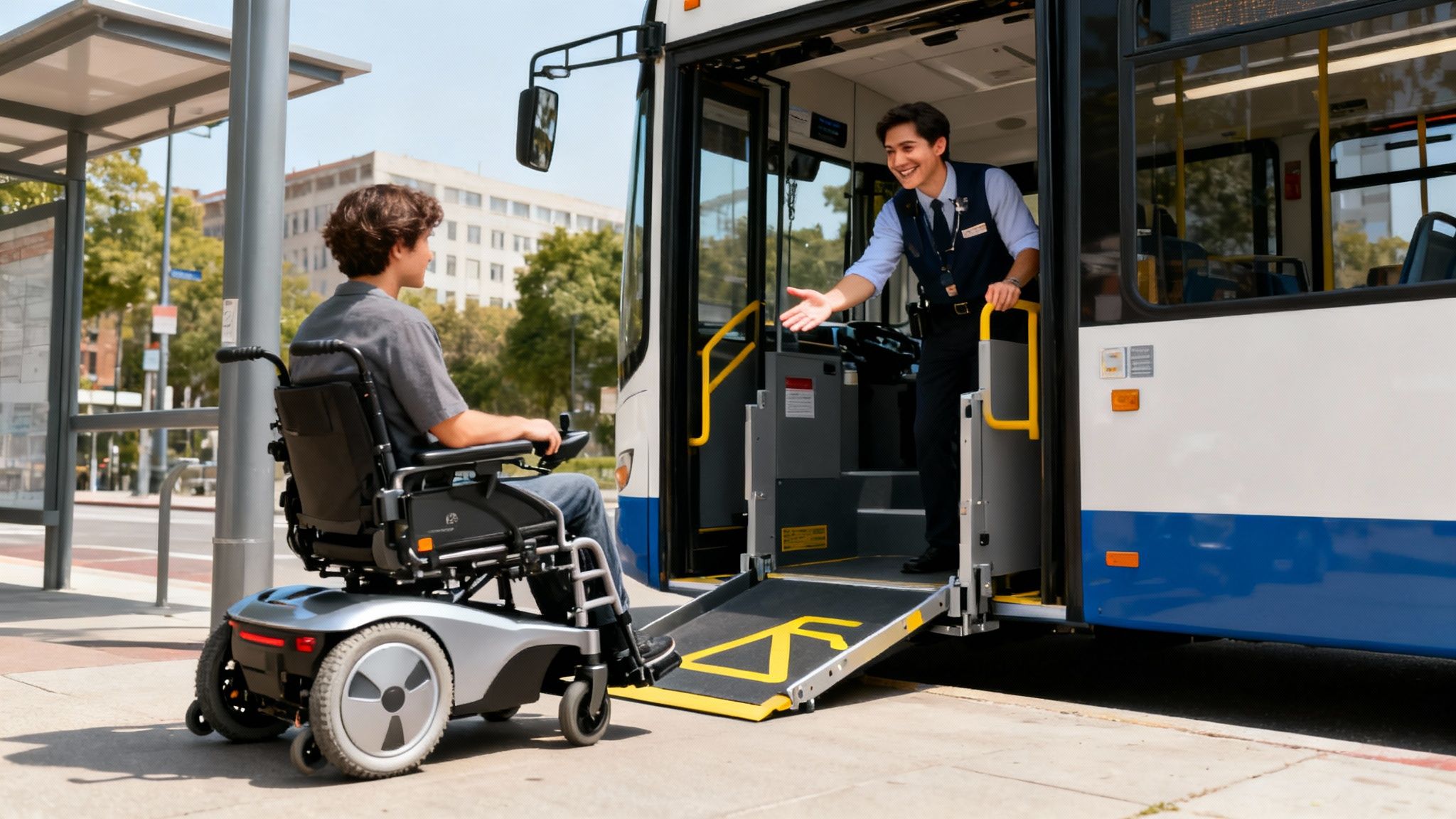
Public transit is becoming more accessible every year. Infrastructure is constantly improving to meet the needs of riders, and electric wheelchairs are a big part of that equation. In fact, projections show that over 98% of public transit buses in the U.S. will be equipped with wheelchair-accessible ramps in the coming years. This is great news for all of us. You can learn more about the electric wheelchair market growth and see just how common these devices are becoming.
Before you head to the bus stop, it's a smart move to double-check a few key details about your chair and the local transit rules. While most bus systems follow standard guidelines for lift capacity and securement area dimensions, there can be slight variations. Knowing this information ahead of time is the best way to prevent any surprises when the bus pulls up.
The main idea behind bus accessibility rules is keeping everyone safe. The guidelines for size, weight, and securement aren't there to keep people off the bus. They exist to make sure every single passenger—including you in your wheelchair—has a safe and stable ride from start to finish.
To make things easier, I've put together a simple checklist to help you prepare.
Here’s a quick rundown of the essential things to confirm before you roll out. A quick check of these items can save you a lot of hassle and make your journey smooth and stress-free.
| Factor | What to Check | Why It Matters |
|---|---|---|
| Size & Dimensions | Your wheelchair’s length and width. | Needs to fit on the bus lift (most are 30" x 48") and in the securement area. |
| Total Weight | Your weight plus the wheelchair's weight. | Must not go over the bus lift’s capacity (usually 600-800 lbs). |
| Battery Type | Confirm if your battery is non-spillable (like AGM or Gel). | For safety reasons, many transit systems prohibit spillable batteries. |
| Maneuverability | Your ability to turn and position the chair. | You’ll need to navigate onto the lift and into the securement space with confidence. |
Checking these four simple things will put you in a great position for a successful trip. It’s all about being prepared
Stepping onto a public bus can feel a little intimidating when you're not sure about the rules. But here's the good news: you have a powerful ally in your corner. The Americans with Disabilities Act (ADA) is a major federal law that makes sure you have the same access to public bus services as everyone else.
Think of the ADA as the rulebook that every public transit agency has to follow. It’s not just a friendly suggestion—it’s the law. It legally requires bus companies to accommodate riders with disabilities, and that absolutely includes people who use electric wheelchairs. You have a protected right to get on, ride, and get off the bus safely.
So, what does this mean for you on a practical level? The ADA gives you specific, concrete rights when you travel with a mobility device. Knowing these will help you feel more confident and prepared for your trip.
Here are the big ones:
The ADA is the main law for public buses, but similar rules often apply to other types of travel. We dig into some of those broader protections in our post covering the law and mobility scooters.
Your rights are one part of the equation, but the transit agencies have their own set of responsibilities to make it all work. They can't just have the equipment; they have to make sure it's in good shape and their staff knows what they're doing.
The whole point of the ADA is to guarantee equal access. That means transit authorities don't just need to buy the right gear—they need to maintain it and train their people to use it properly.
This boils down to a few key duties for them:
While your rights are very strong, there are a handful of very specific, limited situations where a bus driver can legally refuse to let you board. It's important to remember these exceptions are strictly about safety and the physical limits of the equipment—never about discrimination or convenience.
An operator can only turn you away if:
Knowing these rare exceptions can help set your expectations and keep a minor hiccup—like having to wait for the next bus—from ruining your day.
The nitty-gritty technical details of your electric wheelchair are what really matter when it comes to bus travel. Think of it like a suitcase—it has to fit in the overhead bin. Your chair has to meet the bus's specific rules for size, weight, and even its power source. Getting a handle on these rules is your ticket to a smooth ride.
Public transit systems are designed to accommodate what the ADA refers to as a "common wheelchair." This isn't a specific brand or model, but a standard set of dimensions. Most bus lifts and the securement areas on board are built for a wheelchair with a footprint of 30 inches wide by 48 inches long.
If your chair fits within these measurements, you're already in a great spot. The next big thing is the total weight—that’s you plus your wheelchair. For safety, bus lifts have a maximum capacity, which is typically between 600 and 800 pounds.
Picture a small elevator in an old building; it has a clear weight limit to make sure it runs safely. A bus lift operates on the exact same principle. Going over that limit can strain the lift's mechanics or, worse, create a dangerous situation while you're boarding.
Bus operators are trained to know their vehicle’s lift capacity. As long as your combined weight doesn't exceed this limit, they are required to let you board.
Your wheelchair's specs are your boarding pass. Knowing its exact dimensions, weight, and battery type ahead of time takes all the guesswork out of the equation. You can board with confidence, knowing you meet the safety standards.
Even with these standards, things don't always go smoothly. Real-world challenges like unreliable ramps, operators who need more training, and inconsistent safety features can pop up, which is why being prepared is so important.
Last but not least, let's talk about power. The type of battery in your electric wheelchair is a major safety point for any transit agency. Their main worry? Hazardous leaks.
Because of this, buses almost universally accept non-spillable batteries. This is the kind you want. These include:
Older, wet-cell (spillable) batteries are pretty much a no-go on public transit because of the risk of acid leaks. Making sure your battery is non-spillable is a non-negotiable step before you head to the bus stop.
To get a better handle on your power source, check out our guide on the best practices for your mobility scooter or power chair batteries. It’s also helpful to understand why battery health is a personal safety issue so you can keep your device reliable and ready for travel.
Knowing the rules is one thing, but actually rolling onto a bus for the first time can feel like you’re on stage. Don't sweat it. Bus drivers do this all day, every day, and after you’ve done it once or twice, it’ll feel like second nature. Let's walk through exactly what to expect, from the curb to your spot on the bus.
As the bus pulls up, make sure you're positioned on the sidewalk where the driver can easily see you. This gives them a clear signal that they’ll need to deploy the ramp or lift. Once the bus stops, the driver will lower it and extend a ramp to the sidewalk, creating a smooth path for you.
The key to a wobble-free boarding is to line yourself up so you're facing the ramp straight on. A direct approach is the most stable. Head up the ramp at a slow and controlled speed. Some buses use a lift instead of a ramp; in that case, you'll roll onto the platform, lock your brakes, and hold on while the driver operates it.
Once you’re on board, your next move is to head to the designated securement area. It's usually near the front and clearly marked. Other passengers should clear a path to let you through.
The single most important part of this whole process? Communication. A simple nod to the driver when you're ready for the ramp, or a quick "all set" when you're in place, makes everything go smoother for you, the driver, and everyone else on board.
This visual gives you a quick recap of the big three requirements—size, weight, and battery type—that we covered earlier. Think of these as the foundational checks for a hassle-free ride.
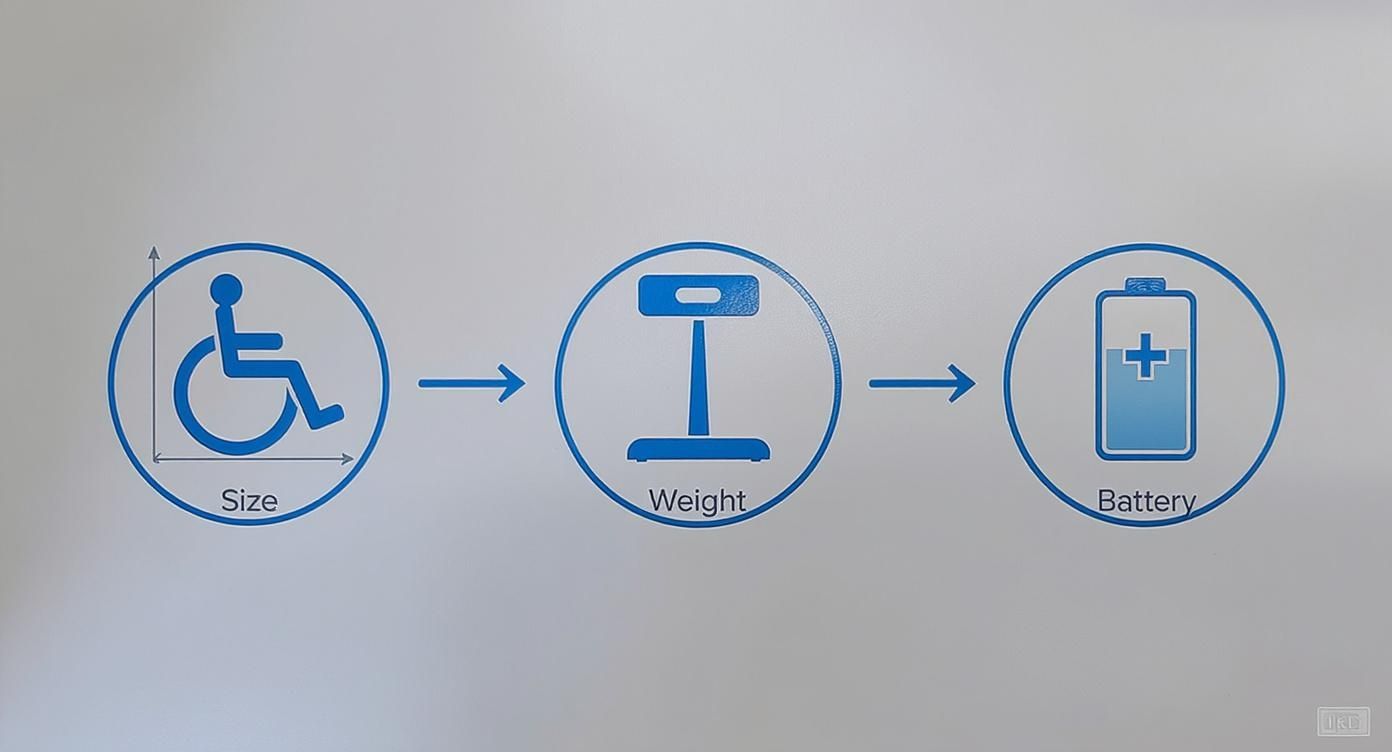
As long as your chair meets these core standards, you're well on your way to boarding any public bus without a hitch.
The bus driver is trained to handle securing your wheelchair, so you can relax. The most common and safest method they use is a four-point tie-down system. It's the gold standard for keeping your chair locked in place.
Here’s how it usually works:
Your job here is pretty simple: just position your chair where asked and set your brakes. The driver does all the heavy lifting.
For a closer look at travel safety, our guide on how to transport a power wheelchair safely has extra tips you can use in all sorts of travel situations, not just on the bus.
A little bit of planning ahead can be the difference between a stressful trip and a smooth, confident ride. Honestly, knowing what to expect before you even leave the house is a game-changer. It gets rid of all the guesswork and lets you handle your journey like you've done it a hundred times before.
The best first step? Get in touch with the people who actually run the buses.
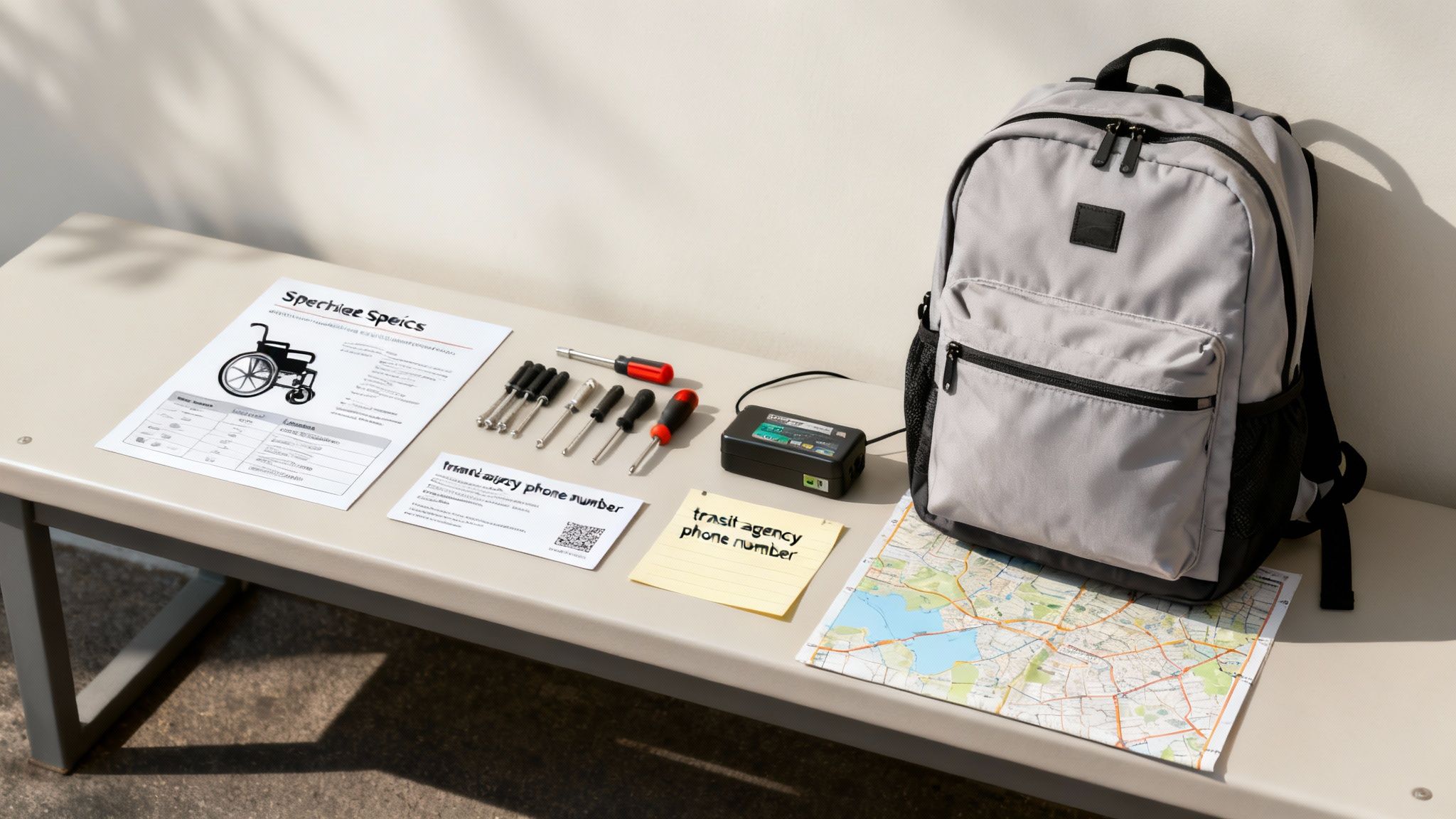
Making a quick call to your local transit agency is one of the smartest moves you can make before your trip. While just about every agency follows the ADA guidelines, some might have buses with specific lift capacities or their own unique procedures for securing wheelchairs. Asking those questions upfront arms you with the most accurate info.
Think of it like calling a restaurant to check their hours before driving across town. That five-minute call can save you a world of unexpected surprises and just makes the whole experience so much easier.
Knowing what to ask can make your call with the transit agency even more productive. Here’s a quick guide to the essential questions to get the answers you need for a worry-free trip.
| Question Category | Specific Questions to Ask | Reason for Asking |
|---|---|---|
| Lift & Ramp Specs | "What is the weight capacity of your bus lifts?" "Are your ramps manual or automatic?" |
To confirm your combined weight (you + chair) is within their limits and understand the boarding process. |
| Securement System | "What type of securement system do your buses use?" "Are there specific securement points you recommend for my chair model?" |
Helps you know what to expect and where the driver will attach the straps, making the process faster. |
| Driver Assistance | "What is the standard procedure for driver assistance during boarding and securement?" | Clarifies the driver's role and how much assistance you can expect, so there are no surprises. |
| Peak Travel Times | "Are there certain routes or times of day that are less crowded?" | Traveling during off-peak hours can mean more space and a less rushed experience for everyone. |
Having these answers before you head to the bus stop gives you a major confidence boost, turning potential unknowns into a clear, predictable plan.
Having your wheelchair's stats ready to go is a huge help. Put together a simple "travel-ready kit"—this could be a note saved on your phone or even a small card you keep in your wallet.
Jot down these key details:
This info is golden if a driver ever has a question. It shows you're prepared and helps them quickly confirm that your wheelchair meets all their safety requirements.
Confidence really comes from practice. If you're new to navigating tight spots, try practicing some sharp turns in hallways or small rooms at home. It’s a great way to build the skills you need to get onto a lift and into the securement area without any stress.
It’s also a good idea to use online maps to scout out the bus stops on your route. Look for things like curb cuts and check if the waiting areas are smooth and level. Planning your path from your front door to an accessible stop makes sure the first part of your journey is just as easy as the ride itself.
These same prep principles work for other types of public transport, too. In fact, you can find out if mobility scooters can go on trains in our other guide. When you take these proactive steps, you can board the bus feeling completely prepared and ready for a comfortable trip.
Let's be real: even with the best planning, things can go sideways. You might face a few bumps in the road, but knowing how to handle these situations calmly is the key to getting where you need to go. Staying composed and knowing your rights will solve most problems right on the spot.
Sometimes, a driver might seem a little unsure about the securement process or the accessibility rules. It’s usually not on purpose; they could be new or just need a refresher on their training. This is where all your preparation really pays off.
A calm, confident attitude is your best tool. Politely remind the driver of your right to board and be secured, referencing the ADA. Often, a simple, firm statement is all that’s needed to get the process back on track.
If you get on board and find the securement area is blocked by luggage or strollers, don't hesitate to speak up. Politely ask the driver to request that other passengers move their things. That space is legally designated for wheelchair users, and it’s the driver’s responsibility to make sure it's clear for you.
One of the most frustrating things to run into is a broken lift or ramp. Under the ADA, if a lift is out of order, the driver has to report it immediately. They should also be able to tell you when the next bus with a working lift is scheduled to arrive.
And if a lift breaks down while you're already on your trip? The transit agency is required to provide some form of alternative transportation to get you to your destination.
This problem is part of a much bigger issue. The transport accessibility gap for wheelchair users is a serious social challenge that impacts daily life. For example, studies in the UK found that disabled people make 38% fewer trips than non-disabled individuals because of barriers like these—a statistic that hasn't gotten any better in over a decade. You can learn more about this research on transport accessibility challenges.
When you can't sort out an issue with the driver directly, knowing who to call is your next best move. It's a good idea to keep the transit authority's customer service number saved in your phone.
If a problem does come up, make sure to jot down the key details:
Reporting these incidents does more than just solve your immediate problem—it helps hold transit agencies accountable and pushes them to improve the system for everyone.
We've covered the basics, but I know from experience that specific, real-world questions always come up. Let's tackle a few of the most common ones I hear, so you're ready for just about any situation you might encounter on public transit.
Absolutely not. You are not required to move from your electric wheelchair into a bus seat. The securement area is designed specifically for you to stay in your chair for the whole trip.
If you'd rather transfer to an open seat, that's your choice, but bus staff can never make you do it.
Under the ADA, the bus operator must secure your wheelchair if the bus has a tie-down system, which nearly all of them do. A driver can only refuse if your chair has no safe points to attach the straps, or if securing it would block an aisle or otherwise create a clear safety hazard.
The core principle here is simple: safety and access for everyone. Drivers are trained to get your chair secured, and you have every right to expect this service. It’s one of the most fundamental parts of making bus travel work for all passengers.
That spot is designated as priority seating for passengers with disabilities. If someone is sitting or standing there, the driver is supposed to ask them to move.
While they can’t physically force someone to relocate, a polite request from the driver is usually all it takes. Most people are more than happy to make room once they realize the space is needed.
While our guide is all about public transit, sometimes the FAQs from private companies can offer useful little tidbits for travelers in general. For example, you might find some interesting insights on resources like OzCoachHire's FAQ page for private bus hire.
For a mobility solution that’s ready for any journey, explore the wide selection at Electric Wheelchairs USA. We offer everything from compact, travel-friendly models to heavy-duty chairs, ensuring you find the perfect fit for your lifestyle. Visit us at https://www.electricwheelchairsusa.com to find your freedom.


Leave a comment