(800) 682-9444
Call Now


Buying a wheelchair ramp can be a very complicated process. With this article we aim to shine a light on this process as the best wheelchair ramp buying guide. Questions you might ask when wanting to purchase a wheelchair ramp are whether you should purchase a long ramp or a short ramp.
You might also want to know how well these ramps fair in bad weather. Do they get rusty or are they made of the type of material that can withstand rust?
Also, if the material can withstand rust, is it strong enough to carry the weight of the wheelchair? These and many other questions are what you should be wondering about before you purchase.
Therefore, we aim to make the acquiring of a wheelchair ramp, whether it is for a wheelchair or a mobility scooter, simple. We recommend five different ramp options and will look at a specific ramp that we consider to be the best for each category.
The categories we will look at include the following:
-Single fold ramps
-Multi fold ramps
-Threshold ramps
-Van ramps
-Solid ramps
With each category of ramp, there is a specific niche purpose that is serviced, in order to make entering and exiting more reachable, whether it is done from the home or from within an office.
Just keep in mind that In order to comply with in office accessibility, complicated ADA (Americans with Disability Act) rules have to be taken into consideration.
If a ramp is installed as part of a home, it is often classified as either a permanent or a semi-permanent fixture. The difference between the two lies in how difficult it is to remove the fixtures once installed.
Permanent ramps are in most cases anchored into the ground and have concrete anchors. They are built onto the facility permanently.
Very often these ramps are built with wood or metal and they require the expertise of a licensed contractor.
Semi-permanent ramps on the other hand, even though they are also installation as a fixture to the home, are designed to be easily removable and adjustable.
They can be regarded as the compromise between portable and permanent ramps, and offer a blend of both types, with the strength of the permanent ramp, but the flexibility of the semi-permanent ramp.
The needs you have usually determines which ramp is best for you, whether it be for residential use or commercial use.


Single fold ramps are perfect for people who occasionally need to travel with a ramp to help them navigate through obstructions. They can carry weight of as much as 600lbs and come in five different sizes. These ramps are ideally for the outdoors to be used with travel mobility scooters.
PVI’s single fold ramps are excellent for all types of mobility devices. They are solid and durable with an anti-slip high traction surface for added safety. They are easy to carry as they can be carried like a suitcase when folded.
It is made of durable welded material with safety DVD and steel security pins included.

The second option would be multi-fold ramps, which are longer. With a single fold ramp, a user may fall if there is a small staircase to the entrance of the home. If this is the case, entrance to the home via mobility scooter or power wheelchair will be prohibited.
In this case a multi-fold ramp will be ideal because it will allow the wheelchair user to enter and exit the home without the need to get off the mobility scooter or power wheelchair.
PVI’s multi-fold ramps have a unique design, allowing for easy storing and carrying. It can separate into two pieces and can be folded in half to be carried like a suitcase. It is made of a durable welded fabric and also has an anti-slip high-traction surface.

The third option is the threshold ramp. This ramp is best if the wheelchair user needs to ascend a short rise before the home or office area.
This type of ramp is especially made for doorways. It is affixed to the doorway through holes punched in each of the four corners. It has a load a capacity of 300lbs, but despite its high weight capacity it is light in weight.
It is made of durable aluminum and is equipped with ahigh-traction anti-slip surface.

-The fourth option is the van ramp. This ramp is perfect for people who travel with their mobility scooter or powerchair within the van. It makes uploading or downloading very simple.
They can upload from either the back or the side of the ramp. When it is not in use it can be folded and stored without taking up a lot of space.
This ramp, also known as the PVI folding rear door ramp is a three-section ramp, which is operated manually to be mounted to the floor of the van.
It is constructed from aluminum and is assisted by four springs which make the ramp easily operable by one person.
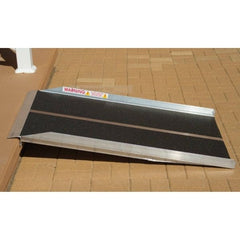
-The solid ramp is the last option. This type of ramp is a solid option which can support up to 800lbs in weight. This ramp has an anti-slip coat, in order to increase grip for your power wheelchair or mobility scooter.
In order to determine the proper length of a ramp, one has to take into consideration the space available at the location. When there is not enough space, we would recommend a low ramp.
If there is excess space, then a long ramp is a better investment. Longer ramps are, in anyway, better for the health of the wheelchair user.
With short ramps, you have a steeper grade, meaning that the incline will be steeper. However, steeper slopes can be mobility hazards, especially when the weather is not favorable.
With longer ramps you have a decrease in the steepness of the slope, which makes for a safer ramp, especially in miserable weather conditions.
The first thing you have to think of when choosing a ramp is who will use it. Take their size and their weight into consideration, as well as how mobile they are. If the person is quite active and seems to be healthy, then you can opt for a lightweight ramp.
Heavier users or people who are older should be using stronger ramps or add safety features like additional traction pads or handrails.
Next you want to consider what type of mobility device will frequently be used on the ramp and whether it will change over time.
If patients are in recovery and are using a wheelchair, they might progress to a rollator and then to a cane, whereas people who are living with a degenerative disease may use a cane, then a walker, and eventually a powerchair or scooter.
Each one of these devices will require a different type of ramp. Scooters and power chairs with a higher weight capacity require wider ramps.
Should the user suffer from muscle weakness in their legs and feet, they should make sure that the ramp is free of slip or trip hazards, such as having a surface that drains freely or have traction pads added.
It does not really matter whether you are in temporary recovery or whether you’ve been in a wheelchair since birth, the time you need a ramp for is important to consider when selecting a ramp.
If you need one for a long time, you might want to consider a permanent ramp, while a portable or threshold ramp might be preferable for usage of a few months to a year.
Do you need a ramp:
Each of these questions will bring you nearer to the answer you are looking for.
The post's existing content says longer ramps are safer — but stops there. Here's the actual formula buyers need before ordering.
The ADA 1:12 ratio — the standard formula: The Americans with Disabilities Act recommends a maximum slope of 1:12 for wheelchair ramps: for every 1 inch of rise, you need at least 12 inches (1 foot) of ramp length.
The formula:
Rise (in inches) × 12 = Minimum ramp length (in inches) Divide by 12 to convert to feet.
Worked examples:
A 4-inch rise at a doorway threshold → 4 × 12 = 48 inches → 4-foot ramp minimum
A 6-inch front step → 6 × 12 = 72 inches → 6-foot ramp minimum
A 12-inch (1 step) porch rise → 12 × 12 = 144 inches → 12-foot ramp minimum
A 24-inch (2 step) porch rise → 24 × 12 = 288 inches → 24-foot ramp minimum
How to measure your rise: Stand at the base of the step, door threshold, or porch. Measure vertically from the lower surface (ground/floor) to the upper surface (top of step or threshold). This vertical measurement is your "rise." For multi-step porches, measure from the ground level to the top step surface.
The safer ratio for power wheelchairs and mobility scooters: 1:16 or 1:20 The 1:12 ADA ratio is a minimum standard — it's steep enough that power wheelchairs and mobility scooters (especially heavier models) work harder on the incline, increasing motor strain and reducing battery range. For users with power chairs or heavy scooters, a 1:16 ratio (16 inches of ramp per inch of rise) is a more comfortable and mechanically kinder slope.
A 6-inch rise at 1:16 ratio → 6 × 16 = 96 inches → 8-foot ramp
A 12-inch rise at 1:16 ratio → 12 × 16 = 192 inches → 16-foot ramp
Quick reference table — Common rise heights and recommended ramp lengths
|
For rises above 24 inches, multi-fold ramps (which can be combined in longer configurations) or semi-permanent modular ramp systems are typically more practical than single portable ramps.
The post's intro mentions "complicated ADA rules" — but never actually explains them. Here's what they require.
Maximum slope: 1:12: The ADA maximum allowable slope is 1:12 (8.33%). A steeper slope — regardless of how short the ramp is — does not meet ADA standards. A 1:12 slope allows most manual wheelchair users to ascend independently; steeper grades typically require caregiver assistance.
Minimum clear width: 36 inches: The ADA requires a minimum of 36 inches of clear width between any handrails on the ramp surface. At the top and bottom landings, the minimum clear width is 32 inches. For practical purposes, 36"–42" wide ramps are most commonly specified to accommodate both the device and a caregiver walking alongside if needed.
Landing requirements at top and bottom: The ADA requires a flat, level landing at both the top and bottom of any ramp, measuring at least 60 inches × 60 inches (5 feet × 5 feet). This landing space gives wheelchair users room to stop, turn, and transition safely without being on the sloped surface. For tight residential doorways where a 60"×60" landing isn't possible, a 60"×48" minimum is sometimes accepted.
Handrail requirements: In commercial/public applications, handrails are required on both sides of any ramp with a rise exceeding 6 inches. Handrail height must be 34–38 inches measured from the ramp surface. Handrails must extend 12 inches horizontally beyond the top landing and 12 inches plus the ramp run length at the bottom, providing support through the transition.
Edge protection: The ADA requires edge protection — a raised lip, curb, or barrier at least 4 inches high on each side of the ramp — to prevent wheelchair wheels or scooter tires from rolling off the edge.
Cross slope: 2% maximum: The slope perpendicular to the direction of travel (left-right tilt) must not exceed 2%. A tilted ramp creates lateral instability for wheelchair users and is a significant safety hazard.
Residential vs. commercial applications: ADA standards are legally required for commercial and public accommodation buildings. Residential ramps (for private homes) are not legally required to meet ADA standards — but following ADA guidelines is strongly recommended for safety. Building permits for residential ramps may trigger local code requirements that reference ADA standards.
When to consult a licensed contractor: For rises above 12 inches, complex multi-landing ramp systems, or commercial installations requiring ADA certification, the design and construction should involve a licensed contractor familiar with ADA and local building codes. The PVI products in this guide are appropriate for residential and light commercial use; permanent commercial installations typically require professional specification.
The post's intro asks "do they get rusty?" — a material question it never answers. Here's the complete materials comparison.
Aluminum (all 5 PVI products in this guide): Aluminum is the dominant material for portable and semi-permanent wheelchair ramps — and for good reason. It does not rust. Aluminum naturally forms an oxide layer that prevents corrosion without any treatment or maintenance. The PVI single fold, multi-fold, threshold, van, and solid ramps are all aluminum for this reason.
Pros: Rust-proof, lightweight (easiest to handle for portable ramps), high strength-to-weight ratio, anti-slip surfaces readily available (punched or textured), low maintenance, most durable for outdoor use
Cons: Can feel cold in winter (avoid bare skin contact on freezing aluminum surfaces); retains cold and can become slippery if ice forms — always use anti-slip treatments in winter
Weight capacity range: 300–800+ lbs depending on thickness and design
Best for: Portable ramps, semi-permanent installations, outdoor use, any situation where rust is a concern
Steel: Heavier and stronger than aluminum, but requires rust protection. Galvanizing or powder coating is essential for any outdoor steel ramp. Used primarily in heavy-duty permanent installations where maximum strength is required.
Pros: Higher weight capacity for equivalent material cost; very rigid
Cons: Significantly heavier than aluminum; will rust if coating is damaged; requires maintenance
Best for: Very high weight capacity permanent applications; rare for portable use
Wood: Traditional material for custom-built permanent ramps. Integrates aesthetically with home architecture. Requires sealed and maintained regularly to prevent rot and weathering.
Pros: Customizable to any size and configuration; aesthetically matches home; warm underfoot; can be painted or stained
Cons: Requires regular maintenance (sealing, painting every 2–5 years); can rot if moisture penetrates; can become slippery when wet without proper surface treatment; requires licensed contractor for most installations
Best for: Permanent residential ramps where aesthetics matter and professional installation is planned
Rubber and rubber composite (threshold ramps): The PVI threshold ramp is essentially a rubber/composite wedge — purpose-built for small rises (1–4 inches). Lightweight, inexpensive, weatherproof, and extremely easy to install (bolts through 4 corner holes).
Pros: Inexpensive, light, weather-resistant, easy to install, effective for small rises
Cons: Limited to small rises (typically under 4 inches); not rated for the weight capacities of folding aluminum ramps
Best for: Doorway thresholds, small rises, temporary or rental situations, budget-conscious applications
Which material for my situation?
|
The post discusses ramp length in detail but never mentions width — a critical spec buyers must confirm before ordering.
Standard mobility device widths:
Manual wheelchairs: 24–27 inches wide
Power wheelchairs: 23–30 inches wide (vary significantly by model)
Mobility scooters: 21–27 inches wide (3-wheel) to 24–30 inches (4-wheel full-size)
Bariatric power chairs and scooters: up to 32"+ wide
Required clearance buffer: The ramp width should provide at least 4–6 inches of clearance on each side of the widest part of the mobility device (usually the armrests on power chairs, the widest point of the footrest or tiller on scooters). This buffer prevents wheels from going over the ramp edge.
Recommended ramp widths by device:
|
ADA minimum width: The ADA requires a minimum of 36 inches of clear ramp width for commercial/public applications. For residential use, this is strongly recommended as a practical minimum.
How to measure your device: Measure the widest point of your mobility device — this is typically the outer edges of the armrests on a power wheelchair, or the widest point of the tires/body on a scooter. Your ramp's clear width should be this measurement plus at least 8 inches (4 inches per side) of clearance.
Available widths on the featured PVI ramps: The PVI single fold and multi-fold ramps are available in multiple widths — confirm the available size options on each product page or call 800-682-9444 to verify the right width for your specific device.
The post mentions the solid ramp supports 800 lbs and the threshold ramp supports 300 lbs — but never explains how to choose the right capacity for your situation. Here's the calculation that matters most.
The total load calculation: A ramp's weight capacity must support the user's weight PLUS the weight of the mobility device simultaneously. This is the most common mistake buyers make.
Example: A 200-lb user on a 320-lb power wheelchair = 520 lbs total load. A threshold ramp rated at 300 lbs is not just undersized — it's dangerous for this combination.
Common mobility device weights:
Manual wheelchairs: 15–50 lbs
Lightweight folding power chairs (ComfyGo, Jazzy Carbon): 40–70 lbs
Standard indoor power chairs (Jazzy 600 ES, Compass Sport): 100–250 lbs
Full-size scooters (FreeRider FR1, Afiscooter): 150–400 lbs
Heavy-duty bariatric scooters (Silverado Extreme, Cheeta Ninja): 200–387 lbs
The safety buffer rule: Choose a ramp rated at least 25–50% above your calculated total load. Operating a ramp at exactly its maximum rating creates excessive flexion, accelerates wear on joints and surface materials, and increases the risk of catastrophic failure over time.
Safe buffer calculation: Total load (lbs) × 1.25 to 1.50 = Minimum ramp rating
Example: 520 lb total load × 1.25 = 650 lb minimum ramp rating → Choose the 800 lb PVI Solid Ramp
Featured PVI ramp weight capacities mapped to use cases:
|
If your total load calculation puts you near or above 600 lbs, the PVI Solid Ramp at 800 lbs is the appropriate choice from this lineup.
A wheelchair ramp failure can cause serious injury — and a well-maintained ramp prevents failures before they happen. Here's the essential safety and maintenance guide.
Anti-slip surfaces: what's on these ramps: All 5 PVI ramps in this guide feature anti-slip high-traction surfaces. PVI uses punched aluminum (textured pattern) on their folding ramps and a grit anti-slip coat on the Solid Ramp. Both provide friction for rubber wheelchair tires and scooter tires.
Winter safety: the most overlooked maintenance issue: Aluminum ramps retain cold temperature — in winter, the ramp surface can become colder than the surrounding air, encouraging ice formation even when ambient temperatures are above freezing. Add anti-slip measures in winter: rubberized anti-slip tape (applied to the ramp surface), anti-freeze doormats at the base of the ramp, or rubber overlay strips.
Never use chloride-based deicers (rock salt) on aluminum — chloride accelerates aluminum oxidation. Use sand or sand/calcium chloride mixes, or non-chloride deicers specifically rated safe for aluminum.
Securing the ramp against shifting: A heavy power chair rolling onto an unsecured portable ramp creates significant forward force that can cause the ramp to shift. PVI's folding ramps include safety features to prevent sliding, but always confirm the ramp is stable before use. For frequent use at a fixed location, anchor the ramp using the existing holes in the design, or use a rubber friction mat under the ramp base.
Handrails: when required and how to add them: The ADA requires handrails on both sides of any ramp with a rise over 6 inches in commercial settings. For residential users — particularly older adults or those with limited upper body strength — handrails add meaningful safety even when not legally required. Aftermarket handrail systems are available for most portable ramps; call 800-682-9444 to discuss compatible options for PVI ramps.
Regular inspection checklist: Inspect your ramp monthly if used daily, quarterly if used occasionally:
Check all hinges on folding ramps for smooth operation — lubricate with a dry lubricant or silicone spray if stiff
Check for any visible bending, cracking, or deformation in the aluminum surface or frame
Inspect the anti-slip surface for wear — replace or add traction tape if surface is worn smooth
Check security pins (single fold ramp) for proper function
Check the threshold ramp's corner bolts for tightness
Confirm the ramp sits flat with no rocking — an uneven ramp indicates a surface issue that needs correction
Cleaning: Aluminum ramps clean easily with mild soap and water. Pressure washing is safe for most PVI ramps. In winter, clear salt residue promptly with water to prevent long-term oxidation. Keep hinge areas on folding ramps clear of debris. Store folding ramps in a dry location when not in use for extended periods.
The standard formula is Rise (inches) × 12 = Minimum ramp length (inches). Divide by 12 for feet. A 6-inch rise needs a 6-foot ramp at minimum (1:12 ADA ratio). For power wheelchairs and heavy scooters, a 1:16 ratio is recommended: multiply your rise by 16 instead. A 6-inch rise at 1:16 = 8 feet. See the quick reference table in our ramp length section above for common rise-to-length calculations.
The ADA maximum slope is 1:12 — for every 1 inch of vertical rise, the ramp must be at least 12 inches long. This corresponds to an 8.33% grade. A steeper slope than 1:12 is not ADA-compliant regardless of ramp length. Additional ADA requirements include 36" minimum clear width, 60"×60" landings at top and bottom, handrails on both sides for rises over 6 inches (commercial), and maximum 2% cross slope.
Measure the vertical rise at your entry point (ground to threshold, or ground to step top). Multiply that number in inches by 12 for the ADA minimum length in inches, then divide by 12 for feet. Example: 8-inch rise × 12 = 96 inches ÷ 12 = 8-foot ramp. For power chairs and heavier scooters, multiply by 16 instead for a gentler, safer slope.
Add your body weight to the weight of your mobility device — this is your total load. Then apply a 25–50% safety buffer. Example: 175 lb user + 250 lb power chair = 425 lb total load × 1.25 = 531 lb minimum ramp rating — choose the 600 lb PVI Single Fold Ramp or 800 lb Solid Ramp. The featured PVI ramps: Threshold (300 lbs), Single Fold (600 lbs), Solid (800 lbs).
For most residential doorways with rises under 6 inches: the PVI Threshold Ramp (300 lbs, lightweight, bolts to the doorframe). For larger rises requiring a portable ramp that stores easily: the PVI Single Fold Ramp (600 lbs, folds like a suitcase, 5 size options). For permanent semi-permanent use with high weight capacity: the PVI Solid Ramp (800 lbs, no moving parts).
The PVI Single Fold Ramp is the most versatile portable option — 600 lb capacity, folds in half for carrying like a suitcase, available in 5 sizes, and works for all types of mobility devices. The PVI Multi-Fold Ramp provides greater length options for higher rises while still folding into two pieces for transport.
Costs vary significantly by type. Threshold ramps: $50–$300 for basic aluminum or rubber models. Portable folding ramps (single or multi-fold): $200–$800 depending on length and weight capacity. Van ramps: $300–$800. Solid aluminum ramps: $300–$600. Permanent modular ramp systems installed by contractors: $2,000–$10,000+ depending on size and rise. The PVI products in this guide are in the portable aluminum category.
Medicare Part B does not directly cover wheelchair ramps as durable medical equipment (DME). Ramps are generally classified as home modification costs rather than medical devices. However, some state Medicaid programs, VA benefits, and nonprofit grants (such as through the Rebuilding Together network) may fund ramp installation. Some states also offer home modification tax credits.
A threshold ramp is a small wedge ramp (typically 1–4 inches rise) designed to bridge a doorway threshold or small elevation change. It's permanently or semi-permanently attached at the door and rated for lower total loads (300 lbs for PVI's model). A folding ramp (single or multi-fold) handles larger rises, supports higher loads (600+ lbs), and is designed for portability — it folds for transport and storage and is deployed as needed.
The ADA minimum is 36 inches of clear width for commercial applications. For residential use, this is the practical minimum recommendation. Measure the widest point of your mobility device (usually the armrests or outer tires) and add at least 8 inches (4 inches per side) for clearance. Standard folding ramps in this guide are available in widths from 30" to 36"; confirm available sizes on the product page or call 800-682-9444.
Yes — all five PVI ramps in this guide are suitable for both wheelchairs and mobility scooters. The key differences: scooters are often heavier than manual wheelchairs, so confirm total weight (user + scooter) against the ramp's rated capacity; scooters may be wider than some standard ramps — confirm the ramp width against your scooter's maximum width; and the 1:12 slope may be steep enough to strain a mobility scooter's motor, making a 1:16 slope preferable for regular scooter use.
Aluminum is the best material for most residential and semi-permanent ramps — it's rust-proof, lightweight, strong, low-maintenance, and weather-resistant. All PVI ramps are aluminum. Rubber/composite is appropriate for small threshold rises. Wood is appropriate for custom permanent ramps where aesthetics matter and professional installation is planned, but requires ongoing maintenance. Steel offers the highest weight capacity but is heavy and requires rust protection.
Whether you need a ramp for easy transitions into your home or a larger outdoor ramp, a wheelchair ramp is an important solution for making a building accessible to wheelchair or mobility scooter users. The location, the type of user as well as the device that will be used on the ramp are important facts to consider.
We also have a special offer you can benefit from by taking 6% off your order. Simply enter coupon code EW6 at checkout and it will apply the discount. This offer won't be around long, so act soon! See product pages for details and if you have any questions feel free to give us a call at 800-682-9444 and one of our agents will be happy to assist you. We are open every day from 8AM - 8PM est!
If you are more interested in looking for other ramp related articles for your mobility scooter or your powerchair, our staff compiled a great list of the Top Folding Mobility Scooters of 2026 and have had some great feedback on that article as well. We also have another article on the Top 5 Mobility Scooter Issues And How to Fix Them.
Feel free to write me anytime at kellon@electricwheelchairsusa.com if you have any questions or comments. At Electric Wheelchairs USA, we truly love helping our customers make the best choice for their needs whether it is a power chair, mobility scooter, or lift chair.


Leave a comment