(800) 682-9444
Call Now


Of course. It's a common question we get all the time: can an electric wheelchair really handle the hills in my neighborhood?
The short answer is a resounding yes, but with a big asterisk. A modern power chair's ability to safely climb an incline depends entirely on what’s under the hood. It’s a bit like comparing a standard sedan to a rugged 4x4—both are cars, but you wouldn't take the sedan off-roading and expect a smooth ride.
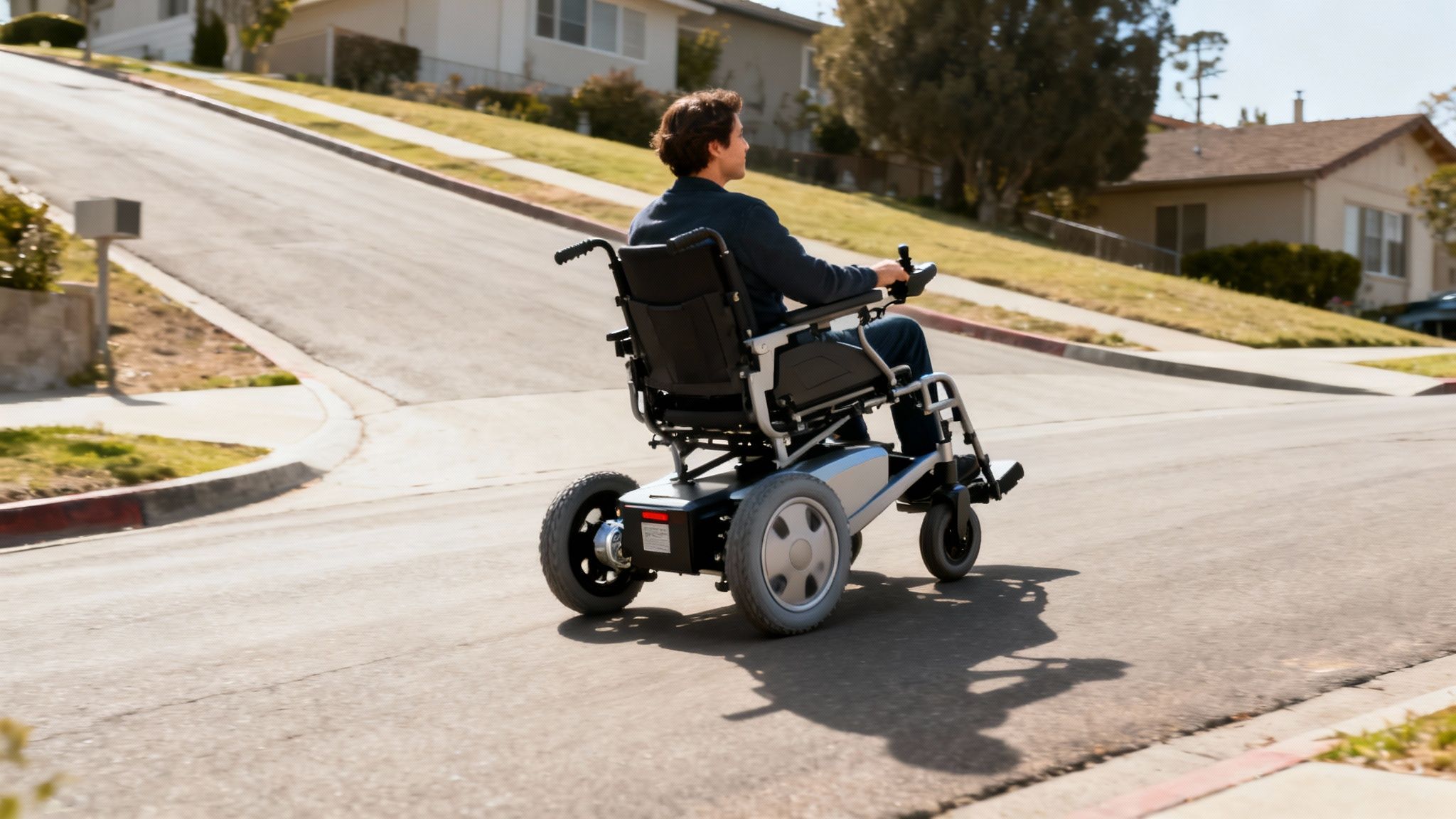
Making it up a slope isn’t a given for every power chair; it’s the result of several key components working together in harmony. Think of it as a team effort. If one part of the system is weak, it can turn a manageable ramp into an intimidating, impassable obstacle.
Getting familiar with these core features is the first step toward picking a chair that truly fits your environment and lifestyle. You don’t need to be an engineer, but knowing the basics will make all the difference.
At the heart of any good hill-climbing wheelchair are three critical elements:
These elements are just the beginning, but they form the foundation of a chair's climbing capability. To get a better sense of how all the pieces fit together, our guide on the anatomy of a great electric wheelchair is a great place to start.
For now, here’s a quick breakdown of what you should be looking for.
This table sums up the most important factors that determine how well a power chair will perform on inclines.
| Key Factor | Why It Matters for Hills | What to Look For |
|---|---|---|
| Motor Power | Provides the necessary torque to propel the wheelchair and user uphill without stalling. | Higher wattage (W) or horsepower (HP) ratings. Look for chairs marketed for outdoor or all-terrain use. |
| Drive Type | Affects traction, stability, and weight distribution on a slope. | Rear-wheel drive often provides the best traction for climbing, while mid-wheel offers good all-around stability. |
| Slope Rating | The manufacturer's safety-tested maximum incline, measured in degrees. | A rating of 6 degrees is common for indoor/outdoor models, while heavy-duty chairs can handle 10 degrees or more. |
| User Weight | The total load impacts the motor's ability to climb. | Ensure your weight is well within the chair’s maximum capacity, as getting close to the limit can reduce performance. |
| Battery Life | Climbing hills demands significantly more power, draining the battery faster. | Look for chairs with high-capacity batteries (measured in Amp-hours or Ah) to ensure you don’t run out of juice. |
These specs are your roadmap to finding a chair that won't leave you stranded at the bottom of a hill. In the sections ahead, we’ll break down what these numbers actually mean in the real world and how you can use them to make the right choice.
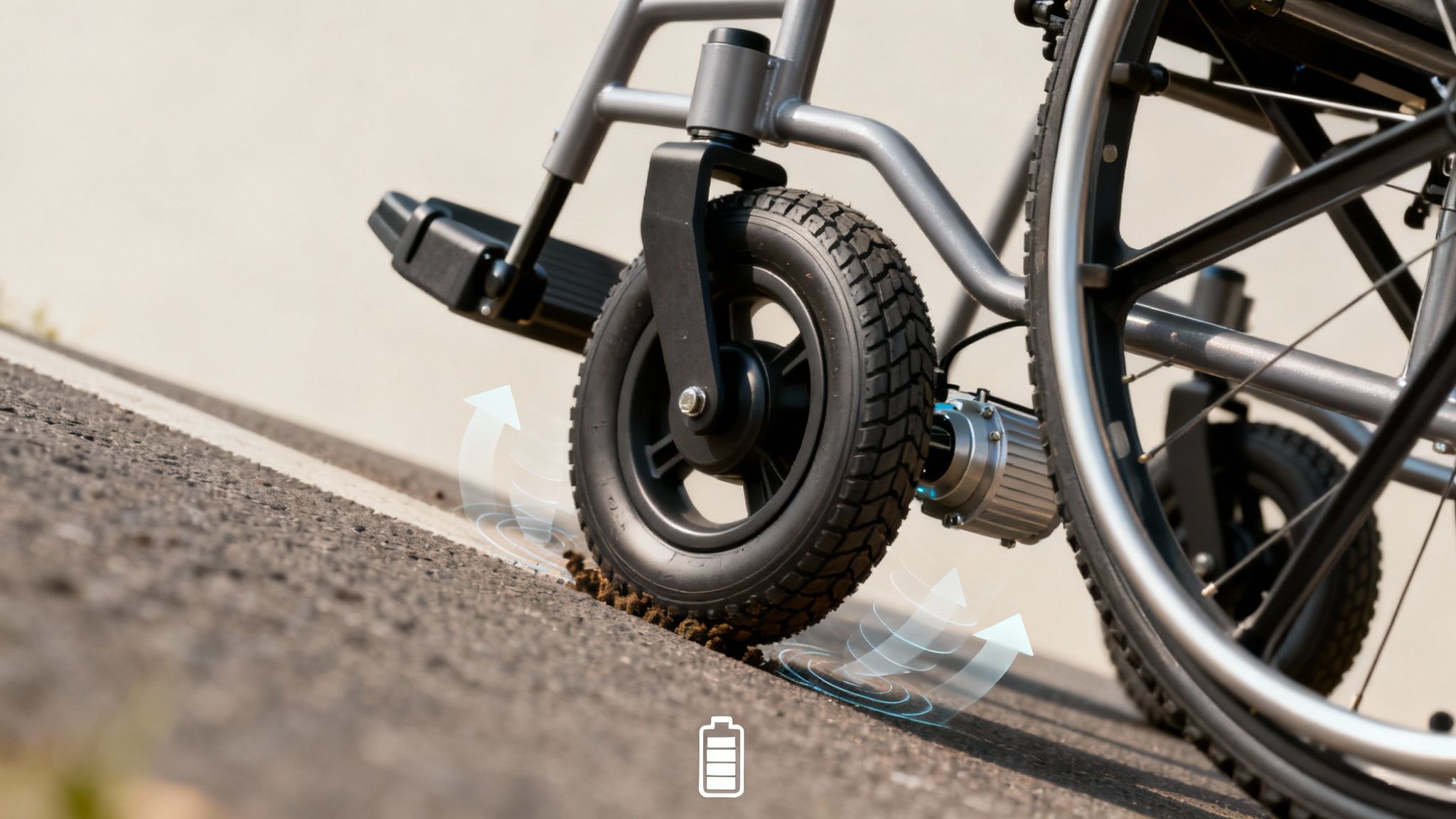
So, what’s really going on when your power chair takes on a hill? It’s not magic—it's a fascinating bit of physics where every single part of your chair has a job to do. If you understand these forces, you'll see exactly why some chairs cruise up inclines like they aren't even there, while others seem to struggle.
Think of your electric wheelchair less like a simple chair and more like a purpose-built vehicle. The motor is its engine, the battery is the fuel tank, and the tires are what give it grip on the road. Just like a car, a big, beefy engine is pointless if the tank is empty or the tires are bald. Everything has to work together in harmony.
When you ask, "can electric wheelchairs go up hills?" you're really asking about the entire system. Each piece of the puzzle, from the grunt of the motor to the condition of the pavement, plays a part.
Let's meet the key players on the team:
If even one of these components is weak, the whole climb is at risk. For example, a chair with a beast of a motor but old, worn-out tires might just spin its wheels on a steep, damp ramp and go nowhere.
Remember, the total weight—that’s you, plus anything you’re carrying—directly affects how the chair performs. The heavier the load, the harder the motor has to work and the quicker the battery will drain.
Where the power is sent—to the rear, middle, or front wheels—also makes a huge difference in how your chair tackles a slope. This setup determines how weight is distributed, which is the secret to maintaining both traction and stability.
For instance, rear-wheel drive (RWD) chairs often shine outdoors. When you go up a hill, your body weight naturally shifts back, pushing down on those drive wheels and giving them a much better grip. To see how this stacks up against other types, you can dive into our article on choosing between front, mid, and rear-wheel drive.
Most standard electric wheelchairs are built to handle slopes between 6° and 12°, which works out to a grade of about 10% to 20%. But keep in mind, that number assumes perfect conditions. The chair's true ability will always depend on all those factors we just talked about working together flawlessly.
When you start digging into a wheelchair's spec sheet, you’ll find a number for its "slope rating," listed either in degrees (°) or as a percentage (%). These numbers can feel a bit abstract, but they are your best clue to understanding how a chair will perform when the going gets steep.
Think of this number as the manufacturer's promise of what the chair can handle under absolutely perfect, lab-like conditions. You'll usually find it tucked away in the user manual or on the product's online spec sheet. A bigger number means a better climber, but the context is what really matters. So, what does a 6° or 10° slope actually look like in your daily life?
To make sense of these ratings, let's translate them from technical jargon into inclines you’ve probably seen before.
Here’s the single most important thing to remember: The "maximum slope" rating is a benchmark. It was achieved in a controlled test environment—with a fully charged battery, on a perfectly dry, smooth surface, and carrying a specific test weight. It's not a target for you to hit every day.
Understanding this difference is the key to both staying safe and making sure your chair lasts for years to come. If you know you'll be dealing with tough hills regularly, it's worth looking into models with the highest incline rating to get that extra power and peace of mind.
Always treat that maximum rating as a hard safety ceiling, not a routine challenge to conquer.
Knowing what your wheelchair can handle is only half the battle. Real confidence on hills comes from mastering the techniques to navigate them safely. Whether you're heading up or coming down, a few core practices can make a world of difference and keep you in complete control.
The number one rule? Always maintain a slow, consistent speed. Try to avoid any sudden stops, starts, or sharp turns. These kinds of abrupt movements can throw off your stability and create a tipping hazard. When you're climbing, it often helps to lean your upper body forward just a bit to keep your center of gravity nice and balanced.
Before you even think about tackling a hill, a quick safety check is a must. These simple steps can prevent a world of trouble.
Thinking beyond just the chair itself can also boost your safety. When public spaces and homes apply universal design principles for accessibility, it creates a much safer environment for everyone.
If you feel your wheels start to spin, your first instinct might be to gun it. Don't accelerate. Instead, stop what you're doing. Try to reverse slowly back down the slope for a few feet, then attempt the climb again from a slightly different angle. If you’re still struggling, it's much safer to just find an alternate, less steep route.
Unfortunately, incidents can happen. One study revealed that 55% of wheelchair users have had at least one mishap, with a staggering 88% of those being tips or falls on uneven ground or inclines. This is exactly why consistent maintenance and careful driving are so important. To stay prepared, check out our guide on 7 maintenance tips to keep your electric wheelchair running smoothly.
If your daily life involves tackling slopes and inclines, not just any old electric wheelchair is going to cut it. You really need a model that's specifically engineered for the challenge. Focusing on the right features from the get-go ensures you're investing in freedom, not frustration.
Think of it this way: just as specialized equipment is a must for managing steep slopes in a big construction project, picking the right mobility device requires a sharp eye for performance details. You'll want to look for models with high-torque motors, a solid suspension system, and properly placed anti-tip wheels. These parts all work together to give you the raw power and stability needed to conquer hills safely.
One of the biggest decisions you'll make is the drive wheel setup. While mid-wheel drive (MWD) chairs are absolutely brilliant for zipping around indoors, rear-wheel drive (RWD) models are often the undisputed champs for outdoor hill climbing. Having the drive wheels at the back gives you much better traction and stability when you're heading uphill, because your body weight naturally shifts backward and presses those wheels firmly into the ground.
This simple flowchart gives you a quick mental checklist to run through before you even think about tackling an incline.

The main takeaway here is simple: if you have any doubt at all about the slope or your chair's ability to handle it, the smartest and safest move is to stop and find another way around.
When you're comparing different chairs, keep these hill-climbing essentials at the top of your list:
Armed with this knowledge, you can walk into a retailer and ask the right questions, making sure you leave with a wheelchair that can truly handle your environment.
Even after digging into the mechanics, you might still have a few things you're wondering about. Let's tackle some of the most common questions we get about electric wheelchairs and their hill-climbing chops.
Most standard electric wheelchairs are built to handle slopes between 6 to 10 degrees. This is usually more than enough for public accessibility ramps and the gentle inclines you find on most sidewalks.
Now, if you're looking at heavy-duty or all-terrain models, those can often tackle steeper challenges, sometimes pushing up to 12 degrees. But it's absolutely critical to check the user manual for your specific model. Never just guess what your chair can handle.
It plays a huge role. Think of it this way: the manufacturer's slope rating is tested under perfect conditions with a specific test weight, which is often much less than the chair's maximum capacity. When you're operating closer to that maximum limit, you're asking the motor and battery to work much, much harder.
That extra strain directly cuts into your chair's real-world climbing power and drains the battery way faster than normal. For the best performance and your own safety, it's always a smart move to pick a chair with a weight capacity that gives you plenty of breathing room.
The bottom line is that a chair's max slope rating is a best-case scenario. Pushing the weight limit will always compromise its actual climbing ability and its safety on an incline.
Climbing a hill is one of the biggest power draws your wheelchair will ever face. It's like flooring the gas pedal in a car—it demands a massive surge of energy and will drain your battery far more quickly than cruising on flat ground.
Because of this, heading out to tackle slopes with anything less than a fully charged, healthy battery is a serious safety risk. A low or aging battery might not deliver the consistent power needed to get you all the way up, leaving you stranded or, worse, at risk of rolling backward. Always, always top off your battery before taking on a hilly route.
For regular outdoor use on hilly terrain, Rear-Wheel Drive (RWD) wheelchairs typically come out on top. The larger drive wheels are in the back, so as you go uphill, your body weight naturally shifts backward, pushing those drive wheels firmly into the ground. This gives you far better traction and stability when you need it most.
Mid-Wheel Drive (MWD) chairs are fantastic for their tight turning radius indoors, but when it comes to consistently handling slopes and uneven outdoor ground, RWD is almost always the better setup.
At Electric Wheelchairs USA, we believe you deserve a mobility solution that fits your world perfectly. If you need a chair that can handle any challenge, explore our collection of heavy-duty and all-terrain models.


Leave a comment