(800) 682-9444
Call Now

In today's fast-paced world, maintaining independence can be challenging for the elderly and disabled. But here's an often-overlooked solution that can transform lives—handicap scooters. Whether you're an elderly caregiver, a home accessibility seeker, or someone in need of mobility assistance, understanding the benefits and types of handicap scooters is essential.
Dive into this comprehensive guide to learn everything you need to know about handicap scooters, from choosing the right one to ensuring safe and effective use.
One of the first decisions you'll face when shopping for a handicap scooter is choosing between 3-wheel and 4-wheel configurations. Both have genuine advantages — and the right choice depends entirely on where and how you'll use your scooter most.
3-Wheel Scooters Three-wheelers have a single front wheel centered below the tiller, which allows the front of the scooter to swing in a much tighter arc when turning. This makes them noticeably more maneuverable in tight indoor spaces — grocery store aisles, restaurant corridors, elevator lobbies, and home hallways where every inch of turning radius counts. If you spend most of your time indoors or in crowded public spaces, a 3-wheel model is often the more practical choice.
The trade-off: a single front wheel provides less lateral stability than two. On uneven outdoor surfaces or gentle slopes, 3-wheelers can feel less planted, particularly for riders who are already managing balance challenges.
4-Wheel Scooters Four-wheelers have two front wheels, giving them a wider, more stable base. This stability pays dividends outdoors — on sidewalk seams, parking lot slopes, grass, gravel, and any surface that isn't perfectly level. Users who ride outdoors frequently, navigate varied terrain, or feel more secure with a wider footprint consistently prefer 4-wheel models.
The trade-off: a wider front end means a larger turning radius. Standard 4-wheelers typically need 40–55 inches to complete a full turn — workable in most spaces, but noticeably less nimble than a 3-wheeler in tight quarters.
The best of both worlds: EZ Turn technology The top pick on this list — the Pride Go-Go Sport EZ Turn — addresses this trade-off directly. Its patented iTurn technology achieves a 38-inch turning radius (comparable to many 3-wheel models) while maintaining the full stability of a 4-wheel platform. It's an unusually practical solution for buyers who need indoor maneuverability without giving up outdoor confidence.
Quick decision guide:
Primarily indoor use, tight spaces → 3-wheel
Primarily outdoor use, uneven terrain → 4-wheel
Both indoor and outdoor, can't compromise on either → 4-wheel with EZ Turn technology
Handicap scooters span a surprisingly wide price range — from around $600 for basic entry-level travel models to over $5,000 for premium bariatric or all-terrain scooters. Understanding what drives cost differences helps you identify the right tier for your budget before you start comparing individual models.
Entry-Level Travel Scooters: $600–$1,500 At this tier, you get a reliable, lightweight scooter designed for occasional use and easy transport. Expect solid build quality, ranges of 8–12 miles, weight capacities of 250–300 lbs, and disassembly into 4–5 manageable pieces. Color options and accessories are typically limited. These are the right choice for buyers who need a scooter primarily for shopping trips and outings, not daily all-day use.
Mid-Range All-Purpose Scooters: $1,500–$3,000 This is where most buyers find their match. Mid-range handicap scooters deliver better range (12–20 miles), higher weight capacities (300–350 lbs), more comfortable seating, improved suspension, and thoughtful features like adjustable tillers, Delta handlebars for one-hand operation, LED headlights, and dual charging ports. The Pride Go-Go Sport EZ Turn sits in this range and represents strong value for the features delivered.
Full-Size and Bariatric Scooters: $2,500–$5,000+ Full-size and bariatric models prioritize capacity, comfort, and outdoor performance over portability. They support 400–600 lbs, feature larger seats, more powerful motors, and better suspension — but are not designed for trunk transport. These are everyday primary-use scooters for users who have a dedicated vehicle transport solution (hitch lift or ramp) or primarily use the scooter within their community.
What drives the cost difference? Motor power and battery capacity are the biggest factors. Better suspension systems, wider seats, and premium features like full LED lighting packages, anti-theft systems, and USB charging ports add cost incrementally. Brand warranty and service coverage (particularly 1-year in-home service) also affect price — and represent genuine long-term value.
Reducing your out-of-pocket cost Medicare Part B can cover up to 80% of the approved amount for a qualifying handicap scooter. If you're eligible, Medicare coverage is almost always more valuable than any retail discount. Financing through Klarna, Shop Pay (with Affirm), or PayTomorrow is also available through Electric Wheelchairs USA, making mid-range and premium models accessible without paying the full purchase price upfront. Call 800-682-9444 for help with financing options.
One of the most common concerns for first-time handicap scooter buyers — especially active seniors — is how to get the scooter where they need it. The good news: most of the models on this list are specifically designed with transport in mind.
Loading into a car trunk The key spec to look for is the weight of the heaviest piece after disassembly. The Pride Go-Go Sport EZ Turn disassembles into 5 lightweight pieces through feather-touch disassembly — the heaviest piece (typically the main frame) is manageable for most caregivers without a lift. When loading into a car trunk, always disassemble in the order specified in the manual, store the battery safely, and check that your trunk floor can handle the combined weight.
A general rule: if any single piece exceeds 30–35 lbs and you're loading without assistance, consider a hitch-mounted carrier (which eliminates the lifting entirely for non-disassembly models) or a vehicle ramp designed for scooter weight. Electric Wheelchairs USA carries a range of car ramps for wheelchairs and scooters that simplify this process.
Hitch-mounted scooter carriers For heavier scooters that don't disassemble conveniently, a hitch-mounted platform carrier is often the best solution. These mount to your vehicle's receiver hitch and lower the scooter to ground level for roll-on loading — no lifting required. This is particularly useful for larger 4-wheel models with limited disassembly options. Make sure your carrier is rated for the combined weight of the scooter plus any accessories.
Airline travel Taking a handicap scooter on an airplane is free under the Air Carrier Access Act — airlines cannot charge fees for checked mobility devices. The process:
Notify your airline 48–72 hours before your flight that you'll be traveling with a power mobility device
Confirm your battery type with the airline: sealed lead acid (SLA) batteries are accepted as installed; lithium-ion batteries must be under 300Wh to comply with FAA regulations
Ride or push the scooter to the boarding gate; it will be checked at the jetway
Take a photo of the scooter from multiple angles before handing it over — documentation helps in the event of any damage during baggage handling
Request the scooter be returned to the jetway upon arrival, not to baggage claim
The Go-Go Sport EZ Turn's lightweight design makes it one of the more airline-friendly 4-wheel scooters in its class.
Cruise ship travel Most major cruise lines accommodate handicap scooters with advance notice — typically 30+ days before sailing. Request an accessible cabin (wider doorways, roll-in shower) at the time of booking. Check the cabin doorway width against your scooter's width before sailing; standard accessible cabin doorways are 32–36 inches. Cruise ship elevators are generally large enough for most mobility scooters, and crew members can often assist with embarkation and disembarkation.
Practical tip: Measure before you travel Before any trip, note three key dimensions of your scooter: total width, total length, and the weight of the heaviest piece after disassembly. These numbers answer 90% of transport-related questions — from trunk fit to cabin doorway clearance to carrier weight ratings.
The best handicap scooter for a senior depends primarily on where they'll use it most. For a senior who moves between indoor spaces — home, stores, and medical appointments — the Pride Go-Go Sport EZ Turn is an excellent choice: it combines the tight turning of a 3-wheel scooter with the stability of 4 wheels through its patented iTurn technology, weighs a manageable amount for caregiver transport, and has a 14-mile range sufficient for typical daily outings. For a senior who spends more time outdoors on varied terrain, a sturdier full-size 4-wheel model with better suspension and ground clearance would serve better. When in doubt, consider calling our team at 800-682-9444 — we ask a few questions and help narrow down the right model quickly.
Yes — Medicare Part B can cover mobility scooters (classified as "power-operated vehicles") when they are prescribed by a physician and deemed medically necessary for use in the home. To qualify, a physician must document that the patient has a medical condition limiting mobility, has difficulty performing mobility-related activities of daily living, and cannot use a cane, walker, or manual wheelchair effectively. Medicare typically covers 80% of the approved amount after the Part B deductible, with the patient responsible for the remaining 20%.
In practice, there is no meaningful difference — "handicap scooter" and "mobility scooter" refer to the same category of power-operated vehicles. "Handicap scooter" is an older term that many seniors and caregivers still use, while "mobility scooter" is the industry-standard and Medicare classification term. Both refer to three- or four-wheeled, battery-powered vehicles operated via a tiller (handlebar-style steering), designed for people with mobility impairments. The key distinction that matters for buyers is the type of scooter (travel/folding, standard, full-size, bariatric, outdoor/all-terrain) rather than the label used to describe it.
Medicare does not provide mobility scooters for free, but it does cover a significant portion of the cost. To qualify: (1) your physician must conduct a face-to-face examination and document your medical need; (2) the physician must issue a Certificate of Medical Necessity (CMN) specifying that you cannot perform mobility-related activities without a power scooter; (3) you must purchase from a Medicare-approved supplier. Once approved, Medicare pays 80% of the "allowable amount" — which is a rate set by Medicare, not the retail price. Your 20% copay applies after the Part B deductible. Some supplemental insurance plans (Medigap) cover that 20%. Veterans may have additional coverage through the VA. The word "free" sometimes appears in advertising because, for buyers with full Medicare + supplemental coverage, the out-of-pocket cost can be near zero.
Yes. Under the Air Carrier Access Act, airlines must transport mobility devices at no charge — they cannot add fees for checking a wheelchair or scooter. The process requires notifying the airline in advance (48–72 hours is recommended) and confirming your battery type: sealed lead acid (SLA) batteries are accepted as installed in the scooter; lithium-ion batteries must fall under the FAA's 300Wh limit to be carried in the cabin. Most travel-oriented handicap scooters on this list use compliant batteries. Ride the scooter to the boarding gate, check it at the jetway, and request jetway return upon arrival. Always photograph the scooter before handing it over as a record of condition.
There are two ways to answer this: per charge and over time. Per charge, the models on this list range from approximately 8–20 miles depending on battery size, rider weight, terrain, and speed. The Go-Go Sport EZ Turn delivers a 14-mile range under standard conditions — sufficient for most daily use scenarios. Over time, sealed lead acid (SLA) batteries typically last 12–18 months with proper care; lithium-ion batteries last 3–5 years. The most important maintenance habit is charging after every use rather than waiting for the battery to fully deplete — this significantly extends battery lifespan. Avoid storing the scooter with a depleted battery for extended periods.
Weight limits vary by model. Standard travel and mid-size scooters typically support 250–325 lbs. Heavy-duty and bariatric models support 400–600 lbs. The Go-Go Sport EZ Turn, the top pick on this list, supports 325 lbs. A critical rule: always choose a scooter rated at least 30 lbs above your body weight. Operating a scooter at or near its maximum capacity strains the motor, reduces battery range, and accelerates frame wear. If you're close to a model's weight limit, step up to the next capacity tier for safety and longevity.
Among travel-oriented mobility scooters, the lightest models available weigh as little as 40–55 lbs total — with the heaviest individual piece (after disassembly) often weighing just 18–28 lbs. The Go-Go Sport EZ Turn disassembles into 5 lightweight pieces through feather-touch disassembly, making it one of the more manageable 4-wheel scooters for car trunk loading. If absolute minimum weight is the priority — for example, for frequent airline travel or solo loading — a 3-wheel travel scooter or a folding travel scooter may offer a lighter solution. Browse our folding travel scooters collection for the lightest options available.
Yes — most handicap scooters on this list are designed for both indoor and outdoor use. The key indoor consideration is turning radius: standard indoor doorways are 32–36 inches wide, and most corridors and aisles require a scooter to make turns within 36–55 inches of space. Three-wheel scooters and the Go-Go Sport EZ Turn (with its 38" iTurn turning radius) are the most practical for indoor use. Full-size outdoor scooters with larger turning radii can be difficult to maneuver in tight indoor spaces. If you'll use your scooter indoors frequently, prioritize turning radius in your decision — it's the spec that determines whether a scooter works in your actual living environment.
Many private insurance plans, Medicaid programs, and VA benefits cover mobility scooters. Coverage varies significantly by plan. Medicaid coverage varies by state — many states' Medicaid programs cover scooters for qualifying low-income recipients. Veterans Administration benefits include mobility scooter coverage for veterans with service-connected disabilities or those who meet VA medical eligibility criteria. Private insurance (including Medicare Advantage plans) often mirrors traditional Medicare's criteria. The best first step is to call your insurance provider directly and ask whether "power-operated vehicles" or "mobility scooters" are covered under your plan, and what documentation your physician needs to provide.
Best Handicap Scooter
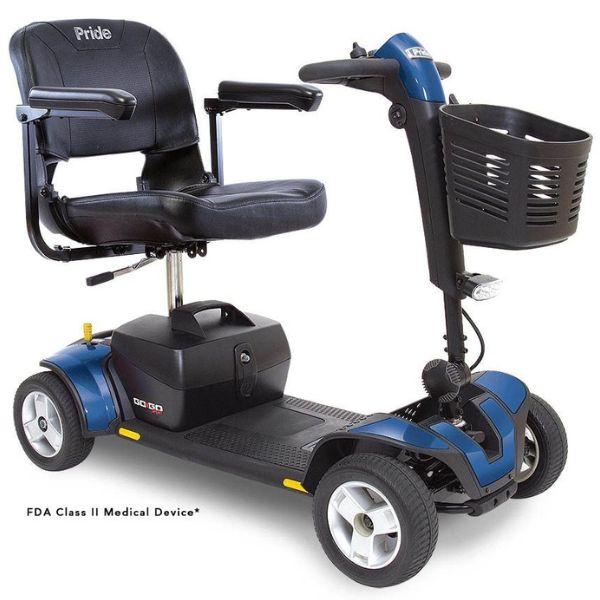
The Go Go Sport 4-Wheel With EZ Turn by Pride Mobility is a versatile travel scooter with a high weight capacity, impressive battery range, and additional features like an LED headlight and adjustable tiller for added convenience.
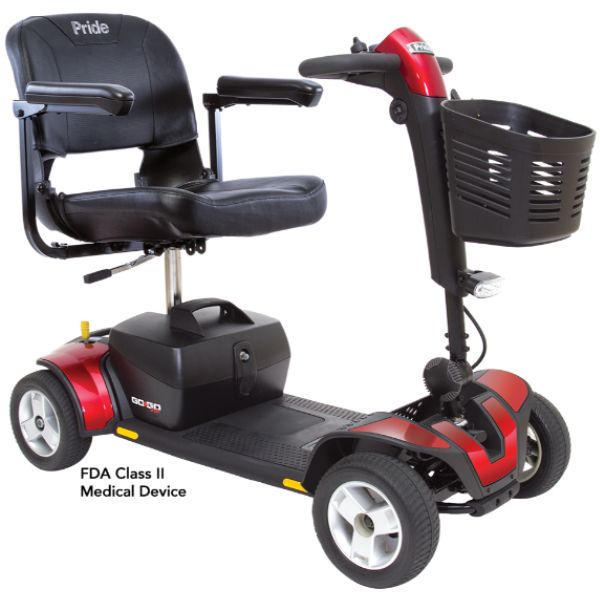
| Top Speed: | 4.70 mph |
| Drive Range: | 14.00 miles |
| Weight Capacity: | 325.00 Lbs |
| Seat Width: | 17" |
| Turning Radius: | 50.5" |
| Ez Turn Technology: | Yes |
Exclusive Offer!
Get 20% Off + Free Cup Holder
Are you searching for a mobility scooter that’s perfect for travel, supports a high weight capacity, and offers an impressive battery range? Look no further than the Go Go Sport 4-Wheel With EZ Turn by Pride Mobility. This model not only meets those essential criteria but also exceeds expectations with its additional features like Ez Turn Technology.
The Go Go Sport 4-Wheel With EZ Turn boasts an ultra-bright LED headlight for enhanced visibility and a 325 lbs weight capacity, making it suitable for a wide range of users. The adjustable tiller includes an easy-access charging port conveniently located near the control panel, so there’s no need to bend over awkwardly to recharge.
Taller riders will appreciate the extra legroom and the scooter’s 3-inch ground clearance, coupled with larger tires, which ensure a comfortable ride across various terrains. As a full-size scooter, it offers increased legroom, comfort, and durability, making it ideal for extended use. Even if you don’t require the 325 lbs carrying capacity or additional legroom, the enhanced ground clearance and durable rear tires make this travel scooter versatile for different environments.
The upgraded Delta Tiller allows you to operate the scooter in both forward and reverse with either hand, pulling the throttle with your fingers rather than pressing it with your thumb, a design that is particularly beneficial for those with limited hand use or arthritis.
Another notable advantage is that the Go Go Sport 4-Wheel With EZ Turn is 2.75 inches longer than the Go Go Elite Plus (SC54), providing extra foot room for taller users. When you choose a Pride Mobility product, you are investing in one of the best mobility scooters available on the market today.
Pros
Cons
Best Portable Handicap Scooter
The Go-Go Elite Traveller 2 SC442E by Pride Mobility is a versatile and travel-friendly mobility scooter that combines the stability of a 4-wheel scooter with the maneuverability of a 3-wheel one.
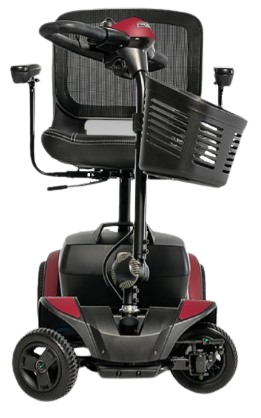
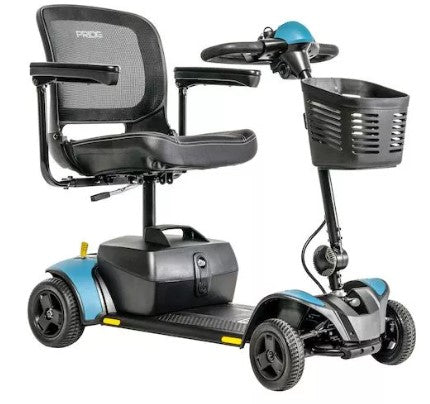
| Top Speed: | 4.23 mph |
| Drive Range: | 13.80 miles |
| Weight Capacity: | 300.00 Lbs |
| Seat Width: | 17" |
| Turning Radius: | 37" |
Exclusive Offer!
Get 20% Off + Free Cup Holder
Are you looking for a mobility scooter that is travel-friendly, affordable, and combines the stability of a 4-wheel scooter with the maneuverability of a 3-wheel one? The Go Go Elite Traveller 2 SC442E by Pride Mobility fits the bill perfectly and offers even more.
When considering various mobility solutions for individuals with mobility difficulties, it's important to compare different options, such as a power wheelchair, to find the right fit for specific needs and preferences.
Introducing the latest model in Pride Mobility’s renowned Go-Go line: the Go-Go Elite Traveller 2 4-wheel mobility scooter. This lightweight scooter features Pride’s innovative iTurn Technology™, which provides an incredibly tight turning radius of just 37 inches. This allows for easy navigation through tight spaces and almost completing a full 360-degree turn. The Go Go Elite Traveller 2 merges the steadiness of a 4-wheel scooter with the nimbleness of a 3-wheel scooter.
Curious about how the Pride Go-Go Elite Traveller 2 performs on the move? Check out the video below to see this compact, travel-friendly scooter in action. Click the video to join us for a test drive and discover why it’s a favorite among travelers.
With its exceptional mobility and stability, this scooter will be your steadfast companion through all the ups and downs of your active lifestyle. Whether you’re gliding through busy areas or navigating vibrant city streets, the Go-Go Elite Traveller 2 easily keeps pace with your movements.
What sets this scooter apart is its seamless blend of functionality and convenience. You can effortlessly switch from travel mode to storage mode thanks to its simple disassembly feature. Pride Mobility’s unique feather-touch, one-hand disassembly design allows the Go Go Elite Traveller 2 to break down into smaller components quickly, making travel and storage hassle-free. This frees up your time to focus on enjoying the moment rather than worrying about how to carry or store it.
Pros
Cons
Best Outdoor Handicap Scooter
The Buzzaround EX Extreme 4-Wheel Travel Scooter GB148D by Golden Technologies is a heavy-duty mobility scooter with a 350 lb. weight capacity, 18-mile battery range, full suspension, and comprehensive lighting package.
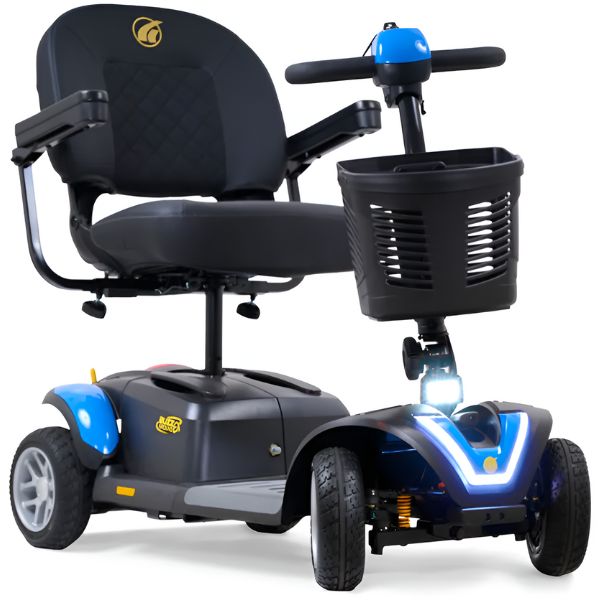
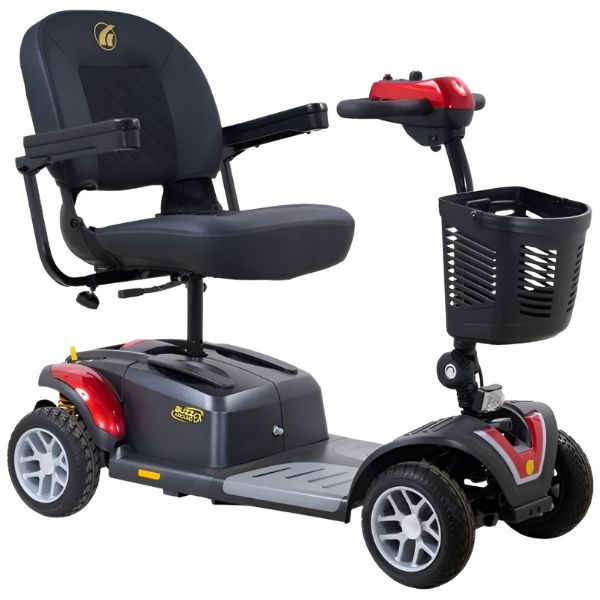
| Top Speed: | 5.00 mph |
| Drive Range: | 18.00 miles |
| Weight Capacity: | 350.00 Lbs |
| Seat Width: | 18" |
| Turning Radius: | 56" |
Exclusive Offer!
Get 20% Off + Free Cup Holder
Golden Technologies, a leader in the mobility industry, sets a high standard with advanced and well-built products. Among their standout offerings is the Buzzaround EX Extreme 4-Wheel Travel Scooter GB148D, a top contender in the heavy duty mobility scooter market.
This model supports up to 350 lbs. with a higher weight capacity, powerful motors, and enhanced durability, making it ideal for larger framed individuals. It can be easily disassembled into five manageable pieces for stress-free transport.
A key feature that sets this scooter apart is its impressive battery range. The Buzzaround EX Extreme boasts an 18-mile range per charge, thanks to its two U1 batteries. These batteries can be charged offboard, allowing you to remove them, charge them at home, and then place them back on the scooter, ready for use.
With a maximum speed of 5 mph, it outperforms other scooters in its class. Additionally, its 44” length provides extra legroom for taller riders.
To ensure a smooth ride, the GB148D is equipped with full suspension on both the front and rear wheels. The spring coils in the suspension absorb bumps, offering a much more comfortable experience compared to scooters without this feature.
Not only does it provide one of the smoothest rides in the transportable mobility market, but it also includes a comprehensive lighting package. The fun doesn’t have to stop when the sun goes down; its ultra-bright LED headlight and rear tail light allow for safe operation in the evening.
In summary, the Buzzaround EX Extreme 4-Wheel Travel Scooter GB148D combines advanced features, powerful performance, and thoughtful design to offer users an exceptional mobility experience.
Pros
Cons
Best 4 Wheel Handicap Scooter for Adults
The Golden Technologies Buzzaround XLS-HD 4-Wheel Scooter GB124A-SHZ is a portable scooter with stability and comfort features. Ideal for indoor and outdoor use, it offers a smooth ride, impressive maneuverability, and customizable options.


| Top Speed: | 4.00 mph |
| Drive Range: | 18.00 miles |
| Weight Capacity: | 325.00 Lbs |
| Seat Width: | 20" |
| Turning Radius: | 44" |
Exclusive Offer!
Get 20% Off + Free Cup Holder
Are you in the market for a portable scooter that offers the stability and comfort of a heavy-duty model? Look no further than the Golden Technologies Buzzaround XLS-HD 4-Wheel Scooter GB124A-SHZ. This exceptional mobility scooter is ideal for both indoor and outdoor use, boasting a narrow 20-inch width that allows it to easily maneuver through doorways and around furniture.
Experience the Golden Technologies Buzzaround XLS-HD in real-world conditions by watching the video below. Witness its smooth ride, impressive maneuverability, and top-notch comfort features firsthand.
The Buzzaround XLS-HD is a compact 4-wheel scooter offering a weight capacity of 325 lbs. Powered by two 12AH batteries, it has a range of 9 miles per charge and a top speed of 4 miles per hour, making it suitable for various settings. Charging the scooter is convenient, thanks to the port located just below the control panel.
Portability is a key feature of the Buzzaround XLS-HD. This scooter disassembles in just four simple steps, making it easy to transport to your next destination. The heaviest piece weighs only 40 lbs, allowing it to fit into almost any vehicle. Additionally, this model comes with two interchangeable color panels in red or blue, enabling you to customize its appearance to your liking.
Golden Technologies is renowned for its quality scooters, and the Buzzaround XLS-HD is no exception. It features an adjustable wraparound delta tiller, which is particularly beneficial if you have limited mobility, as it allows for one-handed steering. The lever system reduces wrist strain, enabling you to effortlessly control the scooter with your fingers.
With a turning radius of just 44 inches, the Buzzaround excels at navigating tight corners and narrow hallways, making it equally versatile for indoor and outdoor use. Its solid 7.5-inch front tires, 8-inch rear tires, 2-inch rear anti-tip wheels, and 4-inch ground clearance ensure a comfortable ride on various terrains.
In summary, the Golden Technologies Buzzaround XLS-HD 4-Wheel Scooter GB124A-SHZ is a versatile, portable, and reliable choice for those seeking a high-quality mobility aid. With its excellent maneuverability, customizable features, and ease of transport, it's designed to enhance your mobility and independence.
Pros
Cons
The Pride Go-Go Endurance AL+ SC54ALX 4-Wheel Portable Scooter from Pride Mobility is one of the best value handicap scooters on the market today. This travel-friendly handicap scooter comes with a lithium battery, is easy to transport, and features 3-wheel turning capability with a stable 4-wheel design.

This lightweight handicap scooter features an aluminum frame that's 13% lighter than previous models, with the front section weighing just 35.2 lbs for easy transport and storage. With a sturdy 325 lb weight capacity, top speeds of up to 4.8 mph, and Pride's advanced iTurn Technology™ offering an impressive 38" turning radius, this handicap scooter delivers dependable performance with effortless maneuverability through hallways, crowded areas, and tight spaces.

Pros:
Cons:
Specifications:
Handicap scooters are mobility devices designed to assist individuals with limited mobility. These scooters are battery-powered and typically feature a comfortable seat, handlebars for steering, and a platform for foot support. They are an excellent alternative to wheelchairs, offering greater flexibility and ease of use. Compared to electric wheelchairs, handicap scooters generally provide better maneuverability and a more straightforward design, making them suitable for users who prioritize ease of use and outdoor functionality.
For many elderly and disabled individuals, handicap scooters are more than just a mode of transportation. They represent freedom and independence. These scooters allow users to perform daily tasks, visit friends, go shopping, and much more without relying on others. The regained sense of autonomy significantly improves their quality of life.
Mobility is a critical aspect of life that many of us take for granted. For individuals struggling with movement, the ability to get from one place to another can be life-changing. Handicap scooters offer a practical, efficient solution that bridges the gap between limited mobility and full independence.
Selecting the right type of handicap scooter is crucial for meeting individual needs. Here, we break down the various types available in the market.
Travel scooters are lightweight and easily foldable, making them perfect for those who frequently travel. They can be disassembled into smaller parts, allowing for convenient storage and transportation in the trunk of a car.
Designed for durability and higher weight capacities, heavy duty mobility scooters are ideal for larger framed individuals who require enhanced durability for outdoor use. These scooters can handle rougher terrains and offer more robust construction, ensuring long-term reliability.
3-wheel scooters are known for their agility and tight turning radius. They are excellent for navigating indoor spaces and crowded areas. Their design allows for more legroom, making them a comfortable option for taller users.
Offering enhanced stability, full size mobility scooters are perfect for outdoor use, providing increased comfort and space compared to portable travel scooters. They provide a smoother ride over uneven surfaces and are less likely to tip over, making them a safer choice for users who spend a lot of time outside.
Choosing the right handicap scooter involves considering several factors to ensure it meets the user's specific needs.
First and foremost, evaluate the user’s medical condition and mobility level. Consulting healthcare professionals is crucial to ensure the choice of mobility aid aligns with individual medical needs. Some may only need assistance for short distances, while others might require a scooter for all-day use. Understanding the level of assistance needed will guide you toward the appropriate type of scooter.
Check the weight capacity of the scooter to ensure it can comfortably support the user. Exceeding the recommended weight limit can affect the scooter's performance and safety.
Battery life is a crucial factor, especially for users who plan to use the scooter for extended periods. Ensure the scooter has sufficient battery capacity to avoid frequent recharging and potential interruptions during use.
Consider how often the scooter will need to be transported. If frequent travel is anticipated, a travel scooter that can be easily folded or disassembled might be the best choice.
Think about where the scooter will be primarily used. For indoor use, a 3-wheel scooter might be sufficient, while a 4-wheel scooter could be better suited for outdoor environments.
Handicap scooters play a vital role in enhancing home accessibility, making everyday living more manageable for the elderly and disabled.
These scooters enable users to move around their homes with ease, reducing the risk of falls and injuries. They can effortlessly transition from room to room, access different floors with the help of ramps or stair lifts, and even perform household chores more efficiently.
Ensuring the safe and effective use of handicap scooters is essential for maximizing their benefits and longevity.
Regular maintenance is key to keeping the scooter in optimal condition. Flat free tires are a reliable and convenient feature, eliminating the worry of flat tires and providing a smoother ride. Check the battery regularly, inspect tires for wear and tear, and clean the scooter to prevent dirt build-up. Scheduling routine professional check-ups can also help identify potential issues early on.
Safety should always be a priority. Ensure the user is familiar with the scooter's controls and features before use. Encourage them to practice in a safe, open area until they feel confident. Always use the seatbelt if the scooter is equipped with one, and avoid overloading the scooter with heavy bags or items.
Caregivers play a crucial role in ensuring the safe use of handicap scooters. They should be aware of the scooter's maintenance needs and assist with any necessary repairs. Additionally, caregivers can help monitor the user's safety, especially when navigating unfamiliar or challenging terrains.
The field of handicap mobility solutions is continuously evolving, with exciting advancements on the horizon.
Innovations such as smart scooters equipped with GPS, obstacle detection, and automated emergency calls are becoming more prevalent. These features enhance user safety and provide peace of mind for both users and caregivers.
In the future, we can expect even more sophisticated mobility solutions. Lightweight materials, improved battery technology, and enhanced AI-driven navigation systems are just a few of the advancements that could revolutionize the industry.
Handicap scooters are invaluable tools for enhancing mobility and independence for the elderly and disabled. By understanding the different types available, considering key factors for selection, and prioritizing safety and maintenance, users can make the most of these devices.
Whether you’re an elderly caregiver, a home accessibility seeker, or someone in need of a mobility aid, investing in a handicap scooter can significantly improve quality of life. For those interested in exploring their options further, seeking professional advice and engaging with the community can provide additional support and insights.
Our team of mobility scooter specialists is ready to answer inquiries and assist you in finding the right mobility scooter to meet your specific transportation needs.
For more information, please read our guides “5 Best Long Distance Power Wheelchairs” and “Tips For Transporting Your Mobility Scooter Or Wheelchair”.
If you need more insights and personalized advice, reach out to us or consult your healthcare provider. Our team of Mobility Experts is always ready to help.
Got questions about a specific chair? Not sure which option meets your unique needs?
Call us now at 800-682-9444
Email us at info@electricwheelchairsusa.com
Your journey to improved mobility starts here.
Looking for the perfect wheelchair? Our mobility experts are here to assist! Contact us at 800-682-9444 for personalized guidance.
We're pleased to offer a range of financing options designed to fit your financial situation and give you the choice you deserve:
Klarna Financing:
Partnering with a leading European bank, we offer installment plans tailored to your budget.
Shop Pay:
In collaboration with Affirm, this option provides a clear and straightforward payment schedule.
PayTomorrow:
Enjoy a hassle-free application, transparent pricing, and auto-pay features—all while maintaining your credit standing.
Call us now at 800-682-9444 and get a brand new mobility scooter without breaking the bank!
Choosing the right handicap scooter is a significant decision — and it's one that's much easier to make with the full picture in front of you. Specifications, dimensions, color options, and current pricing all matter, and they're easier to evaluate side by side than model by model.
Our free printed catalog covers every handicap scooter and mobility scooter we carry — with complete specs, dimensions, color choices, and pricing — so you can review your options at your own pace. Share it with a family member, bring it to a doctor's appointment, or simply keep it on hand while you decide.
Request Your Free Catalog Here →
No obligation. No purchase required. Just a comprehensive, easy-to-reference guide you can use at home.
Prefer to talk it through? Our mobility experts are available every day from 8AM to 8PM EST at 800-682-9444. We'll help you match your mobility needs, weight requirements, and budget to the right model — and can guide you through Medicare coverage, VA benefits, and financing options as well. There's no pressure and no rush. Your independence matters, and we want to make sure you get it right.


Leave a comment